
Surf's up!
Blue Wave News is a community of Democrats working to further liberal causes, expose untruths, and draw attention to important local, national, and global issues.
Blue Wave News is a community of Democrats working to further liberal causes, expose untruths, and draw attention to important local, national, and global issues.
You do not do the things you do because others will necessarily join you in the doing of them, nor because they will ultimately prove successful. You do the things you do because the things you are doing are right.
Sometimes I think we both oversell and undersell the notion of fighting for social justice. Oversell in that we focus so much on "winning" the battle in which we're engaged, that we often create false hope, and when as often happens, victory is limited or not at all, those in whom we nurtured the hope feel spent, unable to rise again to the challenge.
Yet we undersell the work too, in that we often neglect to remind folks that there is redemption in struggle itself, and that "victory," though sought, is not the only point, and is never finally won anyway. Even when you succeed in obtaining a measure of justice, you're always forced to mobilize to defend that which you've won. There is no looming vacation. But there is redemption in struggle.
Invariably, it seems it is we in the white community who obsess over our own efficacy, and fail to recognize the value of commitment, irrespective of outcome. People of color, on the other hand, never having been burdened with the illusion that the world was their oyster, and thus, anything they touched could and should turn to gold, usually take a more reserved, and I would say healthier view of the world and the prospects for change. They know (as indeed they must) that the thing being fought for, at least if it's worth having, will require more than a part-time effort, and will not likely come in the lifetimes of those presently fighting for it. And it is that knowledge which allows a strength and resolve few members of the dominant majority will ever, can ever, know.<...>
This isn't to say it's impossible to inspire young whites to fight for justice, nor to stick it out. It's just a bit more of a challenge sometimes, for it requires that the person be open to an entirely different way of thinking about the world and their place in it: a challenge, but not undoable, as any glimpse at the long list -- however much longer it should be -- of whites who have committed their lives to equity and peace will attest. And so, I explain, there is something to be said for confronting the inevitable choice one must make in this life, between collaborating with or resisting injustice, and choosing the latter. There is something to be said for knowing you did all you could to stop a war, eliminate racism, or improve your community for the good of all. There is something to be said for a good night's sleep, and the ability to wake in the morning, look in the mirror, and never doubt that if you died before lunch, you would have lived a life of integrity.
Her argument proceeds by looking at the "ethic of control" that guides the assumptions of white middle-class people, whether on the left or the right side of the political spectrum. In the second section of the book, she examines various works of African-American fiction as a source for a contrasting "ethic of risk" that upholds the worth of struggle in the face of probable defeat.
What is hope? It is the presentiment that imagination is more real and reality less real than it looks. It is the suspicion that the overwhelming brutality of fact that oppresses us and represses us is not the last word. It is the hunch that reality is more complex than the realists want us to believe, that the frontiers of the possible are not determined by the limits of the actual, and that, in a miraculous and unexpected way, life is preparing the creative events which will open the way to freedom and to resurrection.
But, hope must live with suffering. Suffering, without hope, produces resentment and despair. And hope, without suffering, creates illusions, naiveté, and drunkenness. So, let us plant dates, even though we who plant them will never eat them. We must live by the love of what we will never see.
This is the secret of discipline. Such disciplined love is what has given saints, revolutionaries, and martyrs the courage to die for the future they envision; they make their own bodies the seed of their highest hope.
...young people are no longer at risk: they are the risk; young people are no longer troubled; they are trouble.
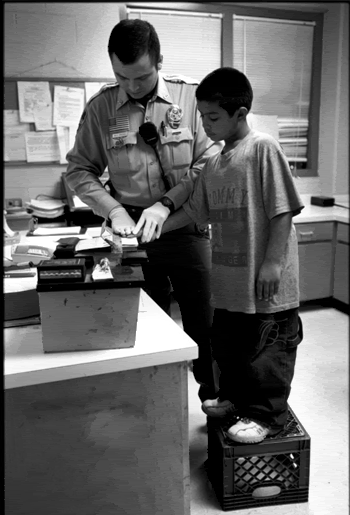
Not surprisingly, studies show that being arrested has detrimental psychological effects on children. An arrest nearly doubles the odds that a child will eventually drop out of school. Coupled with a court appearance, an arrest nearly quadruples the odds of dropping out and increases the likelihood of future interaction with police. Arrests and police interactions also disproportionately affect low-income schools with large African-American and Latino populations. In essence, being arrested in school robs children of their access to educational opportunity.
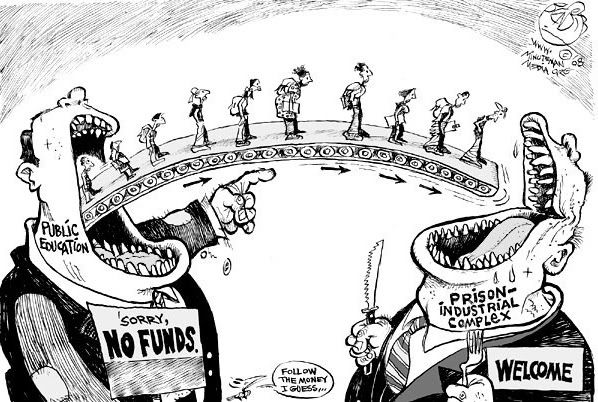
The shift to a society now governed through crime, market-driven values and the politics of disposability has radically transformed the public school as a site for a civic and critical education. One major effect can be seen in the increasingly popular practice of organizing schools through disciplinary practices that closely resemble the culture of prisons. For instance, many public schools, traditionally viewed as nurturing, youth-friendly spaces dedicated to protecting and educating children, have become one of the most punitive institutions young people now face - on a daily basis.<...>
Students being miseducated, criminalized and arrested through a form of penal pedagogy in lockdown schools that resemble prisons is a cruel reminder of the degree to which mainstream politicians and the American public have turned their backs on young people in general and poor minority youth in particular. As schools are reconfigured around the model of the prison, crime becomes the central metaphor used to define the nature of schooling while criminalizing the behavior of young people becomes the most valued strategy in mediating the relationship between educators and students. The consequences of these policies for young people suggest not only an egregious abdication of responsibility - as well as reason, judgment and restraint - on the part of administrators, teachers and parents, but also a new role for schools as they become more prison-like, eagerly adapting to their role as an adjunct of the punishing state.
In my dream, the angel shrugged & said, If we fail this time, it will be a failure of imagination & then she placed the world gently in the palm of my hand.
- Brian Andreas
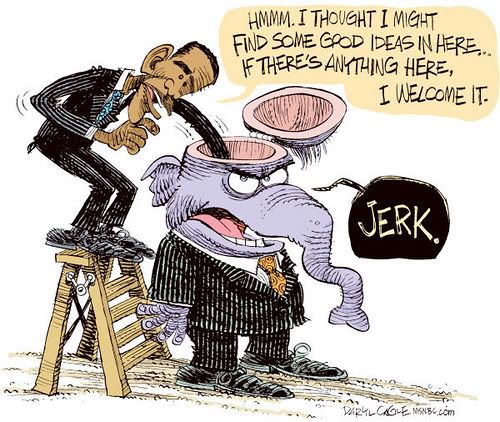
One way to deal with that kind of bad-faith opposition is to draw the person in, treat them as if they were operating in good faith, and draw them into a conversation about how they actually would solve the problem. If they have nothing, it shows. And that's not a tactic of bipartisan Washington idealists -- it's a hard-nosed tactic of community organizers, who are acutely aware of power and conflict. It's how you deal with people with intractable demands -- put ‘em on a committee.
Last year I wrote a column making a similar point. Obama uses a similar approach toward Republicans as foreign enemies like the Iranian regime: take them up on their claim to some shared goal (nuclear disarmament, health care reform), elide their preferred red herrings, engage them seriously, and then expose their disingenuousness:This apparent paradox is one reason Obama's political identity has eluded easy definition. On the one hand, you have a disciple of the radical community organizer Saul Alinsky turned ruthless Chicago politician. On the other hand, there is the conciliatory post-partisan idealist. The mistake here is in thinking of these two notions as opposing poles. In reality it's all the same thing. Obama's defining political trait is the belief that conciliatory rhetoric is a ruthless strategy.
Republicans want to make this event--and, indeed, this whole debate--a referendum on the Democratic health care reform plan. Obama wants to make this a referendum on what to do about the nation’s health care problems, with each party putting forward its ideas. And it looks to me like Obama will get his way.
If the Republicans don’t post a plan, everybody will see that the GOP isn't serious about health care reform. If the Republicans do post a plan, they'll have to defend it. That might look even worse, given how unpromising their ideas are, although I realize that's a matter of opinion.
The Republican response to this is that they're demanding that the House and Senate refrain from coming up with any unified plan before the summit, which is sort of an odd argument. In essence, the Republican position is that a free and frank exchange of ideas sounds great as long as the Democrats don't bring their ideas.
The fact that Republicans are making bizarre requests to change the rules of the summit rather than just ignoring the gambit altogether suggests they've not figured out how to deal with the event. This is the first time since the Massachusetts election, in fact, that's it's been them, rather than the Democrats, who've seemed confused.
Asked whether this indicated that Obama wants Democratic congressional leaders to wrap up their discussions about a House-Senate compromise package before the meeting, a White House official wrote: "We’ll have more details on this moving forward. Folks are continuing to work to bridge the differences in the House and [Senate] bills and we’ll have online a detailed and comprehensive proposal."
That bit about posting a proposed health insurance reform package is important. I spoke to the White House over the weekend and they indicated that the president's package will not be a new White House plan, but a compromise between the House and Senate bills. That is to say, the White House expects that the House and Senate will have a compromise plan by February 25th.
That passage seems to suggest one of the following is true:
1) House and Senate leadership have nearly finished negotiating a new compromise version of their legislation. The text the administration plans to post will reflect that compromise.
2) House and Senate leadership are still struggling to come to an agreement, if not over what to pass then in what sequence to pass it. The administration hopes this promise will force them to wrap things up.<...>
If it's (1), the House and Senate have finally worked out most of their differences. If it's (2), President Obama is starting to give them the shove they need.

These early encounters with Obama remind me that he is President not solely, or even primarily, because of innate gifts, but because he moves up a learning curve more swiftly and fully than anyone else in public life. My consistent support for President Obama, despite my real differences with him on a number of policy issues, is deeply rooted in my understanding of his openness to and capacity for learning.
I trust that when he does not have the answer he will seek it. I trust that when he fails with one strategy, he will adjust. I trust that when he needs a new skill, he will learn it. I trust that when he needs advice, he will seek it.
That Barack Obama showed up today. The President put on a clinic in public discourse, political argument, intellectual dexterity and moral courage. It was a reminder of what democracy could be if we engaged our opponents with substance, patience and civility rather than invectives, gamesmanship and boorishness.<...>
President Obama is modeling a different kind of democratic engagement. It is a model he adhered to during the election and he continues to follow it now. President Obama refuses to believe that we can have a functioning democracy if the majority refuses to speak to the minority. He takes seriously his responsibility to govern in the interest of both his supporters and his opponents. He remains committed to the possibility that he and his Party may not always be in sole possession of good ideas.
And I'm not a pundit. I'm just a President, so take it for what it's worth. But I don't believe that the American people want us to focus on our job security. They want us to focus on their job security. (Applause.) I don't think they want more gridlock. I don't think they want more partisanship. I don't think they want more obstruction. They didn't send us to Washington to fight each other in some sort of political steel-cage match to see who comes out alive. That's not what they want. They sent us to Washington to work together, to get things done, and to solve the problems that they're grappling with every single day.
"I came over here where crazy things are happening," Lowery told his audience, and then, referring to Obama and the echoes of his own history, added: "There are people in this country who say certain things can't happen, but who can tell? Who can tell? . . . Something crazy may happen in this country."<...>
Here is where Barack Obama and the civil rights leaders of old are joined -- in a shocking, almost certifiable faith in humanity, something that subsequent generations lost. The Rev. Martin Luther King Jr. may have led African Americans out of segregation, and he may have cured incalculable numbers of white racists, but more than all that, he believed that the lion's share of the population of this country would not support the rights of thugs to pummel people who just wanted to cross a bridge. King believed in white people, and when I was a younger, more callow man, that belief made me suck my teeth. I saw it as weakness and cowardice, a lack of faith in his own. But it was the opposite. King's belief in white people was the ultimate show of strength: He was willing to give his life on a bet that they were no different from the people who lived next door.
an often blindly partisan advocate or adherent of a particular ideology
Jordan, Minnesota is a town with three streets, four churches, a championship high school football team—and an atmosphere heavy with fear. It is a town where people shun old friends, where mothers forbid their children to enter the homes of neighbors, where parents have stopped taking their kids to baby-sitters, because they don't know whom to trust. Jordan is a town that buzzes with a cacophony of charges and countercharges, talk of sex rings and witch-hunts, and rumors of acts so dark, so vile, that they are merely hinted at. It is a place where the fear is so pervasive and so deep that some parents admit sadly that they are afraid to show affection for their own children lest they themselves come under suspicion of unspeakable acts.
That verdict infuriated Morris and she responded with tears and an unprofessional outburst. "This means we live in a society that does not believe children," she said, violating the unwritten rule against criticizing juries. Raging at what she saw as the injustice of the acquittal, Morris even attacked a cardinal tenet of the judicial system, telling the local media, "I'm sick to death of things like the presumption of innocence."
At the conclusion of their investigation, the FBI/BCA agents submitted their investigative findings to Attorney General Humphrey. Those findings are as follows:
There is no credible evidence to support allegations of murder, which arose during the sexual abuse investigation.
There is insufficient evidence to justify the filing of any new sex abuse charges.
In the Scott County cases, however, something clearly went awry. This is not to suggest that the objectives of Scott County authorities were improper. There is no evidence that the Scott County authorities were motivated by anything other than concern for the protection of children. That concern is shared by the Attorney General and by everyone involved in the investigation. That legitimate concern, however, must be balanced against the rights of accused individuals. That balance can be best maintained when such cases are investigated and handled in a manner which results in the development of credible evidence. The best way to protect children is to conduct investigations in a responsible manner, in a way that will lead to discovery of what really happened and lead to convictions, if justified by the evidence. It is in this regard that the Scott County cases foundered.
A few weeks ago I wrote about how MAGA influencers are trying to convince their base that - despite Trump's growing disapproval rates -...


