Sunday, August 15, 2010

Building a New Bandwagon

I expect that many folks are like me - really tired of combating the right wing hysteria that is stirred up over one issue after another. It seems that no matter how often we demonstrate how extreme and irrational these positions and ideas are, at minimum they suck way too much oxygen out of the kinds of political discussions we really should be having. Of course the latest is the whipped up controversy over building a Muslim community center in Manhattan.

In trying to understand how this happens over and over again (weren't way too many people talking about Michelle's vacation in Spain just last weekend?), I can't help but go back to the genius of Steven Colbert in giving us the word truthiness (video). Wikipedia defines the word this way:

a "truth" that a person claims to know intuitively "from the gut" without regard to evidence, logic, intellectual examination, or facts.


All of the recent hysterias we've been subjected to started out this way. The right wing finds something that trips people's emotional wires...connects to their feelings, and grabs them before any look at evidence, logic, or historical context has taken place. Once its been cemented in their "guts," it becomes almost impossible to challenge because that narrative has been set. Reason can't challenge those deep places where emotion attaches and won't let go.

The next step is to spread this truthiness through something we've long called the bandwagon effect.

people often do and believe things merely because many other people do and believe the same things.


This is where the media comes in. When people start talking about something - especially if it stirs up conflict and emotions, it spreads like wildfire. People hear others talking about it - so it must have some validity.

At that point, you have the ability to argue in favor of the hysteria via argumentum ad populum.

a fallacious argument that concludes a proposition to be true because many or all people believe it


Of course, all of the polling firms are making millions off of this one. The minute a particular hysteria hits fever pitch, we get polls saying that the majority of the country agrees with the wingers. Apparently there is even an old Chinese proverb about this one called three men make a tiger.

So now you have a majority of the country demanding that something be done about the latest hysteria. Shoot...swish...score.

I had hoped that the country had decided to step off of the bandwagon created by the manipulation of our emotions - especially our fears - when Bush/Cheney were repudiated. But it seems like we were just getting over the raw emotions of 9/11 (that provided the fodder previously) when the economy tanked, people got scared, and that gave fuel to a whole new round of manipulations.

I think its important to keep combating this kind hysteria with facts and reason. But I also suspect that people need to be called to the higher nature of our emotions like compassion, justice, unity, and empathy.

Last weekend I took a look again at Obama's speech at the Ebenezer Baptist Church in Atlanta on January 20, 2008. I really recommend that you go read the whole thing. But I'd like to provide a few excerpts.

And on the eve of the bus boycotts in Montgomery, at a time when many were still doubtful about the possibilities of change, a time when those in the black community mistrusted themselves, and at times mistrusted each other, King inspired with words not of anger, but of an urgency that still speaks to us today:

"Unity is the great need of the hour" is what King said. Unity is how we shall overcome...

Unity is the great need of the hour - the great need of this hour. Not because it sounds pleasant or because it makes us feel good, but because it's the only way we can overcome the essential deficit that exists in this country.

I'm not talking about a budget deficit. I'm not talking about a trade deficit. I'm not talking about a deficit of good ideas or new plans.

I'm talking about a moral deficit. I'm talking about an empathy deficit. I'm taking about an inability to recognize ourselves in one another; to understand that we are our brother's keeper; we are our sister's keeper; that, in the words of Dr. King, we are all tied together in a single garment of destiny...

So we have a deficit to close. We have walls - barriers to justice and equality - that must come down. And to do this, we know that unity is the great need of this hour.

Unfortunately, all too often when we talk about unity in this country, we've come to believe that it can be purchased on the cheap. We've come to believe that racial reconciliation can come easily - that it's just a matter of a few ignorant people trapped in the prejudices of the past, and that if the demagogues and those who exploit our racial divisions will simply go away, then all our problems would be solved.

All too often, we seek to ignore the profound institutional barriers that stand in the way of ensuring opportunity for all children, or decent jobs for all people, or health care for those who are sick. We long for unity, but are unwilling to pay the price.

But of course, true unity cannot be so easily won. It starts with a change in attitudes - a broadening of our minds, and a broadening of our hearts.

It's not easy to stand in somebody else's shoes. It's not easy to see past our differences. We've all encountered this in our own lives. But what makes it even more difficult is that we have a politics in this country that seeks to drive us apart - that puts up walls between us.

We are told that those who differ from us on a few things are different from us on all things; that our problems are the fault of those who don't think like us or look like us or come from where we do. The welfare queen is taking our tax money. The immigrant is taking our jobs. The believer condemns the non-believer as immoral, and the non-believer chides the believer as intolerant...

So let us say that on this day of all days, each of us carries with us the task of changing our hearts and minds. The division, the stereotypes, the scape-goating, the ease with which we blame our plight on others - all of this distracts us from the common challenges we face - war and poverty; injustice and inequality. We can no longer afford to build ourselves up by tearing someone else down. We can no longer afford to traffic in lies or fear or hate. It is the poison that we must purge from our politics; the wall that we must tear down before the hour grows too late.

Because if Dr. King could love his jailor; if he could call on the faithful who once sat where you do to forgive those who set dogs and fire hoses upon them, then surely we can look past what divides us in our time, and bind up our wounds, and erase the empathy deficit that exists in our hearts.


Does that touch you emotionally? It does me. It calls me to a higher place beyond all of the pettiness in which I sometimes engage - asks me to move towards the better part of who I am. Do you suppose we could start a new bandwagon effect in that direction?

Wednesday, July 28, 2010

The Conversation

What Ta-Nehisi Coates said...

Expecting an American conversation on race in this country, is like expecting financial advice from someone who prefers to not check their bank balance. It's not that the answers, themselves, are pre-ordained, its that we are more interested in answers than questions, in verdicts than evidence...

It's not so much that we don't know--it's that we aspire to not know. The ignorance of the African-American thread in the broader American quilt--the essential nature of that thread--is willful, and the greatest evidence that the spirit of white supremacy walks with us. There was a lot of self-congratulation around the justice done on Shirley Sherrod. It's premature. The thing will happen again. Race isn't a "distraction" from Obama's agenda--it's the compromised, unsure ground upon which this country walks everyday. It is the monster, and it will not be evaded writing Shirley Sherrod off to the machinations of the 24-hour news cycle.

Talk is overrated. There can be no talk with people who've conditioned themselves out of listening. This is the country we've made. This is the country we deserve.


Of course, Coates is reacting to the Shirley Sherrod situation and he's talking specifically about the "race conversation." But I think it applies to most all of our communication these days - at least most of the online variety that I've seen.

As I think about this I wonder what it would take for us to have that conversation. I keep coming back to what Coates said...its about curiosity - asking questions - listening.

But curiosity doesn't seem to be what we're aiming for these days. Instead, we seem to be caught up in the value of self-expression. A few months ago, Al Giordano wrote an interesting post titled Facebook, Privacy, and the New Exhibitionism.

Jacques Ellul wrote, prophetically in 1948, the radio age, that, “we live in an age of non-response.” The subsequent advent of new communications technologies like television and mass media only made that more true. The more “information” that has bombarded us with each passing day and year, the more isolated and alienated folks in the “developed world” have felt. TV played a big role in atomizing the nuclear family and the long tradition of conversation (which used to be the glue that held cultures and societies together). And the rest of capitalism and media did away with quaint concepts like “community.”

Increasingly, the individual – his and her ego, super ego and id – ended up floating out there no longer having a captive audience inside or outside the home or the community. The new technological distractions just proved more, well, distracting.

Along came the Internet and many of us thought, “Aha! Finally, a screen we can talk back to!” One of the buzzwords of the ‘90s and early ‘00s was the concept of “online community.” People sought out and found like-minded strangers and conversation shifted from oral to typed format. It was the simulacrum of “response” that had been missing from so many lives.


So perhaps we're still in "response" mode culturally after so many years of passivity and isolation.

But frankly, I'm tired of it. It seems like everywhere I go on the internet, what I find is either like-minded people congratulating themselves for being so right about everything, or folks shouting their opinions at each other while shedding more heat than light. I know that I bought into the latter as I tried to find my voice amidst all of the shouting. But after awhile, its not very satisfying. I needed to break away from that as I found myself digging in and defending rather than opening up and learning.

I'd like to talk to people who have different experiences than mine - in terms of politics, race, gender, class, geography, sexuality, etc. Surely sometimes that will mean conflict - that's the cutting edge of learning for me. But there's no reason that curiosity and conflict can't be partners. A friend of mine once called it the "state of critical ambivalence."

I reposted the diary below titled How do you change your mind? as both an introduction and a reminder to me about how that has happened for me over my lifetime.

So I'm wondering if there's anyone else out there who is longing for the conversation. If so, is there someplace you go to find it? Where does the cutting edge of your curiosity about life find its satiation?

How do you change your mind?

The assumption in that question is that we change our minds. I would certainly hope that's true. After all, its hard to imagine thinking of ourselves as progressives if we can't "progress" in our thinking. But it seems to me that this is a question we can only answer for ourselves. I would imagine that the process is unique to the individual.

But in a world of political dialogue - I think this is an important thing to know about both ourselves and those with whom we are in dialogue. So here's how I would answer the question.

First of all...some background. I was raised mostly in East Texas in a family and community of rightwing christian fundamentalists. As a child, I didn't rebel...just accepted all I was taught. With the benefit of hindsight however, I see that I was an observer. I spent most of my childhood and adolescence staying out of the fray and watching from the sidelines. That turns out to have been the first step in changing my mind...paying attention.

In my 20's and 30's, that activity of observation presented me with alot of cognitive dissonance. What I had been taught to think and what I observed in the world didn't jive. So I began asking questions - of myself more than of others. That, to me, is the groundbreaker to changing our minds...questions.

Sometimes
By David Whyte

Sometimes
if you move carefully
through the forest

breathing
like the ones
in the old stories

who could cross
a shimmering bed of dry leaves
without a sound.

you come
to a place
whose only task

is to trouble you
with tiny
but frightening requests

conceived out of nowhere
but in this place
beginning to lead everywhere.

Requests to stop what
you are doing right now,
and

to stop what you
are becoming
while you do it,

questions
that can make
or unmake
a life,

questions
that have patiently
waited for you,

questions
that have no right
to go away.


I think that the most radical thing we can do is to ask ourselves questions. Once I began the process, I couldn't stop until I found the ground I was comfortable standing on...until the dissonance started to fade. I hope it never goes away. But it is certainly a balancing act for me at the moment. That's because I've come to see that it is important to have a certainty in my convictions. Otherwise the changing winds can blow me here and there. But, as Nezua at The Unapologetic Mexican put so beautifully, there is danger in surety as well.

We are always new. Every moment is new. No moment need be like anything that came before, even when the resemblance is striking and our imagination lacking. And yet, of course we must learn from who we once were. But to let a lesson that once helped inform every step forward is to walk an old path, and to preclude the sight of new horizons from our view.<...>

Because life is not like a series of books in a course on ...anything. It fluctuates. We fluctuate. We are not a being, but a becoming, as Friedrich once said. And sometimes ideas are hammered out and we draw lines and walls and are told we fall on one side or the other and so do our thoughts and so does all that follows from them...and so it goes. We buy into these illusory borders.<...>

Being sure is but the borderwall we place around a heart to ward off the skinstripping wind of the next living moment.


So how to maintain that balance becomes the key question to me. There is a lot of comfort in being sure - that "skingstripping wind of the next living moment" can be hard to endure. But stasis is deadly too. We're currently watching conservatives drown in it as the world around them demands change and adaptation.

As it pertains to many blog conversations, I can tell you that someone yelling at me that I'm wrong tends to send me to the place of surety to defend my position. In some cases I can, with the benefit of hindsight, reflect on that kind of conversation and change my mind. But its difficult to do and almost impossible "in the moment."

What tends to work better for me is someone asking probing questions that re-create that sense of dissonance enough that I am invited to reflect. I also find that as I am in a position to articulate what I think, either in opposition or reflection, I have to ask myself those questions in order to create a response. That tends to change me as well and is one of the main reasons why I blog.

Sunday, June 13, 2010

On "Aliens"

This week, Dorothy Rabinowitz published an editorial in the Wall Street Journal titled The Alien in the White House.

For it was clear from the first that this president—single-minded, ever-visible, confident in his program for a reformed America saved from darkness by his arrival—was wanting in certain qualities citizens have until now taken for granted in their presidents. Namely, a tone and presence that said: This is the Americans' leader, a man of them, for them, the nation's voice and champion. Mr. Obama wasn't lacking in concern about the oil spill. What he lacked was that voice—and for good reason.

Those qualities to be expected in a president were never about rhetoric; Mr. Obama had proved himself a dab hand at that on the campaign trail. They were a matter of identification with the nation and to all that binds its people together in pride and allegiance. These are feelings held deep in American hearts, unvoiced mostly, but unmistakably there and not only on the Fourth of July.

A great part of America now understands that this president's sense of identification lies elsewhere, and is in profound ways unlike theirs. He is hard put to sound convincingly like the leader of the nation, because he is, at heart and by instinct, the voice mainly of his ideological class. He is the alien in the White House, a matter having nothing to do with delusions about his birthplace cherished by the demented fringe.


My disgust at this kind of thinking reminded me that I'd felt the same way during the Presidential campaign when Kathleen Parker said basically the same thing. She was responding to a young McCain supporter who said "he would just be more comfortable with someone who is a full-blooded American as president."

Full-bloodedness is an old coin that's gaining currency in the new American realm. Meaning: Politics may no longer be so much about race and gender as about heritage, core values, and made-in-America. Just as we once and still have a cultural divide in this country, we now have a patriot divide.

Who "gets" America? And who doesn't?

The answer has nothing to do with a flag lapel pin, which Obama donned for a campaign swing through West Virginia, or even military service, though that helps. It's also not about flagpoles in front yards or magnetic ribbons stuck on tailgates.

It's about blood equity, heritage and commitment to hard-won American values. And roots.


When I can get beyond my anger at this kind of nonsense, I recognize that these two women are articulating what I think is behind much of white America's discomfort with Obama...whether they couch that in policies or temperament.

We've grown used to a myth in this country that white Americans embraced their new black President because he won the Iowa Democratic Caucus and there certainly was a national celebration of this historic milestone between the November election and the January inauguration. But the truth of it is that almost 60% of white Americans voted for the other guy.

This week Gallup released a poll who's headline was about the drop in support for Obama among Hispanics.


While that is indeed an important story, what struck me was the consistency of the numbers from whites and blacks. As folks on the right (like Rabinowitz) and others on the left espouse the reasons they think Obama is loosing support across the nation, this Gallup poll seems to indicate that there hasn't been much change among whites and blacks, but that perhaps Hispanics are beginning to question his commitment to immigration reform.

Its just another example to me of how the media and bloggers tend to be blinded by our white privilege...we always want to frame the story from our own perspective, even when it is contradicted by facts like this. So if Obama is loosing support, it just must be related to how I (and those I surround myself with) feel about him.

Rabinowitz got it right in one sense...white Americans are uncomfortable with Obama, the majority of them always have been. As I've written about before, I believe that this discomfort with Obama is rooted in the way that white Americans fear the changing dynamics of power in this country as it relates to the changing demographics. Another story that caught my eye this week was the release of 2009 data from the US Census Bureau. Here's the kicker:

In 42 states, numbers show a loss of non-Hispanic whites under age 45. Nationally, this group declined by 8.4 million. In contrast, the number of states in which the majority of children under 15 are minorities has increased, with Florida, Maryland, Georgia and Nevada bringing the number of such states to 10.


BooMan put it well.

I have news for you. Nearly half of all 15 year-olds will be eligible to vote in 2012. And watch out in 2016.


This is the larger canvas on which folks like Rabinowitz and Parker are reacting. Recently, Michael Tomasky at the Guardian wrote about Obama returning the bust of Churchill to England and some folks desire to make that story into a controversy about Obama's dislike of Britain. In the process, he summed it all up perfectly.

I suspect this diffidence (if it's real, which we don't really know) has something to do with the fact that Obama's roots are Kenyan. Which country colonised Kenya? Ah. This is the kind of thing that happens when white Anglo-Saxon hegemony is interrupted and you let people into the club whose forebears saw history from the other side. Deal with it.


(emphasis mine)

Yes...the world is changing. The folks "whose forebears saw history from the other side" are developing a foothold in the halls of power. We can either try to scare ourselves about that (as Rabinowitz and Parker were trying to do) or we can embrace it as perhaps the next thing the world needs to right the wrong direction we've been going for centuries. I, for one, welcome the "alien" voice of all the people Obama has come to represent.

Tuesday, April 20, 2010

Catch the Wave


Surf's up!

Blue Wave News is a community of Democrats working to further liberal causes, expose untruths, and draw attention to important local, national, and global issues.

Monday, April 19, 2010

The arc of the moral universe is long...

Friday in Black Kos, dopper0189 wrote about Congo and the 5.4 million people who have been killed since 1998 in the civil war going on there over coltan (used to make our cell phones and computers). In the comments section, a few of us were talking about what we do with this kind of information. For some of us, a worldwide view of things can result in compassion fatigue when we attempt to engage in the battle for social justice.

This is certainly something I struggle with and so it was interesting that after this conversation, I had a moment of "when the student is ready, the teacher will appear." That's because Friday night I decided to dig a little deeper into the words and work of Tim Wise. One of the first things I read was an article written by him several years ago titled The Threat of a Good Example: Reflections on Hope and Tenacity.

Wise starts out the article by talking about the power of a particular question he gets often when speaking to college students..."What's the point? Can you really make a difference? Why keep fighting against such incredible odds?" His response is to reflect on a letter he received from Archbishop Tutu for work he was doing at Tulane on divestiture in South Africa during apartheid. In that letter, Tutu said:

You do not do the things you do because others will necessarily join you in the doing of them, nor because they will ultimately prove successful. You do the things you do because the things you are doing are right.


Wise goes on to expound on these words.

Sometimes I think we both oversell and undersell the notion of fighting for social justice. Oversell in that we focus so much on "winning" the battle in which we're engaged, that we often create false hope, and when as often happens, victory is limited or not at all, those in whom we nurtured the hope feel spent, unable to rise again to the challenge.

Yet we undersell the work too, in that we often neglect to remind folks that there is redemption in struggle itself, and that "victory," though sought, is not the only point, and is never finally won anyway. Even when you succeed in obtaining a measure of justice, you're always forced to mobilize to defend that which you've won. There is no looming vacation. But there is redemption in struggle.


So I begin to wonder if its any surprise that in this world view we're so accustomed to where "winner takes all" and any important story of struggle can be summed up in 120 minutes on the screen and instant gratification is the order of the day - so many of us get discouraged when we alone can't seem to change the trajectory of social justice around the globe with a few words spoken/written or a few dollars contributed.

Wise goes on to talk about how its actually more difficult for those of us who are white to understand this struggle than it is for so many people of color.

Invariably, it seems it is we in the white community who obsess over our own efficacy, and fail to recognize the value of commitment, irrespective of outcome. People of color, on the other hand, never having been burdened with the illusion that the world was their oyster, and thus, anything they touched could and should turn to gold, usually take a more reserved, and I would say healthier view of the world and the prospects for change. They know (as indeed they must) that the thing being fought for, at least if it's worth having, will require more than a part-time effort, and will not likely come in the lifetimes of those presently fighting for it. And it is that knowledge which allows a strength and resolve few members of the dominant majority will ever, can ever, know.<...>

This isn't to say it's impossible to inspire young whites to fight for justice, nor to stick it out. It's just a bit more of a challenge sometimes, for it requires that the person be open to an entirely different way of thinking about the world and their place in it: a challenge, but not undoable, as any glimpse at the long list -- however much longer it should be -- of whites who have committed their lives to equity and peace will attest. And so, I explain, there is something to be said for confronting the inevitable choice one must make in this life, between collaborating with or resisting injustice, and choosing the latter. There is something to be said for knowing you did all you could to stop a war, eliminate racism, or improve your community for the good of all. There is something to be said for a good night's sleep, and the ability to wake in the morning, look in the mirror, and never doubt that if you died before lunch, you would have lived a life of integrity.


I think that many of us struggle with this obsession with efficacy...in other words, when we don't see that our particular efforts produce the results we want, we get discouraged. One of the effects of this can be that we then look for someone to blame and get lost in our anger and cynicism. Others give up and quit trying. But as Wise says, a few hang in there and recognize what MLK said about the arch of the universe being long, but bending towards justice.

A few months ago, dirkster42 wrote about this same phenomenon based on a book by Sharon Welch titled A Feminist Ethic of Risk.

Her argument proceeds by looking at the "ethic of control" that guides the assumptions of white middle-class people, whether on the left or the right side of the political spectrum. In the second section of the book, she examines various works of African-American fiction as a source for a contrasting "ethic of risk" that upholds the worth of struggle in the face of probable defeat.


It can be humbling to recognize that, as individuals we are not in control and that no one has appointed us "master of the universe" to fix all that's wrong in the world...that our path is to instead join with others in the generational struggle to bend the arch of the universe towards justice.

Many of the wise among us have left us this message over the years. One of my favorites comes from the Brazilian poet Rubem Alves.

What is hope? It is the presentiment that imagination is more real and reality less real than it looks. It is the suspicion that the overwhelming brutality of fact that oppresses us and represses us is not the last word. It is the hunch that reality is more complex than the realists want us to believe, that the frontiers of the possible are not determined by the limits of the actual, and that, in a miraculous and unexpected way, life is preparing the creative events which will open the way to freedom and to resurrection.

But, hope must live with suffering. Suffering, without hope, produces resentment and despair. And hope, without suffering, creates illusions, naiveté, and drunkenness. So, let us plant dates, even though we who plant them will never eat them. We must live by the love of what we will never see.

This is the secret of discipline. Such disciplined love is what has given saints, revolutionaries, and martyrs the courage to die for the future they envision; they make their own bodies the seed of their highest hope.


And then, of course, there is the powerful, strong, and unrelenting voice of Maya Angelou when she says And Still I Rise.


And finally, is it any wonder that the song "Lift Every Voice and Sing" is the Black National Anthem? I love this video of that song with the words imprinted on the history of the struggle. You can watch as the arch of the universe bends...slowly towards justice. And think of all the humble individuals who played their role in making it happen - even though so many didn't live to see their dreams come true. And the struggle continues...

Sunday, March 14, 2010

A Failure of Imagination

I remember years ago, while reading "The Autobiography of Malcolm X," one small incident stood out to me. As a child of 13, he had his first experience with the Juvenile Justice System when he was placed in a locked facility for putting a tack on his teacher's chair. That would have been in 1938 and I suspect that those kinds of things were fairly common at the time. Children were not afforded the same rights as adults when it came to things like incarceration and the right to the presentation of evidence of a crime before punishment was meted out.

Those things changed in 1974 with the passage of the Juvenile Justice and Delinquency Prevention Act, an outgrowth of the Great Society Programs. The major thrust of that legislation was to say that juveniles have to commit an actual crime in order to be locked up.

As part of this movement, community-based agencies grew up all over the country to work with youth who were behaving badly, but had not committed actual crimes.

Much of this progress was undermined when, in the 1980's, the idea of the juvenile super-predator was advanced, followed by the rash of school shootings in the 1990's. These things were coupled with a media hysteria about crime to roll back many of the previous gains we had made and became the impetus for dramatic changes in both our juvenile justice system and our schools. As Henry Giroux says:

...young people are no longer at risk: they are the risk; young people are no longer troubled; they are trouble.


And we're no longer talking just about "young people"...we're talking about children.


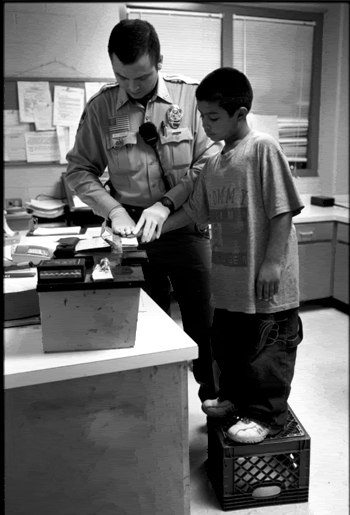
We'll leave the discussion about the changes to the juvenile justice system for another day. Today I'd like to focus on how this has affected our schools. I'm sure you've probably heard some of the anecdotal stories...like the one about the 5 year old girl in Florida who was hauled off in handcuffs by police for having a temper tantrum at school. Then there's the story of 12 year-old Alexa Gonzales in New York, who was arrested for doodling on her desk, and the 13 year old boy in Maryland who was arrested for refusing to say the pledge of allegiance. Stories like this are cropping up in the news pretty regularly these days.


The judge who was interviewed for this story makes the point...we are criminalizing the behaviors of children that were formerly handled by teachers and principals. The effect of this on children and their education has been documented by the ACLU.

Not surprisingly, studies show that being arrested has detrimental psychological effects on children. An arrest nearly doubles the odds that a child will eventually drop out of school. Coupled with a court appearance, an arrest nearly quadruples the odds of dropping out and increases the likelihood of future interaction with police. Arrests and police interactions also disproportionately affect low-income schools with large African-American and Latino populations. In essence, being arrested in school robs children of their access to educational opportunity.


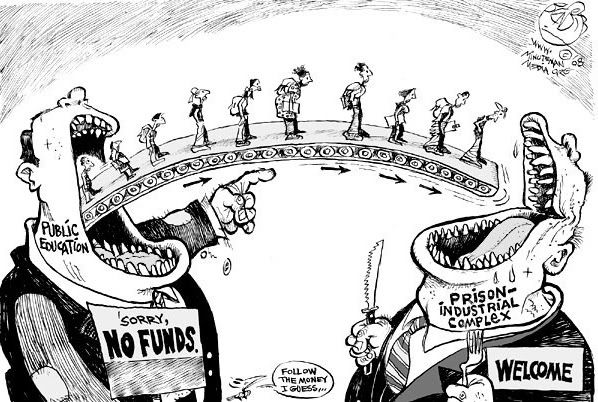
Many have labeled this pattern the school to prison pipeline.


Once again, Henry Giroux describes what is happening.

The shift to a society now governed through crime, market-driven values and the politics of disposability has radically transformed the public school as a site for a civic and critical education. One major effect can be seen in the increasingly popular practice of organizing schools through disciplinary practices that closely resemble the culture of prisons. For instance, many public schools, traditionally viewed as nurturing, youth-friendly spaces dedicated to protecting and educating children, have become one of the most punitive institutions young people now face - on a daily basis.<...>

Students being miseducated, criminalized and arrested through a form of penal pedagogy in lockdown schools that resemble prisons is a cruel reminder of the degree to which mainstream politicians and the American public have turned their backs on young people in general and poor minority youth in particular. As schools are reconfigured around the model of the prison, crime becomes the central metaphor used to define the nature of schooling while criminalizing the behavior of young people becomes the most valued strategy in mediating the relationship between educators and students. The consequences of these policies for young people suggest not only an egregious abdication of responsibility - as well as reason, judgment and restraint - on the part of administrators, teachers and parents, but also a new role for schools as they become more prison-like, eagerly adapting to their role as an adjunct of the punishing state.


The result of this transformation of our schools has been documented by organizations like the NAACP (pdf), the ACLU, the American Bar Association, and the Advancement Project (pdf). In New York City, with the Police Department taking over responsibility for school safety in 1998, the ACLU recently filed suit against the department over the use of excessive force and wrongful arrests in the schools.

While I appreciate the Obama administration's focus on education, it seems to continue the idea that the problems can be solved without addressing this very fundamental issue. As long as we see our children as potential threats to be feared and controlled, we'll continue to lose too many of them to the criminal justice system...at a very high price both in dollars and human suffering.

ACTION

While there are many policy issues that must be addressed to improve this situation, I believe that first of all, it is a problem of imagination.

In my dream, the angel shrugged & said, If we fail this time, it will be a failure of imagination & then she placed the world gently in the palm of my hand.

- Brian Andreas


So just imagine with me for a moment if all of our schools looked like this - its possible!!!!


Or if this kind of unselfconscious enthusiasm was nurtured in all of our classrooms:


(If you haven't checked out the youtube videos of this PS22 Chorus, I strongly suggest you do so for a jolt of inspiration.)

This is what our children would ask of us and what they're willing to give in return.

Sometimes, it will mean recognizing the reality of the world in which too many of our children live and finding ways to engage them - honestly - about their expectations for themselves.


I'd suggest that anyone who's interested in understanding the challenges faced by our urban schools should watch this 4th season of HBO's series "The Wire." The main storyline follows 4 middle-school African American boys in Baltimore both in and out of school. If we can imagine a way to reach them...we'll have all the answers we need about how to end the school to prison pipeline and create an educational system that works for all of our children.

Here's some additional resources in the meantime:

Stop the Schoolhouse to Jailhouse Track
Cradle to Prison Pipeline Campaign: Key Immediate Action Steps
Mapping the Schoolhouse to Jailhouse Track: Action Kit (pdf)
Education on Lockdown (pdf)
Underperforming Schools and the Education of Vulnerable Children and Youth (pdf)

Immigrants and domestic migrants could be major factors in the Texas Senate race.

A few weeks ago I wrote about how MAGA influencers are trying to convince their base that - despite Trump's growing disapproval rates -...