Friday, February 10, 2012

James Fallows on Obama

In The Atlantic, James Fallows has written one of the most interesting analyses of the Obama administration that I've seen.

A few caveats are in order. First of all, its very long. So if you're going to take a look, give yourself some time. You have to stick with it because he examines many sides and its important to read it all the way through.

Secondly, if you're like me, you won't agree with some of the things he says. But what I appreciated about it is that he doesn't seem to have an ax to grind from either side. He's not trying to defend Obama or take him down. I'll admit that its rare to see an analysis these days that doesn't at least seem to have one or the other agenda - no matter how deep people try to bury it.

Anyone who reads here regularly knows that I'm a strong supporter of the president and I'll admit that much of my reason for having this blog in the first place is that I think its important for people like me to make the case about why I think he's the best president in my lifetime. But even folks like me know that President Obama is a human being and therefore not perfect. Its nice to read a piece like Fallows' that both addresses his accomplishments but also recognizes that humanity. Whether or not its an accurate balance, who knows? It will give you something to think about.

Finally, I'd like to give you a few quotes as a tease. But I really don't think that's possible without doing damage to the whole picture Fallows paints. I'll simply recommend that you read it.

In case you're like me and recognize Fallows' name but don't remember much about who he is, here's a little bit from the wiki about him.

James Fallows is an American print and radio journalist. He has been a national correspondent for The Atlantic Monthly for many years. His work has also appeared in Slate, The New York Times Magazine, The New York Review of Books, The New Yorker and The American Prospect, among others. He is a former editor of U.S. News & World Report, and as President Jimmy Carter's chief speechwriter for two years was the youngest person ever to hold that job.

Fallows has been a visiting professor at a number of universities in the U.S. and China, and holds the Chair in U.S. Media at the United States Studies Centre at University of Sydney. He is the author of nine books, including National Defense, for which he received the 1983 National Book Award, Looking at the Sun (1994), Breaking the News (1996), Blind into Baghdad (2006), and Postcards from Tomorrow Square (2009).

There's a whole section in the article where Fallows describes in some detail the remarkable success President Obama has had in transforming the US relationship with China. Its a story I hadn't heard anyone else tell. Given Fallows experience there - that alone makes this piece worth a read.

Thursday, February 9, 2012

NY AG Schneiderman on the foreclosure fraud settlement: "Sometimes people on the left have to take yes for an answer"

After months of whispers about what might or might not happen, forty-nine state attorney generals today agreed to a $25 billion settlement with 5 major banks on a civil case about robo-signing in foreclosure fraud. The only state attorney general who didn't participate is Republican E. Scott Pruitt from Oklahoma. That means that liberal icons like CA Attorney General Kamala Harris, Delaware AG Beau Biden and NY AG Eric Schneiderman all signed on to the deal.

You can learn more about what's included by visiting the web site set up to explain the settlement. Ezra Klein collected the response of several experts to the deal and I found Jared Bernstein's (former adviser to Vice President Joe Biden and senior fellow at the Center for Budget and Policy Priorities) particularly enlightening.

Here are two reasons why I like the mortgage settlement agreement just announced: It’s not voluntary and it doesn’t require Congressional approval.

I’ll elaborate in a moment, but first, the caveats: It’s a drop in the bucket. There’s something like $700 billion out there in negative equity, and even with the leveraging — another attractive attribute of the way this should work — the $17 billion for preventing foreclosures ain’t gonna solve this.

But neither is any other single idea. Along with the other interventions policy makers are working on — ones I also hold some hope for — there’s clear potential to help distressed home owners and the macroeconomy.

He's addressing one of the main critiques I've heard about the settlement. People keep pointing out those figures of $700 billion of negative equity and this deal only providing $17 billion of relief (the remaining $8 billion of the $25 billion will go directly to those affected by the illegal foreclosures, the states and the federal government). Those using that argument don't seem to have much understanding of the legal system.

As I've said over and over - this case was about the narrow issue of robo-signing during foreclosures. While the settlement has been designed to provide $ for people who are currently underwater with their mortgages (estimates are that it will provide relief to 1 million of the 11 million in that situation), the illegal practice of robo-signing is not the cause of that particular problem. The relief the banks are providing as a result of this case should be commensurate to the actions that led to the suit in the first place. It was never going to be possible to solve the entire negative equity problem based on this one issue involving foreclosures.

Today Greg Sargent interviewed NY AG Schneiderman about the deal and he made this point very clearly.

In an interview with me just now, Schneiderman — who has gained a national liberal profile for his insistence on true accountability for financial institutions — conceded the settment announced today was “small” in financial terms, given the struggles of underwater homeowners and people who lost their homes.

But he insisted that time will show that today’s settlement was a win — that it secured a framework that will ultimately result in a true accounting of the role big banks played in sparking the economic meltdown.

“This is a small step in an economy where we have $700 billion in negative equity, but it is a significant step,” Schneiderman said, in response to criticism that the $25 billion settlement was far too small given the injuries sustained.

“This is a down payment towards the overall goal of accountability, meaningful relief for those injured by the meltdown, and getting the facts out so we can ensure that this never happens again.”

When Sargent pressed him further on some of the reactions to the settlement from the left, Schneiderman picked up on the meme I've been talking about for the last couple of days.

Asked if progressives should be skeptical of the administration’s assurances, given the lack of accountability so far, Schneiderman insisted that Obama’s private and public assurances have left him convinced he is serious about a real accounting.

“He took ownership of this,” Schneiderman. “Sometimes people on the left have to take yes for an answer. The President is accepting the challenge. It’s time for progressives to say, `okay, he’s moving with us now, he’s using resources of government to aggressively pursue the malefactors of great wealth, as Teddy Roosevelt put it.’”

But ultimately, what Schneiderman might not be aware of is the chronic nature of Obama Derangement Syndrome (ODS) with this crowd and that even though he was once deemed a hero by them, his actions today earn him a toss under the bus. From the ultimate bagger of fire herself:

We are especially disappointed in the “Justice Democrats” — particularly Attorney Generals Eric Schneiderman and Kamala Harris — whose complicity proves that any faith in their moral fiber or independence was misplaced. When Timothy Geither and the Obama White House pressed them to fold, they did so. At a time when America needs leaders to fight for justice and accountability, they chose to advance their own careers by protecting the corporations and bankers of the oligarch class — hoping that a few press releases filled with platitudes echoed through an expensive propaganda machine will fool a credulous public.

It does seem that I was quite premature in giving the Crybaby of the Day award to Matt Taibbi earlier for his inability to take "yes" for an answer about the changes underway on Wall Street. I apologize for that error. To correct it, I've reviewed the multitude of tantrums coming from folks who deem $17 billion in relief for 1 million Americans to be an outrage. But none tops Ms. Hamsher's aptitude for letting her ODS be persistent enough to accuse someone like Eric Schneiderman of selling out to "corporations and bankers of the oligarch class."

This one's for you Jane...

Photobucket

Matt Taibbi: Crybaby of the Day

Its pretty amusing actually. Matt Taibbi read the same article I did in the New York Magazine about the emasculation of Wall Street and came away with a totally different conclusion. Surprise, surprise.

The basic take-away for me was this statement:

And yet, from the moment Dodd-Frank passed, the banks’ financial results have tended to slide downward, in significant part because of measures taken in anticipation of its future effect...Partly, this is a function of the economic headwinds. But the bill’s major provisions—forcing banks to reduce leverage, imposing a ban on proprietary trading, making derivatives markets more transparent, and ending abusive debit-card practices—have taken a pickax to the Wall Street business model even though the act won’t be completely in effect till the ­Volcker Rule kicks in this July (other aspects of the bill took force in December; capital requirements and many other elements of the bill will be phased in gradually between now and 2016).

In other words, due to the current "economic headwinds" and the reforms of Dodd-Frank, the Wall Street business model that led to the financial crisis has been destroyed. My reaction was to think that's a good thing.

All Taibbi seemed to hear was whinning bankers.

Listening to Wall Street whine about how it is misunderstood is nothing new. It’s been going on for years (often in that same mag). But if Sherman’s piece heralds a new era of Wall Street complaining about how it is not only misunderstood but undercompensated, you’ll have to excuse me while I spend the next month or so vomiting into my shoes.

Its true, Sherman did quote a couple of Wall Street folks talking about how the days of 7-figure bonuses were over. But I fail to see how anything in the article suggests that's a bad thing.

Taibbi seems obsessed with the bonus issue. I don't think that's uncommon for a lot of people in this country...its come to be the symbol of all that was wrong with Wall Street. But a symbol is - by definition - not the source of the problem. And what Sherman did was explain to us that the symbol is now gone because the root problem - over leveraging, proprietary trading, and mysterious derivatives - have been dealt with via Dodd-Frank.

Taibbi's other point seems to be that he REALLY wants to make sure that Dodd-Frank doesn't get any credit for the changes happening on Wall Street. Even though Sherman acknowledges that the current economic headwinds have had an impact, Taibbi wants to assert that any tamping down that's happening now is a result of the Euro crisis.

Now, Gabe Sherman barely even mentions Europe in his article, which is interesting, because the banks on whose behalf he wails so loudly in this piece have mostly all pointed to Europe as more or less the sole reason for their reduced revenues of late.

I'm certainly not well-versed enough in all of this to quantify the degree to which regulatory reform vs on-going stresses in the world markets have had on the changes we're seeing. But I can say this: first of all, its silly to simply dismiss regulatory reform as a contributor and secondly, the fact that these companies are having to change their business model as a result of the on-going failures we continue to experience from their past mistakes is a good thing - is it not?

But here's the most ludicrous statement of all from Taibbi on Sherman's article:

1. He’s wrong. See the above argument about Europe, QE, etc.
2. Even if he wasn’t wrong, which he is, his reaction to the "news" that Wall Street’s outsized bonuses are dropping is all wrong. If it were true, it would be good news, not bad news.

That #2 gets back to my original point. Yes, its good news! And that's how I read it from the beginning. Taibbi seems to suffer from the same malady I talked about last night...the inability of some folks to take "yes" for an answer. Is it too early in the day to give out the Crybaby of the Day award?

Photobucket

Wednesday, February 8, 2012

Some people can't take "yes" for an answer

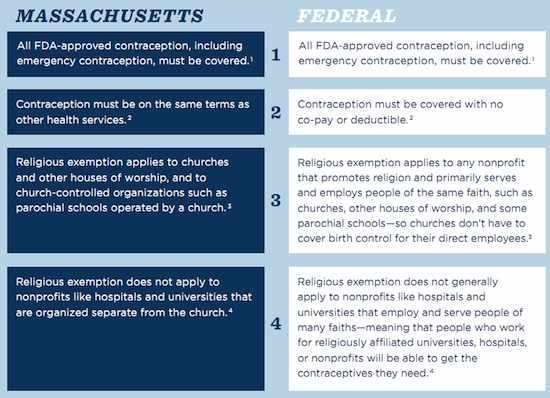
By now we all know that the Obama administration issued a directive requiring all employees to provide contraception as part of their health insurance plans. As the backlash from the Catholic Bishops and Republicans intensifies, the administration doesn't seem to be budging. As a matter of fact, they are mounting a pretty strong defense as is demonstrated by the fact that this comparison of the federal HHS rule to Romneycare was developed by the Obama campaign and posted on their blog yesterday.


But those who have watched Obama over the years know that it is very typical of him to want to keep communication open with the opposition until every avenue for resolution is explored. That's what Press Secretary Jay Carney indicated was happening today.

I think on this issue, from the very beginning we have said that we will listen and work with individuals who have concerns as we work to implement the law. As I said yesterday, on January 20th, when this decision was announced, Secretary Sebelius said: “We will continue to work closely with religious groups during this transitional period to discuss their concerns.”...

We want to work with all these organizations to implement this policy in a way that is as sensitive to their concerns as possible.

And then his very next sentence...

But let’s be clear. We are committed -- the President is committed -- to ensuring that women have access to contraception without paying any extra costs no matter where they work.

This idea of leaving the lines of communication open for possible resolution seems to drive some people a bit nuts as was demonstrated by a Daily Kos front-pager with her diary titled Time for the White House to end the contraception conversation with Catholic leaders. I'm not going to quote from it because the title already tells you all you need to know. Instead I think I'll give the author the Crybaby of the Day award...

Photobucket


...and suggest that she grow up and learn how to take "yes" for an answer.

Why the Santorum surge now?

Conventional wisdom for months now has been that this presidential election will hinge on the economy. As I've said many times, I don't tend to buy conventional wisdom. Life in this 24/7 news cycle is just too chaotic for one thing to dominate an election completely for that long.

So last Friday we had another great jobs report and it looks like the economy might be continuing the long slow slog towards recovery. Almost immediately I asked the question what will Republicans run on now? When you look at what they have in their bag of tricks, it doesn't take a rocket scientist to figure out the few remaining things they have left. So first up...cultural wedge issues.

It should come as no surprise then, that the media is consumed with talk about the Obama administration's new rule on employer contraception coverage, the Komen fiasco, and now - in the days ahead - I assume we'll be hearing alot about the California circuit court ruling on gay marriage.

Enter Rick Santorum. No matter how hard he tried to bolster his bonafides on the economy and foreign policy during the debates, he's known for one thing...being a cultural warrior.

All those Republican establishment folks who thought Romney would be the man to take it to President Obama on the economy misread the situation on two counts. First of all, they misread the voting public's (both Democrat and Republican) distaste for a vulture capitalist at this point. And even more importantly, they assumed they could ensure the economy would fail despite Obama's efforts. Wrong!

Given all that, it should come as no surprise that Santorum won the 3 races that were held yesterday in Missouri, Minnesota and Colorado.

But let me stipulate a couple of things. First of all, I don't think the Republicans can win on cultural wedge issues. It appeals to their base but not the general electorate. And secondly, I'm not saying that these things will dominate the race over the entire 9 months until election day. If we've learned anything from this primary its that the Republican base is volatile at this point. So I expect to continue to see swings. And I expect the Republican establishment to try their hand at turning the conversation to foreign policy before this thing is over. Their ace on that one will be developments in Iran. So keep an eye out for that one. The truth is that Mitt Romney has shown himself to be a total idiot when it comes to foreign policy. But that likely won't matter. Americans tend to take for granted that someone from the Republican establishment will be strong on that issue. So focus on Iran as the next big scary threat to America will likely play to his favor.

Tuesday, February 7, 2012

"We're going to show young people how cool science can be"

Today Steve Benen said this:

I can't think of a modern president who speaks as often and as enthusiastically about science as Obama.

Way back in the early days of his presidency, Obama signed an executive order ending the Bush-era restrictions on stem cell research. Here's what he said on that occasion.

"Promoting science isn't just about providing resources, it is also about protecting free and open inquiry," Obama said. "It is about letting scientists like those here today do their jobs, free from manipulation or coercion, and listening to what they tell us, even when it's inconvenient especially when it's inconvenient. It is about ensuring that scientific data is never distorted or concealed to serve a political agenda and that we make scientific decisions based on facts, not ideology."

As a way to promote science in education, a few months later President Obama launched the Annual White House Science Fair.

If you win the NCAA championship, you come to the White House. Well, if you're a young person and you've produced the best experiment or design, the best hardware or software, you ought to be recognized for that achievement, too. Scientists and engineers ought to stand side by side with athletes and entertainers as role models, and here at the White House we're going to lead by example. We're going to show young people how cool science can be.

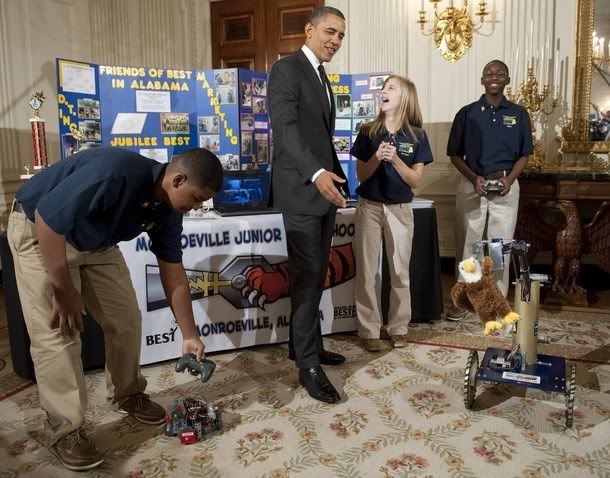
Today was the Second Annual White House Science Fair.


Someone is definitely enjoying himself. And its not just fourteen year old Joey Hudy who invented this extreme marshmallow cannon.

Ahhh...robots and stuffed chickens - what a combo!.

And yes, science is for girls too!

This is perhaps my favorite picture. What do you do when you have some time on your hands at the White House while you're waiting for the science fair to start?

I have a hunch that this 2 1/2 year old will be traveling to the White House Science Fair in no time.

Has Wall Street been emasculated?

Photobucket


That's the cover of the latest New York Magazine with the cover story by Gabriel Sherman. It's long, but an absolute must-read.

The crash four years ago was shocking enough to the financial class. But what is happening on Wall Street now is even more terrifying. No doubt the economy itself—the crisis in Europe, the effects of the tsunami in Japan, America’s sputtering recovery—has played a large part in the financial industry’s struggles. But even the most stubborn economies improve eventually. The bigger issues are structural. The Dodd-Frank financial-­reform act, much maligned, has already begun to change the shape of the financial system—even before a number of its major provisions are proposed to go into full effect this coming July...

A few years ago, the Masters of the Universe never could have imagined their industry being compared to big-box retailing. And yet, the model that had fueled bank profits has finally broken, as markets sputtered and new regulation kicked in. “Compensation is never really going to come back,” a Wall Street headhunter told me. “That is something entirely new.”

What is even more startling about this reversal is that few thought the much-vilified Dodd-Frank act would have much effect at all. From the moment it was proposed in 2009, the bill was tarred from all sides. Critics from the left, who wanted a return of Glass-­Steagall, which had kept investments banks and commercial banks separate until it was repealed during the Clinton years, howled that Dodd-Frank wouldn’t go far enough to break up the too-big-to-fail banks... The too-big-to-fail banks, for their part, argued that the 2,300-page bill would create an overly complex morass of overlapping regulators that risked killing their ability to compete against foreign rivals...

By the time the bill passed, in July 2010, the legislation hadn’t found many new friends. Banks were especially upset by the inclusion of the Volcker Rule, which banned proprietary trading and virtually all hedge-fund investing by banks. Banks also complained about an amendment that slashed lucrative debit-card fees. They capitulated mainly because the alternative—breaking them up—was worse.

Part of the perception that the financial crisis changed nothing is that, in the immediate wake of the crash, the banks, buoyed by bailout dollars, whipsawed back to profitability. Goldman earned a record profit of $13.4 billion in 2009, as markets roared back from their post-Lehman lows. This dead-cat bounce was central to the formation of Occupy Wall Street and the neopopulist political currents that first erupted when the Treasury Department appointed Ken Feinberg to regulate bonuses for several TARP recipients...

And yet, from the moment Dodd-Frank passed, the banks’ financial results have tended to slide downward, in significant part because of measures taken in anticipation of its future effect. Since July 2010, Bank of America nosed down 42 percent, Morgan Stanley fell 25 percent, Goldman fell 21 percent, and Citigroup fell 16—in a period when the Dow rose 25 percent. Partly, this is a function of the economic headwinds. But the bill’s major provisions—forcing banks to reduce leverage, imposing a ban on proprietary trading, making derivatives markets more transparent, and ending abusive debit-card practices—have taken a pickax to the Wall Street business model even though the act won’t be completely in effect till the ­Volcker Rule kicks in this July (other aspects of the bill took force in December; capital requirements and many other elements of the bill will be phased in gradually between now and 2016). “If you landed on Earth from Mars and looked at the banks, you’d see that these are institutions that need to build up capital and that they’re becoming ­lower-margin businesses,” a senior banker told me. “So that means it will be hard, nearly impossible, to sustain their size and compensation structure.” In the past year, the financial industry has laid off some 200,000 workers.

Here's yet another example in our polarized politics where the real story of progressive reform is not being told because both left and right extremists have such trouble actually recognizing success. But thanks to President Obama and Congressional Democrats, Wall Street is being reformed without taking the entire US economy down with it.

Immigrants and domestic migrants could be major factors in the Texas Senate race.

A few weeks ago I wrote about how MAGA influencers are trying to convince their base that - despite Trump's growing disapproval rates -...