Sunday, January 9, 2022

Republicans Want to Talk About Inflation. Democrats Focus on Job Creation. Here's Why They're Both Wrong

Republicans are facing a bit of a dilemma. In the midst of the Biden Boom, they are determined to paint the president's economic policies as a massive failure. Other than blaming him for measures designed to mitigate a pandemic that they're helping to fuel, the most potent tool they've used is to fear-monger about inflation. The GOP got a major assist on that one from mainstream media. As a result, three-quarters of Republicans now point to prices as the key indicator of economic health (up from 25% a year ago).

Democrats have taken the more traditional approach to measuring the health of the economy by focusing on job creation. On that front, Biden has been a tremendous success.
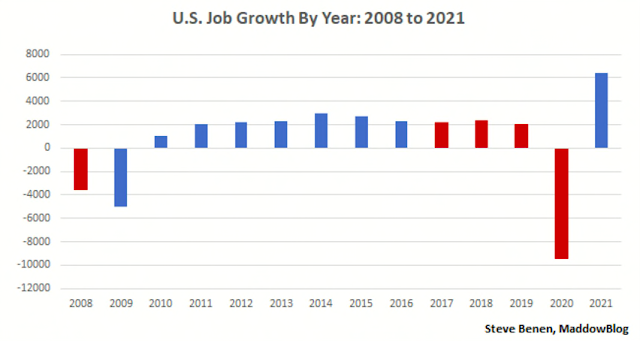
But with some major changes underway, both indicators will increasingly miss the point. When it comes to inflation, this has been a main driver:
The U.S. economic recovery from the covid pandemic was the strongest of any of the big Western economies...

The Biden stimulus pushed the bank accounts of even the lowest-income Americans to unexpected heights. On average, they had more than twice as much in their savings accounts as they did when the pandemic began.

The Federal Reserve, the U.S. central bank that controls interest rates, helped, too. It held rates near zero and pumped hundreds of billions of dollars into the economy.

The twin fire hoses of cash — one from Congress, one from the Fed — sent Americans’ spending roaring back.

The question that poses for Republicans is how they will pivot as inflation slows down

For Democrats, a focus on job creation ignores the fact that the economy isn't creating too few jobs, it's that we're facing a labor shortage. Economists are tying themselves in knots trying to figure out why Americans aren't going back to work. Of course, in the midst of an ongoing pandemic, some of those reasons are understandable, like fears about health, caring for someone who's sick, and lack of child care. But here's the big one:

Retirements explain a large chunk of the missing workers. For some, soaring retirement accounts and home values, combined with the lower expenses of a simplified work-from-home lifestyle, made it financially feasible to retire early. Others retired solely on Social Security, without retirement accounts to ease the way.

A Washington Post analysis found that over 1.5 million more people were retired in November 2021 than would have been expected based on pre-pandemic trends. Employment has actually declined in the last year among workers who were 55 or older at the start of the pandemic.

What almost no one is talking about is that this country was facing a labor shortage BEFORE the pandemic - much of it related to the fact that baby boomers are retiring. Today, boomers range in age from mid-50s to mid-70s, so many have been either retiring or planning to retire. It appears that the pandemic merely sped up that process. 

Here's what Ezra Klein wrote about that back in 2013:

Everyone agrees that aging economies with low birth rates are in trouble...The retirement of the baby boomers is correctly understood as an economic challenge. The ratio of working Americans to retirees will fall from 5-to-1 today to 3-to-1 in 2050. Fewer workers and more retirees is tough on any economy.

When Klein says that "everyone agrees," he's right. Back in 2017, Paul Ryan said the same thing - even if his solution to the problem was abhorrent.

 This is what the Wall Street Journal was reporting back in 2016:

In Dallas, the King of Texas Roofing Co. says it has turned down $20 million worth of projects in the past two years because it doesn’t have enough workers.

In the San Francisco Bay Area, Joe Hargrave is expanding his successful Tacolicious chain of restaurants, but says he is building smaller ones due to “a massive shortage of restaurant workers.”

And in Florida, Steve Johnson, who harvests oranges for the citrus industry, says, “Right now, if I had 80 guys, I could put every one of them to work.”

As hiring accelerates and the labor market tightens thanks to a steady U.S. recovery, employers who need low-skilled workers are increasingly struggling to fill vacancies.

The situation in rural American was even worse. Here's how Art Cullen described what was happening in Iowa:

The population numbers since 2010 look bad for most rural Iowa counties: Pocahontas, down 7.8%; Sac, down 6.1%; Audubon, down 10%; Cass, down 7.3%; Adams, down 9.5%. A small sampling of isolated rural counties. They may have peaked in population in 1940 or before. The sad news is: Nothing is on the horizon to turn it around.

Here is how a researcher in my home state of Minnesota documented the problem back in 2019:

Employment projections indicate that, by 2022, Minnesota will need nearly 3.2 million workers to keep pace with historic rates of economic growth statewide. With just 2.9 million people over the age of 16 expected to be in the labor force and working, our state is expected to fall about 239,000 workers short.

That is the economic challenge this country will continue to face - too few workers - even when the pandemic is no longer an issue.

Paul Ryan sounded an early warning about how Republicans are likely to respond to the challenge. We're already hearing right wingers talk about the need for women to have more babies. For the nativists, that is often pitted against the solution that has always been a hallmark of the U.S. economy: immigration. That is precisely what Klein was writing about in 2013.

There are few free lunches in public policy. But taking advantage of our unique position as a country where the world’s best, brightest and hardest-working desperately want to live is surely one. In the end, economies aren’t mainly about budgets and tax codes, though Congress occasionally pretends otherwise. They’re about workers and business owners. Immigration reform is a way to get more of both.

Immigration reform is often cast as an issue that is a concern for people of color - primarily Hispanics. But the fact is that it should be a priority for all of us. Our economy is going to depend on it.

Saturday, January 8, 2022

I, For One, Take Senator Tom Cotton Very Seriously

Becket Adams, who writes for the Washington Examiner, says that the media needs to take Senator Tom Cotton (R-AR) seriously, suggesting that "he is actually smarter and more reasonable than his critics say."

Given Cotton's track record, the "more reasonable" part is problematic. But I would be the last one to question the senator's intelligence, which is why I've always taken him seriously. Unlike Donald Trump, who combined his malevolence with ignorance, Cotton is smart and knows exactly what he's doing. He's the guy who graduated from Harvard in three years and then went on to get a degree from Harvard Law. That's impressive. 

As Molly Ball wrote back in 2014, Cotton's undergraduate thesis at Harvard on the Federalist Papers gives us a window into a politician who is otherwise something of a cipher.

Cotton insists that the Founders were wise not to put too much faith in democracy, because people are inherently selfish, narrow-minded, and impulsive. He defends the idea that the country must be led by a class of intellectually superior officeholders whose ambition sets them above other men. Though Cotton acknowledges that this might seem elitist, he derides the Federalists’ modern critics as mushy-headed and naive.

Since Cotton still defends that thesis, it is clear that he, too, takes himself seriously as one of those "intellectually superior officeholders." That kind of elitism might not sit well with the fake populism espoused by his party these days. And yet, as Jeffrey Toobin noted, Cotton has somehow managed to garner support from both the insurgent and establishment wings of the Republican Party.

Stephen Bannon, Trump’s former top strategist and the chairman of the right-wing Web site Breitbart News, told me, “Next to Trump, he’s the elected official who gets it the most—the economic nationalism. Cotton was the one most supportive of us, up front and behind the scenes, from the beginning. He understands that the Washington élite—this permanent political class of both parties, between the K Street consultants and politicians—needs to be shattered.” At the same time, Cotton has maintained strong ties with the establishment wing of the G.O.P. Karl Rove, President George W. Bush’s chief political adviser, told me, “Cotton is not like a Steve Bannon, who wants to blow up the existing structure, uproot the ideology of the Republican Party and replace it with something new. He’s a rising star. He’s capable of building bridges within the Party. He wants to get things done.”

I would suggest that Karl Rove values Cotton for his extremely hawkish foreign policy positions. For example, the senator from Arkansas said that waterboarding isn't torture and that Gitmo detainees "can rot in hell." 

Perhaps the position Cotton took on Iran's nuclear weapons is what distinguishes him the most. During his first year in the Senate, as the Obama administration was in the midst of multilateral negotiations to halt the country's development of nuclear weapons, Cotton penned an open letter the Leaders of the Islamic Republic of Iran basically telling them that they shouldn't take the negotiations seriously because either Congress or the next president could revoke any agreement that was ultimately reached. The freshman senator was able to get 46 of his Republican colleagues to sign the letter that undermined the foreign policy of a sitting president. 

Cotton followed that up by defending his preferred method of addressing the issue of Iran's nuclear weapons: a few days of bombing...easy peasy. It's not hard to understand why those who were willing to lie this country into a war in the Middle East would love this guy.

It is Cotton's nativism that attracts the Steve Bannon's of the world. They love the fact that the senator not only fought against criminal justice reform, he actually said that this country has an under-incarceration problem. It was also Cotton who referred to slavery as a "necessary evil" and tweeted this during the protests over George Floyd's murder.

He went on to elaborate in an opinion column that was published by the New York Times.

Since his days in the House, Cotton has opposed comprehensive immigration reform. But it's worth noting that, in early 2018, Trump told lawmakers to seek a bipartisan solution on immigration and signaled that he would sign whatever they put in front of him. 

A bipartisan group of Senators came up with a proposal that the president appeared to support. But when they arrived at the White House to discuss it, they were surprised to be met with several immigration hardliners (perhaps invited by Stephen Miller) who had already talked Trump into opposing the proposal. Of course, one of them was Tom Cotton. It was during that meeting that the president made his infamous remarks about immigrants from shithole countries.

Those are some of the policy positions taken by Senator Cotton. But the fact that he is a mean and spiteful person has occasionally been on display. For example, after Cotton was part of the group that ambushed the bipartisan immigration proposal, Republican Senator Lindsay Graham referred to him as "the Steve King of the Senate." Cotton fired back that, in his 2016 presidential run, Graham "didn’t even make it off the kiddie table in the debates.”

But the moment I began to see that Senator Cotton had sociopathic tendencies was when I read what he did to President Obama's nominee to be the U.S. Ambassador to Bahamas - Cassandra Butts. Frank Bruni told the story.

Senator Tom Cotton, an Arkansas Republican, put a hold specifically on Butts and on nominees for the ambassadorships to Sweden and Norway. He had a legitimate gripe with the Obama administration over a Secret Service leak of private information about a fellow member of Congress, and he was trying to pressure Obama to take punitive action. But that issue was unrelated to Butts and the Bahamas.

Cotton eventually released the two other holds, but not the one on Butts. She told me that she once went to see him about it, and he explained that he knew that she was a close friend of Obama’s — the two first encountered each other on a line for financial-aid forms at Harvard Law School, where they were classmates — and that blocking her was a way to inflict special pain on the president.

After waiting more than two years for Cotton to release his hold on her nomination, Butts died on May 25, 2016.

So yes Mr. Adams, I take Tom Cotton very seriously. As they say..."as serious as a heart attack." 

Friday, January 7, 2022

January 6 House Committee Has the Big Picture on Trump's Attempted Coup

As horrible as it was, it is now clear that the riot at the Capital on January 6 was just a part of the story when it comes to Trump's attempted coup. While we don't know all of the evidence that has been amassed by the January 6 House Committee, Rep. Jamie Raskin made it clear that they are looking into the big picture. He outlined the the three rings of the attempted coup.


The three rings include:
  1. The mass demonstration that turned into a riot,
  2. The organized violent extremist groups (Proud Boys, Oath Keepers, etc.) who initiated the violence that then spread to other rioters, and
  3. The attempt to pressure VP Pence to reject the electoral votes of several states.
The point of the third (or inner) ring was to reduce the number of Biden's electoral votes below the 270 necessary to win. Under the 12th Amendment, that would send the election to the House, where each state delegation gets one vote. At the time, Republicans held the delegations from 27 states and Democrats 22, with Pennsylvania evenly divided. So Trump would be declared the winner.

That was the plan outlined in a memo from John Eastman, a lawyer who was working with Trump's legal team. During his speech at the rally on January 6, it is likely that Trump was referring to Eastman's proposal.
I hope Mike is going to do the right thing. I hope so. I hope so.

Because if Mike Pence does the right thing, we win the election. All he has to do, all this is, this is from the number one, or certainly one of the top, Constitutional lawyers in our country. He has the absolute right to do it.

At about the same time (noon on January 6), Pence released a letter essentially saying that he would not comply. Two hours later, as rioters breached the Capital and shouted "hang Mike Pence,' the vice president was ushered off the House floor to a secure location. Trump then tweeted "Mike Pence didn't have the courage to do what should have been done to protect our Country and our Constitution." Months later, when Trump was asked about the chants to hang Mike Pence, the former guy said it was just common sense because the rioters were angry.

All of that is what we know about the inner ring of Trump's coup attempt from public statements and documents that have already been released. Of course, that was simply Trump's final coup attempt. He had previously pressured election officials to overturn their state's results and planned to oust his acting attorney general, who refused to wield DOJ's power to force state lawmakers to overturn their election results. Neither of those attempts were successful as public servants refused to cooperate with an attempted coup.

It is clear that the January 6 Committee isn't limiting itself to Trump's responsibility for inciting the insurrection - which was the basis for his second impeachment. They're looking at the bigger picture of a months-long attempted coup.

Thursday, January 6, 2022

The Majority of Democrats Aren't Leftist or Centrist

On January 6, Don Trump, Jr. made the stakes perfectly clear for the Republican Party. 

He was right. The GOP is now Donald Trump's Republican Party. Dissenters like Rep. Liz Cheney are denounced and demonized. The governor's race in my home state of Minnesota is a perfect example of how that's playing out. In a state that was once known for moderate Republican governors, not one of the five candidates running in the 2022 GOP primary was willing to denounce Trump's big lie about a stolen election. 

On the other hand, it has become almost impossible for journalists to talk about members of the Democratic Party without identifying where they stand on a bifurcated political spectrum. The two options go by various names, but are usually denoted by "progressive/moderate" or "leftist/centrist."

To the extent that Democrats like Sen. Joe Manchin and Rep. Josh Gottheimer have claimed the mantle of "moderate" or "centrist," with Senator Bernie Sanders and Rep. Alexandria Ocasio-Cortez covering the "progressive" or "leftist" position, where does that leave a Democrat who:

  • supports the Build Back Better Act,
  • fights for voting rights, even if it means eliminating the filibuster,
  • focuses on expanding Medicaid in states that haven't done so, 
  • recognizes the need for criminal justice reform,
  • prioritizes the need to address climate change by advocating for renewable energy sources, 
  • rejects the notion of defunding the police because it creates a false choice at a moment when departments need to be reformed,
  • advocates for common sense gun safety measures,
  • champions the cause of both labor unions and entrepreneurs,
  • supports border security and comprehensive immigration reform, and
  • fights unapologetically for women's equality and reproductive rights?
Here's what's interesting about that list. They are the positions embraced by the vast majority of elected Democrats - including the president and vice-president. 

With such small majorities in both the House and Senate, Democrats who have different policy positions have the power to stop Democrats from advancing that agenda. They are the ones who garner attention from the media. So all we hear about is the dissension between the progressives and the moderates. 

Since we don't have a name for the majority of Democrats who embrace the list of policy positions above, they either become invisible or journalists struggle with where they fit on the left/center divide. As an example of the latter, take a look at a recent column by Astead Herndon titled, "Left and Center-Left Both Claim Stacey Abrams. Who's Right?" He refers to Abram's positioning as a "carefully calibrated strategy" that will be tested in her run for governor in 2022. 
Moderates and progressives sparred in Washington throughout 2021, frustrating a White House struggling to achieve consensus on its priorities and continuing an ideological debate that has raged in the party for years...[A] review of Ms. Abrams’s policy statements and television advertisements, and interviews with political figures who have known her for years, reveal a leader who has carefully calibrated her positions, making a point to avoid drifting into one Democratic lane or another.

The so-called "lane" Abrams inhabits is the same one embraced by a majority of elected Democrats - which is why so many of them wanted her help on the campaign trail in 2020. Herndon could write similar columns about two other Georgia politicians: Senators Raphael Warnock and Jon Ossoff. Neither of them align significantly with either Manchin or Sanders. Is that because they're making a calibrated effort to avoid the left or center lane? Or is it simply because they align with the majority of their party?

None of this is to suggest that there isn't dissension among Democrats. That happens because, unlike Republicans, they're not a cult and actually have a governing agenda. But conflict is what drives media coverage, so it is the dissenters that garner all of the attention. 

That presents a skewed portrait in which the majority of Democrats aren't even given a position on the bifurcated political continuum. If I had my way, we'd call them pragmatic progressives. The name, however, isn't important. We simply need a way to recognize the existence of the majority of Democrats.


Wednesday, January 5, 2022

January 6 Committee Is Exposing Trump's Cable News Cabinet

While the House January 6 Committee is uncovering crucial evidence of Trump's attempted coup, they are also exposing the depth of involvement in the former guy's presidency of Fox News hosts. In the letter to Sean Hannity asking for his cooperation, the committee unveiled a few of his texts with Chief of Staff Mark Meadows. 

December 31, 2020: "We can't lose the entire WH counsels office. I do NOT see January 6 happening the way he is being told. After the 6th [sic] He should announce will lead the nationwide effort to reform voting integrity. Go to FL and watch Joe mess up daily. Stay engaged. When he speaks people will listen."

January 10, 2021: "Guys, we have a clear path to land the plane in 9 days. He can't mention the election again. Ever. I did not have a good call with him today. And worse, I'm not sure what is left to do or say, and I don't like not knowing if it's truly understood. Ideas?"

That second one was sent to Rep. Jim Jordan, in addition to Mark Meadows. In other texts, Hannity said, on January 5, that he was "very worried about the next 48 hours" and seemed to be aware of conversations among Cabinet members about invoking the 25th Amendment on the day of the insurrection. 

The committee had already revealed that, on January 6, Hannity joined Laura Ingraham and Brian Kilmeade in begging Meadows to talk Trump into stopping the violence at the Capital. 

We often talk about "access journalism," but this is evidence that, when it came to people like Sean Hannity, things went to a whole new level with Trump. Hannity was not just cozying up to the president, he was playing the role of an advisor. 

Back in the spring of 2018, Robert Costa wrote this

The phone calls between President Trump and Sean Hannity come early in the morning or late at night, after the Fox News host goes off the air. They discuss ideas for Hannity’s show, Trump’s frustration with the ongoing special counsel probe and even, at times, what the president should tweet, according to people familiar with the conversations. When he’s off the phone, Trump is known to cite Hannity when he talks with White House advisers...The conservative commentator is so close to Trump that some White House aides have dubbed him the unofficial chief of staff...

Trump and Hannity usually speak several times a week, according to people familiar with their relationship. The Fox News host, whose show averages more than 3 million viewers daily, is one of the few people who gets patched immediately to Trump. The two men review news stories and aspects of Hannity’s show, and occasionally debate specifics about whatever the president is considering typing out on Twitter. There have also been times when Trump has assessed the merits of various White House aides with Hannity.

But it wasn't just Sean Hannity

[Lou] Dobbs doesn’t get to just interview and socialize with the president; he is involved in some of the administration’s more sensitive discussions. During the first year of the Trump era, the president has patched in Dobbs via speakerphone to multiple meetings in the Oval Office so that he could offer his two cents, according to three sources familiar with these conversations. Trump will ask Dobbs for his opinion before and after his senior aides or Cabinet members have spoken. Occasionally, he will cut off an official so the Fox Business host can jump in.

Then, there was the often documented feedback loop between Trump and Fox and Friends. 


All of that is why we often referred to Fox News as Trump's cable news cabinet. Over the course of four years, we all just came to accept the fact that the president not only had his own propaganda network, but that they were acting as his close advisors. In reality, it was extraordinary. 

Of course, the main concern is the distortion of the word "news" and how that undermines the whole concept of journalism. But back in 2010, David Frum pointed out that media personalities (his example at the time was Rush Limbaugh, another member of Trump's cabinet) have very different jobs than elected leaders.
I’ve been on a soapbox for months now about the harm that our overheated talk is doing to us. Yes it mobilizes supporters — but by mobilizing them with hysterical accusations and pseudo-information, overheated talk has made it impossible for representatives to represent and elected leaders to lead. The real leaders are on TV and radio, and they have very different imperatives from people in government. Talk radio thrives on confrontation and recrimination...If Republicans succeed — if they govern successfully in office and negotiate attractive compromises out of office — Rush’s listeners get less angry. And if they are less angry, they listen to the radio less, and hear fewer ads for Sleepnumber beds.

With Trump, overheated talk merged with the presidency. Confrontation and recrimination became their shared goals, which kept their troops angry and engaged. That is what eventually laid the groundwork for January 6. 

Tuesday, January 4, 2022

How the Combination of Ignorance and Certainty Opens the Door to Cruelty

Years ago I read a book that had a profound impact on me. "Lest Innocent Blood Be Shed" is the story of how Andre and Magda Trocme inspired the small village of Le Chambon, France to take in refugees from the Nazi's - mostly children. They saved thousands of lives in the process.

Prior to those events, Andre was arrested and questioned by a Vichy police captain. Here is how the author of the book (Phillip Hallie) describes his reaction:

This was a moment Trocme would never forget. In fact, his overnight stay in the police station in Limoges changed his view of mankind. He discovered people like the captain - patriotic, sincere, but above all, severely limited. These people were capable of repeating hate-ridden cliches without any concern for evidence or for the pain of others. Before he entered that police station, he thought the world was a scene where two forces were struggling for power: God and the Devil. From then on, he knew that there was a third force seeking hegemony over this world: stupidity... Now and for the rest of his life, he knew that there were some people - indeed, many people - who did not realize what suspicion and hatred were doing to their own minds and to their victims.

Personally, I prefer the word "ignorance" (a lack of knowledge) to "stupidity" (a lack of intelligence). Perhaps that's because the former is more curable and I need to cling to hope. 

But Trocme definitely had a point when he divided the world into good (God), evil (the Devil), and stupidity/ignorance. It goes a long ways towards helping us understand why otherwise good people - often our family and friends - have joined in the kind of hatred being spread by the MAGA crowd. 

In his description of militant ignorance, Bill Schneider posits that its roots lie in a longing for certainty.

Many Americans long for certainty in their leaders as a sign of strength. But education — even science — is not the realm of certainty. Religion is.

Certainty provides a kind of security in knowing everything that needs to be known. It shuts down uncomfortable questions and doubts because someone who is certain believes they are already right about everything. Insecure people gravitate towards certainty because it allows them to be condescending to those of us who aren't so sure about everything. In our patriarchal world, certainty is seen as a sign of strength. 

But certainty exacts a heavy price by shutting down curiosity, along with the ability to change and grow. Listening requires a suspension of certainty - at least long enough to hear what the other person is saying. 

While overt racism would fall in Trocme's category of evil (or the Devil), the roots of much of the white privilege we see on display today come from a combination of militant ignorance and certainty. There is no interest in listening to the experiences of people of color, along with a certainty that one's understanding of the world from a white perspective is normative. 

So perhaps you can understand how ignorance and certainty become entwined. As a result, empathy isn't possible and the door to cruelty (all in the name of righteous certainty, of course) is opened. 

Monday, January 3, 2022

The Georgia Senate Race Could Shape Up as a Demonstration of Militant Ignorance

In about ten months, the voters of Georgia are likely to have to decide whether to send Democrat Raphael Warnock back to the Senate or replace him with Republican Herschel Walker. It's true that the GOP primary field is crowded. But a poll from a consulting firm a couple of months ago showed that 74% of Georgia Republicans would vote for Walker over his primary opponents. 

Walker has, of course, garnered an endorsement from Donald Trump. But other GOP leaders have gotten on board as well, with Mitch McConnell saying that the former football star is “the only one who can unite the party, defeat Senator Warnock, and help us take back the Senate.”

With three-quarters of Georgia Republicans currently supporting Walker, McConnell could be right about him being the candidate "who can unite the party." But at what price? Walker has been avoiding public events and questions from the press. On the few occasions when he has spoken, it's not hard to understand why that would be a campaign strategy. As an example, here's a clip of Walker talking to the host of a right wing radio program in Georgia.

First of all, John Lewis was never a senator. But even more importantly, the late congressman dedicated his life to fighting for voting rights. None of that is a matter of contention. It is just a fact. 

But that isn't the first time Walker has uttered practically incomprehensible lies. Take a look at this video clip he posted in September 2020.

CNN's fact-checker Daniel Dale had trouble with that one, writing that "if we were understanding him correctly," Walker was referring to "a false claim that a Chinese-American group in California is a "company from China."

It is impossible to know whether Walker actually believes the things he's saying or if he is just intentionally lying. The man not only has a past that includes violent explosions, he has openly talked about suffering from Dissociative Identity Disorder (commonly referred to as multiple personality disorder).

The bigger question is why Georgia Republicans would support a candidate like that. One way to answer that is to recognize just how much they are threatened by Walker's opponent - Raphael Warnock - who recently said this during a speech on the Senate floor in support of a voting rights bill.

But there is also an element of what Bill Schneider calls "militant ignorance." He distinguishes that from the kind of ignorance that comes with a lack of access to education. The militant variety is "Ignorance that is proud of itself, that holds knowledge in contempt."

I would submit that militant ignorance has been growing in this country for a while now. Back in the early 90s, a local sports commentator Joe Soucheray started a radio show called "Garage Logic." It lives on today as a podcast. Here's how the web site defines the show's name:

In an effort to pursue the basic logic and common sense which seem to be sadly lacking in modern America, Joe built a virtual city as a vehicle for discussion. … Joe believes that most problems can be solved using the type of discussions that commonly take place in garages.

Of course, Joe doesn't have to be explicit about the fact that garages are where men tend to hang out. But it undergirds the whole premise. 

If that kind of "logic" sounds familiar, it is perhaps because Stephen Colbert gave it a name back in 2005 - truthiness - which he defined as "the belief in what you feel to be true rather than what the facts will support."

The guys hanging out in a garage are then pitted against "elites" who actually develop expertise by studying the facts. In that way, militant ignorance is celebrated and anyone with expertise is treated with disdain. In such a world, it makes sense to put parents in charge of public education rather than teachers or to elect a reality television star as president. It is also how we got to the place during a pandemic where only 45 percent of Republicans said they had a lot of confidence in science, down from 72 percent in 1975.

You can count on the fact that, should the 2022 Georgia Senate race be a contest between Warnock and Walker, the former will be tarred as an elitist (after all, he does have a PhD from Union Theological Seminary) and the latter will be hailed for his ability to connect with the guys in the garage, even as he spreads lies and conspiracy theories. Thomas Jefferson had a remedy for that:

I know no safe depository of the ultimate powers of the society but the people themselves, and if we think them not enlightened enough to exercise their control with a wholesome discretion, the remedy is not to take it from them, but to inform their discretion by education. This is the true corrective of abuses of constitutional power.

Immigrants and domestic migrants could be major factors in the Texas Senate race.

A few weeks ago I wrote about how MAGA influencers are trying to convince their base that - despite Trump's growing disapproval rates -...