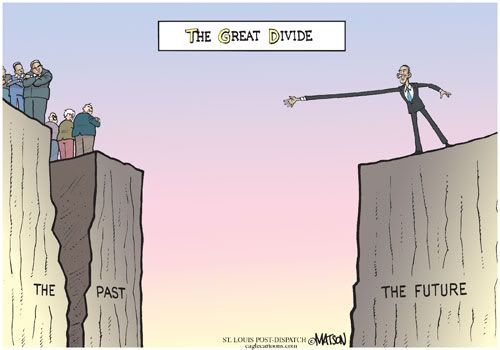
Saturday, July 11, 2009

On Moving Forward - Generational Shifts

I would suspect that most generational shifts are hard to recognize when you're in he middle of them. But based on some of my professional experience as well as watching electoral politics in this country, I think we're beginning to see some generational shifts in the African American community that are affecting all of us.

Certainly the election of Barack Obama as President of the United States gives the nation and the world an opportunity to see this new generation of African American leadership at work. As I've tried to watch and capture what that change indicates, I see that Obama has signaled many of the subtleties in speeches he made both on the campaign trail and since he's been in office. 

Perhaps the most dramatic was when he gave what we've now come to call the race speech. In it, Obama went wide and deep in laying out his view of the racial tensions that continue to exist in this country. But ultimately, there was a theme that developed about where we need to go. In the midst of acknowledging all of the very real conflicts that exist around racism, he talked about what we need to do to move forward.

But race is an issue that I believe this nation cannot afford to ignore right now. <...>

The fact is that the comments that have been made and the issues that have surfaced over the last few weeks reflect the complexities of race in this country that we've never really worked through - a part of our union that we have yet to perfect. And if we walk away now, if we simply retreat into our respective corners, we will never be able to come together and solve challenges like health care, or education, or the need to find good jobs for every American. <...>

This is where we are right now. It's a racial stalemate we've been stuck in for years. Contrary to the claims of some of my critics, black and white, I have never been so naïve as to believe that we can get beyond our racial divisions in a single election cycle, or with a single candidacy - particularly a candidacy as imperfect as my own.

But I have asserted a firm conviction - a conviction rooted in my faith in God and my faith in the American people - that working together we can move beyond some of our old racial wounds, and that in fact we have no choice if we are to continue on the path of a more perfect union.<...>

In the end, then, what is called for is nothing more, and nothing less, than what all the world's great religions demand - that we do unto others as we would have them do unto us. Let us be our brother's keeper, Scripture tells us. Let us be our sister's keeper. Let us find that common stake we all have in one another, and let our politics reflect that spirit as well.


I heard many of these same themes in Obama's Cairo speech. Again, he laid out the particulars of why the various tensions exist both in the Middle East and with the rest of the world. But he calls on us all to find a way to work together and move forward.

Of course, recognizing our common humanity is only the beginning of our task. Words alone cannot meet the needs of our people. These needs will be met only if we act boldly in the years ahead; and if we understand that the challenges we face are shared, and our failure to meet them will hurt us all.

For we have learned from recent experience that when a financial system weakens in one country, prosperity is hurt everywhere. When a new flu infects one human being, all are at risk. When one nation pursues a nuclear weapon, the risk of nuclear attack rises for all nations. When violent extremists operate in one stretch of mountains, people are endangered across an ocean. And when innocents in Bosnia and Darfur are slaughtered, that is a stain on our collective conscience. That is what it means to share this world in the 21st century. That is the responsibility we have to one another as human beings.

This is a difficult responsibility to embrace. For human history has often been a record of nations and tribes subjugating one another to serve their own interests. Yet in this new age, such attitudes are self-defeating. Given our interdependence, any world order that elevates one nation or group of people over another will inevitably fail. So whatever we think of the past, we must not be prisoners of it. Our problems must be dealt with through partnership; progress must be shared.

The message I hear is that we need to acknowledge the past and the tensions it has brought us. But we also need to find a way to move forward...together. If we're ever going to get beyond the stalemates of the past, it will be because we are able to recognize the stake we have in each other - regardless of our past grievances - and find a way to move forward in addressing our common interests. And this applies to our relationships with other countries as well as to those we have deemed to be "other" here in the U.S.

But I've also noticed that this kind of message is not just coming from Obama. Way back in August 2008, Matt Bai wrote an article for the New York Times Magazine titled Is Obama the End of Black Politics? In it, he examined the generational shifts happening in political leadership within the African American Community.

Black leaders who rose to political power in the years after the civil rights marches came almost entirely from the pulpit and the movement, and they have always defined leadership, in broad terms, as speaking for black Americans. They saw their job, principally, as confronting an inherently racist white establishment, which in terms of sheer career advancement was their only real option anyway.<...>

This newly emerging class of black politicians, however, men (and a few women) closer in age to Obama and Jesse Jr., seek a broader political brief. Comfortable inside the establishment, bred at universities rather than seminaries, they are just as likely to see themselves as ambassadors to the black community as they are to see themselves as spokesmen for it.


One of the emerging African American leaders that Bai profiled was Cory Booker, Mayor of Newark, New Jersey. He is a fascinating young man who was also interviewed by Bill Moyers back in March 2008. You can watch the video of this interview here (25 minutes). As I recently watched this interview again, I was struck by some of the same themes we've been hearing from Obama.

Well, I don't want us to be an America that is sanitized, homogenized, "deodorized" as a friend of mine says, and forgets about race. The richness of America is that we are diverse. We're not Sweden. We're not Norway. We are a great American experiment. And as soon as we start trying to forget race or turn our back on race, number one, we don't confront the real racial realities that still persist. But, number two, is we miss the great delicious opportunities that exist in America and no where else.

So, I don't want to be a race transcending leader. I want to be deeply understood as a man, as African- American, as a Christian, all that I am. But, ultimately it's a portal to punch through to a deeper and more textured, more nuanced understanding of the beauty and the brilliance of America. So, that involves a difficult conversation -- not a sound bite.<...>

What I'm trying to say is that you can get so caught up in looking for blame. Who's to blame? Is society to blame? Is it white folks to blame? Is it the prisoner himself to blame? But at some point in America, we're going have to get beyond blame and start accepting responsibility.<...>

But, I'm already getting fatigued with the conversation, and feeling that there's a dearth of action. That it may be in vogue right now because of this presidential election to talk about race, to study and to flip it over. But at the end of the day, is it gonna motivate action? We had the courage to deplore the reality in which we live, but will we show the equal courage to do something about it? Not wait. Not point a finger. Not sit and have debates about a divided America. But, to get into the trenches, to roll up your sleeves, to do the hard, difficult work it takes to manifest the greatness of this nation.


Yep...that's what resonated with me...roll up your sleeves and do the hard, difficult work. Its exactly what I'm hearing from the emerging African American leaders in my community. They too are tired of talking about things and arguing over who is to blame for the problems that exist. They just want to get busy working together to fix it. And any partners that are ready to do that are the ones they're looking for.

I think I'll leave it to others to compare and contrast this attitude to previous generations. But as a boomer myself, I think it behooves us to take a look at this and begin to understand what it is these young leaders are saying and where its coming from.

What I hear most of the time is an honoring of what previous generations have accomplished, but also an awareness that the job is not done and that different approaches are necessary for them to take on the tasks that are in front of them today. And while I don't think that we should just abandon all we learned about the struggle and abdicate our role in it today, we need to hear what these young voices are saying and take it to heart.

To close, here's a beautiful piece that was written by a leader from the Civil Rights era reflecting on his experience of Obama's inauguration. I think it captures his recognition of the passing of the torch beautifully. From the Rev. Gordon Stewart, who marched with King in Chicago and experienced race riots in Illinois and Wisconsin:

They are strange tears, like none other I have ever felt. It confuses me. I wonder what they're about. It feels like joy. A joy I have not felt for a long time. Joy... and hope... that something really new is happening. Joy that all the struggles and all the marches that wore holes in my generation's shoes on behalf of civil rights and peace have brought us to this indescribably holy moment that transcends the old divisions.

For sure, the tears that rise up in me are tears of joy. But they're also about something else. They feel like the convulsing sobs of a prisoner released from prison. They come from a hidden well of poison -- the well of deep grief stuffed away over all the years because of all the marches, all the beatings, all the blood, the well of buried anger -- the silent tears of grief over the America we had almost lost.

Then I realize: Only the appearance of joy and hope can release such deep grief. It was the joy on Yo-Yo Ma's face that finally released the poison locked inside my soul. It is the joy and hope of a new generation that's able to take us where my generation cannot -- free of the taint of sore feet and scars and old grudges the new President says we must move past.

Wednesday, June 10, 2009

Either I do it or it won't get done

I don't know whether the universe conspires to send us messages when we're ready for them or if they're always there and we just notice them when we're ready. All I know is that over the last couple of weeks I've been hearing something that seems to be coming through loud and clear. So I think its time to pay attention.

The message I've been hearing is captured by the title of this diary...either I do it or it won't get done.

This first came through a couple of weeks ago when I had the privilege of attending a speech by Geoffrey Canada, founder of The Harlem Children's Zone. In case you haven't heard of this initiative, 20 years ago Canada took on 100 blocks of Harlem and made the commitment that he and those he worked with would "do whatever it takes" to help the children in that area grow up healthy and strong. His work has been so acclaimed that communities all over the country are trying to replicate it and Obama has promised to include funding for such initiatives as part of his urban agenda.

Having heard Canada in person before and seen him interviewed on TV, I knew we'd walk away from his presentation both challenged and fired up. He did not disappoint. His speech was rebroadcast yesterday on Minnesota Public Radio so you can go listen to the whole thing if you'd like.

But he started off with a challenge that stuck with me. He said that just as most in this country ignored the few economists who warned us of a coming economic crisis, he feels that no one is listening when he tries to warn us about a crisis with our children. Our policies have been consistent over time..."Don't educate them early - lock them up later." And as we continue those policies, we're not only letting the children down, but we're also bankrupting ourselves and heading towards becoming a second-rate nation.

Canada went on to say that these policies continue because we tend to sit back and think that someone "in charge" has the answers and wait for them to fix it.

If you care about our children - you're going to have to save them. Either you do it or it won't get done.


The second way this message came through for me recently was thanks to a diary by Inky99 where he linked to an article by Derrick Jensen titled Beyond Hope. Jensen uses the word "hope" in a more specific way than some of us might.

I’m not, for example, going to say I hope I eat something tomorrow. I just will. I don’t hope I take another breath right now, nor that I finish writing this sentence. I just do them. On the other hand, I do hope that the next time I get on a plane, it doesn’t crash. To hope for some result means you have given up any agency concerning it.<....>

When we realize the degree of agency we actually do have, we no longer have to “hope” at all. We simply do the work.<...>

When we stop hoping for external assistance, when we stop hoping that the awful situation we’re in will somehow resolve itself, when we stop hoping the situation will somehow not get worse, then we are finally free—truly free—to honestly start working to resolve it. I would say that when hope dies, action begins.


This seemed to fit so well with what I had been left pondering from Canada's speech...the end of waiting for someone else or something else to fix things. But Jensen takes it even further. He talks about what happens inside of us when we let that kind of hope die.

When you give up on hope, something even better happens than it not killing you, which is that in some sense it does kill you. You die. And there’s a wonderful thing about being dead, which is that they—those in power—cannot really touch you anymore...You come to realize that when hope died, the you who died with the hope was not you, but was the you who depended on those who exploit you, the you who believed that those who exploit you will somehow stop on their own, the you who believed in the mythologies propagated by those who exploit you in order to facilitate that exploitation.<...>

And who is left when that you dies? You are left. Animal you. Naked you. Vulnerable (and invulnerable) you. Mortal you. Survivor you. The you who thinks not what the culture taught you to think but what you think. The you who feels not what the culture taught you to feel but what you feel. The you who is not who the culture taught you to be but who you are.<...>

When you give up on hope, you turn away from fear.

And when you quit relying on hope, and instead begin to protect the people, things, and places you love, you become very dangerous indeed to those in power.

In case you’re wondering, that’s a very good thing.


I know that some might have problems with how Jensen has used the word hope - I know that I did. But it made me think...and that's a good thing. I'll still continue to be hopeful that we can do things like create a world that works for all of our children. But the truth is... either I do it or it won't get done.

Friday, June 5, 2009

On knowing when to make a u-turn

Several seemingly divergent thoughts are roaming in my head today and so I thought I might find the threads of connection by trying to write about them.

The foremost is about an experience I had at work this week. To explain, it will take giving some background...so here it is. We have been working with a neighborhood in our city that has identified a desire to develop some different ways of handling groups of kids who roam the streets and scare the residents. The subtext here is that most of the kids who scare people are African American and most of the adults who are scared (and angry) are working class white people. The neighborhood is in transition as the working class jobs leave the area and families of color who are trying to escape the violence of urban areas like Chicago, Detroit, etc. move in. So race and class tensions are very real and this is one place they are being demonstrated.

In that context, we have been holding weekly meetings with 20-30 adults in the neighborhood to talk about this problem for the last couple of months. This week, the neighbors were talking about what to do when you're driving down a street and a large group of kids is walking in the street blocking the way. The mostly white adults were stuck - recognizing their fear of confronting the kids, but being angry as hell about it.

At one point, they asked the African American man we had brought in as a guest participant what he does in those situations. His response was simple...I make a u-turn and find another route. On the surface, that sounds simple enough. But to me, it pointed out the way that white privilege can often blind us to obvious solutions. And I thought of this quote from Nezua again.

Mi novia says that it really frustrates White people that no matter how much they know or want to know, there may be an area of experience or knowledge that they cannot access. <...>

This is another way of saying White Privilege.


And I also thought of this quote from H.L. Menken.

The urge to save humanity is almost always a false face for the urge to rule it.


I suppose its sometimes a good thing that we have embedded deep in our psyche as white Americans that we can solve any problem and remove any barrier in the process. But I also think that its possible that we are fooling ourselves with that into a kind of control scheme that places our desires above those of others we don't understand and blinds us to answers that simply let others BE in the process.

In the midst of all of this, I'm also thinking deeply about some of the work Obama is doing on our relationship with the Muslim world - especially through his speech in Cairo. Here's a fascinating point that Al Giordano made about it.

An interesting footnote (well, something much bigger than a footnote for millions of Muslim and Arab youth) is that ten leading Egyptian dissidents have been invited to attend the speech, including former presidential candidate and political dissident Ayman Nur and members of the banned “Muslim Brotherhood” organization. Actions like their inclusion drive a stake between Al Qaida and potential young recruits from the universities, cities and towns throughout the Muslim regions. No wonder bin Laden – who was raised and educated as a member of the elite in Saudi Arabia, the first stop on the President’s tour - is upset: the Arabian rug is being pulled out from under the future of his violent political prescriptions. In recent decades, groups like Al Qaida have thrived largely because the paths for peaceful means to political change and participation have been blocked by states like Egypt. If the invitation of the dissidents to attend Obama’s speech indicates a path back into democratic participation by legitimate critics and social movements in US-friendly but not-very-democratic states like Egypt (a prospect which remains to be seen) the siren call of violent opposition would soon become no more than a whimper.


That made me think about a recent u-turn we made at work and I got to wondering if Obama isn't doing something similar. In our case, we've had difficulty working with other youth-serving non-profits in our area that are run by people of color who grew up in the 60's and 70's during the Civil Rights era. Many see an organization like ours - run by a white woman - as part of the establishment to be fought against, and perhaps rightly so. But when we want to collaborate and learn...the door is closed due to what happened in the past and the assumptions they make in carrying that forward into the future. So at one point, a very wise person counseled us to make a u-turn...ignore those old battles and look for collaboration with the up and coming new leaders in the communities of color. We've done that with great success and are in the midst of working with young people of color to develop the future leadership in our organization.

Just how many times yesterday did Obama talk about not getting caught up in the past? I don't imagine that, as POTUS, he can make a u-turn and simply ignore the leadership in the Middle East that is caught up in old battles. But in the midst of having to deal with the current situation, I DO think he's once again demonstrating that he's playing the "long game." By that, I mean that I think he is playing for the hearts and minds of the next generation of the Muslim world. From some of the reports I've seen, the reviews contain a bit of skepticism, but are overall positive.

A strategy like this will take years to bear fruit. But if it is a plan that Obama sustains over his 4 (hopefully 8) years in office, I definitely think he's on the right track.

Sunday, May 31, 2009

Cruel and Unusual

Did you ever make a mistake when you were 13 years old? Hang around with the wrong people? Go to the wrong places? Take risks with your behavior?

Well, imagine that in addition, you're a black or brown 13 year old who has lived a lifetime with neglect, abuse, poverty, crime, and drug abuse. Imagine the kinds of "mistakes" you might make.

Do you deserve to spend the rest of your life in prison?

Photobucket

Well, in this United States of America, that's exactly what has happened to 73 children who were sentenced to life in prison with no possibility of parole for crimes that were committed when they were 13 or 14 years of age. All of this according to a report by the Equal Justice Initiative.

Here's just one of their stories from an article in NYU's Office of Public Affairs:

Antonio Nunez was 14 when, in April 2001, he left a party in California with two men nearly twice his age. One of the men later claimed to be a kidnapping victim. When police chased their car and shots were fired, Antonio — along with the 27-year-old driver — was arrested. No one was injured, but Antonio was convicted and sentenced to life imprisonment with no chance of parole. Just a year before, Antonio was shot multiple times while riding his bicycle near his house in South Central Los Angeles. His brother, 14, was fatally shot in the head when he ran to help Antonio.


And some data from the report:

The U.S. is the only country in the world known to have condemned 13- and 14-year-old children to imprisonment until death.

Most of these young children were accomplices to adults or older teens who were more culpable for the crime.

Most of the 73 suffered years of severe abuse and neglect. Some tried to commit suicide as young as age eight.

Children of color are disproportionately sentenced to die in prison. Of the 73 children identified, roughly two-thirds are people of color; nearly half are African American.

Most of these kids are from poor families and received grossly inadequate legal representation. Court-appointed attorneys failed to file post-conviction appeals and never challenged the death-in-prison sentence in most of these cases.

All of the 73 have been sent to adult prisons, where many are the target of horrendous physical and sexual assault by adult inmates.


In terms of international standards of decency, the U.S. finds itself alone on this one. In a United Nations resolution calling to abolish life imprisonment without the possibility of parole for children, the vote came out 185 to 1—the U.S. was the lone dissenter. 

But here's the potential for some good news about all of this: the Supreme Court has decided to review two such cases this fall, both are from Florida and neither one involved murder.

One of the cases to be considered, that of Joe Sullivan, clearly demonstrates the horrendous nature of this practice.

In 1989, someone raped a 72-year-old woman in Pensacola, Fla. Joe Sullivan was 13 at the time, and he admitted that he and two older friends had burglarized the woman’s home earlier that day. But he denied that he had returned to commit the rape.

The victim testified that her assailant was “a colored boy” who “had kinky hair and he was quite black and he was small.” She said she “did not see him full in the face” and so would not recognize him by sight. But she recalled her attacker saying something like, “If you can’t identify me, I may not have to kill you.”

At his trial, Mr. Sullivan was made to say those words several times.

“It’s been six months,” the woman said on the witness stand. “It’s hard, but it does sound similar.”

The trial lasted a day and ended in conviction. Then Judge Nicholas Geeker, of the circuit court in Escambia County, sentenced Mr. Sullivan to life without the possibility of parole.

“I’m going to send him away for as long as I can,” Judge Geeker said.


As to Joe's representation in this case:

Mr. Sullivan’s trial, for instance, lasted a day. He was represented by a lawyer who made no opening statement and whose closing argument occupies about three double-spaced pages of the trial transcript. The lawyer was later suspended, and the Florida Bar’s Web site says he is “not eligible to practice in Florida.”

There was biological evidence from the rape, but it was not presented at the trial. When Mr. Sullivan’s new lawyers recently sought to conduct DNA testing on it, they were told that the state had destroyed it in 1993.


Joe Sullivan, now 33 years old, has served 20 years of his life sentence so far. I don't know about you, but it doesn't take much empathy for me to see that this is cruel and unusual. Even if he committed this crime (which looks very suspicious to me), we don't even consider 13 year-olds mature enough to drive cars. How can we think that they should be held responsible FOR THE REST OF THEIR LIVES for something they did as children? Leonard Pitts answers that question in his Open Letter to African American Men.

I'm weary of the truth in that old Richard Pryor line about how he went to court looking for justice and that's what he found. Just us.

Contrary to what society has told us, to what so much of our music claims and to what too many of us have internalized, the reason isn't that we carry some kind of criminal gene. No, it's that we don't get second chances, don't have the same margin for error a white guy would. One strike, and you're out.


As Senator Jim Webb has said, there are many reforms to our so-called "criminal justice system" that are necessary. I strongly support his efforts and in the meantime hope that this fall the SCOTUS finally gets this one right.

Friday, May 29, 2009

Sotomayor/Alito comparison exposes privilege

This week Glenn Greenwald did us all a huge favor by breaking the story about how Alito's "empathy" for his own roots exposes the hypocrisy of the right's attacks on Sotomayor for saying essentially the same thing. After all, why is it that Alito can draw on the experience of his immigrant grandparents, but when Sotomayor talks about drawing on her experience as a Latina, she's labelled an "activist judge?"

There is a one-word answer to that question...privilege.

For too long, the experience of people like Alito has been assumed to be THE experience. So it doesn't really need to be understood or named, it just IS. But when Sotomayor's experience is different, it becomes problematic. It's not that she brings something additional to the judicial process. It's that we are not used to talking about the fact that he does too.

This is how white people obtain privilege in this country. Our world view is assumed to be the norm by which all things are judged. It becomes so accepted as the norm, that we don't need to define it - but it's no less there.

Years ago I had a profound experience that brought this home to me. I attended a three-day conference on "Undoing Racism." On the second day, the facilitators told us that one of the exercises for the final day would be for each of us to bring something to share with the group that expressed our cultural heritage. Many (though not all) of the white people in the group panicked...what cultural heritage???? The take-away from that experience was that our culture is the default by which "difference" is measured. And in the process, we don't even recognize or claim it.

As a white person, I am too often ignorant of the ways I make assumptions about my experience being the norm. Over the years, kind and patient people of color have given me hints about how that happens. As an example, yesterday LaAbogada gave us all the gift of a couple of examples from her own life in a diary titled What the War On Sotomayor Means to a Young Latina Lawyer. Please follow the link and read what she's written if you haven't already. She does a far better job of explaining things than I can.

I'm sure we could all tell our stories about how we slowly...painfully learn that our experience doesn't necessarily translate into a world view that incorporates ALL. I'm also sure that people of color get VERY tired of having to help us learn those lessons. And sometimes, as Nezua at The Unapologetic Mexican says, we just have to come to the place where we do the hardest thing of all...admit we don't, and maybe even can't, know.

Mi novia says that it really frustrates White people that no matter how much they know or want to know, there may be an area of experience or knowledge that they cannot access. <...>

This is another way of saying White Privilege.

How dare the world harbor some sort of Thing that I cannot experience! How dare you insinuate that you possess knowledge I may have to ask you about in humility! How impertinent of you to even imagine that I cannot, with study and great wisdom and effort, also know what it is like to grow up Brown™ in America! The voice of privilege thinks no seat is unavailable, no land unconquerable, no food untasteable, no right deniable, no experience out of reach.


Now there's some words that are hard for us to hear, right? But yes, there are some things that Sonia Sotomayor knows (from experience) about what it's like to be marginalized in this country that Sam Alito will never know. And that's why a voice like hers (added to her tremendous education and experience) is so needed on the SCOTUS.

It's also why we need to listen as much as we can to the voices of people with experiences that are different from our own as we try to craft answers to the problems and issues that challenge our country. Our vision needs to be open to incorporating a world of experiences that we haven't lived.

And while sometimes the process of learning that can be painful, it is certainly a fierce way to live. Again, I'll quote Nezua:

We are always new. Every moment is new. No moment need be like anything that came before, even when the resemblance is striking and our imagination lacking.<...>

Because life is not like a series of books in a course on ...anything. It fluctuates. We fluctuate. We are not a being, but a becoming, as Friedrich once said. And sometimes ideas are hammered out and we draw lines and walls and are told we fall on one side or the other and so do our thoughts and so does all that follows from them...and so it goes. We buy into these illusory borders, too.<...>

Being sure is but the borderwall we place around a heart to ward off the skinstripping wind of the next living moment.

Sunday, May 24, 2009

On the cycle of fear and brutality

As we all know, the fear-mongering from Republicans about the possibility of Gitmo prisoners being transferred to federal prisons in the U.S. worked to convince all but 6 Democrats (Durbin, Harkin, Leahy, Levin, Reed, Whitehouse) to vote against funding for shutting it down. Apparently, Harry Reid was so completely terrorized at the prospect that he had trouble explaining himself clearly without the help of reporters.

Senate Majority Leader Harry Reid (D-NV) declared in a press conference today, “We will never allow terrorists to be released into the United States.” In several tense back and forths with reporters, Reid said he opposes imprisoning detainees on U.S. soil, saying flatly, “We don’t want them around the United States”:


And now, just in time to play on that fear, we get the story of four Muslims who were arrested in New York for trying to blow up synagogues and shoot down airplanes.

The men, all of whom live in Newburgh, about 60 miles north of New York City, were arrested around 9 p.m. after planting what they believed to be bombs in cars outside the Riverdale Temple and the nearby Riverdale Jewish Center, officials said. But the men did not know the bombs, obtained with the help of an informant for the Federal Bureau of Investigation, were fake.<...>

The charges against the four men represent some of the most significant allegations of domestic terrorism in some time, and come months into a new presidential administration, as President Obama grapples with the question of how to handle detainees at the Guantánamo Bay camp in Cuba.


And we can certainly count on our media to ramp up this story, including the part about how these men were "radicalized" during their time in prison.

The four men accused of plotting to blow up synagogues and shoot down a plane all did stretches in state prisons - a major breeding ground for Islamic radicalization.

At least two of the suspects, James Cromitie and Onta Williams, entered the system as Baptists and were paroled as Muslims.

The concern about prisons incubating jihadists has been heightened in the debate over releasing Guantanamo terror suspects to facilities across the U.S.


This week Deoliver47 wrote a powerful diary about all of this and I want to credit her with much of what I am posting here. I was struck by how much this story brings together many threads in what we are facing as a culture and country.

Deoliver47 tells us a little about the town of Newburgh - where these young men are from, and Camp LaGuardia, where one of them lived.

Newburgh, and other small towns above NY city have become a dumping ground for the poor, the homeless, the dysfunctional members of our society, many of whom are black or latino. There has been a shift in the demographics in recent years, with an increasing number of people who can no longer afford to live in NYc, even in the depressed sections. Gentrification in the South Bronx, Harlem, The Lower East Side and sections of Brooklyn that formerly housed the cities poor, has driven more families out of the city; settling in counties upstate, but still in a 2 hour distance from the metropolis. During the Guiliani administration, his efforts to "clean-up" New York, resulted in a wholesale sweep of homeless residents, many of whom were shipped "upstate" to camps like one located in Orange County, Camp LaGuardia, where residents have been vocal about there area become a dumping ground for NYC's social ills.


Then she goes on to explain how it is NOT Islam that is radicalizing our prisons...but the prisons themselves.

Am I surprised that they "converted to Islam" while in prison. Nope.
I've worked with incarcerated folks, and on prison reform since the 60's.
Our nations prisons are warehouses for the poor, and disproportionately full of cullard folks. If any of you have ever done prison time, you will understand that the prison experience in America is a nightmare. Survival in most men's prisons has little to do with the rules or the guards, but requires joining a group that will literally protect your ass.

And BTW, yes there is torture practiced in US prisons, not just GITMO. The entire experience is torture, but that is a subject for another diary.

Many of you are familiar with the Autobiography of Malcolm X, and know that he converted to the NOI in prison. In later years black Muslim groups were able to secure better food for their converts, and to provide protection from "booty bandits" who prey on "new fish" entering the systems. Since that time, protection groups in prison have proliferated, often along racial and ethnic lines. La Familia, The Netas, The Latin Kings, The Mexican Mafia, the Black Guerrilla Family, The Aryan Brotherhood, The Maras Salvatrucas (aka MS-13) all have large memberships in prison society.

You join a group, or you may die. Period. You may still die, since inter-group warfare is rampant, but you may avoid being raped, by other inmates or guards. (Yes "corrections officers" are part of the problem too)


All of this reminded me of what David Simon, creator of HBO's series "The Wire" has been saying for years now.

I am wholly pessimistic about American society. I believe The Wire is a show about the end of the American Empire. We...are going to live that event. How we end up...and survive [and] on what terms, is going to be the open question... There will be cities. We are an urban people...What kind of places they will be are...dependent on how we behave toward each other and how our political infrastructure behaves<...>

We are in the postindustrial age. We do not need as many of us as we once did. We don’t need us to generate capital...to secure wealth. We are in a transitive period where human beings have lost some of their value. Now, whether or not we...can figure out a way to validate the humanity of the individual...I have great doubts...We (America) haven’t figured out the answers to these questions.<...>

I didn’t start [out] as a cynic...,but at every given moment, where this country has had a choice...its governments...institutions...corporations, its social framework...to exalt the value of individuals over the value of the shared price, we have chosen raw unencumbered Capitalism. Capitalism has become our God... You are not looking at a Marxist up here...But you are looking at somebody who doesn’t believe that Capitalism [can work] absent a social framework that accepts that it is relatively easy to marginalize more and more people in this economy...[Capitalism] has to be attended to. And that [this attending] has to be a conscious calculation on the part of society, if that is going to succeed...


If you'd like to hear the whole speech by Simon, you can find it in three episodes on Youtube here, here, and here. I highly recommend it!!!

So here we have four young men of color who were cast aside as worthless. Certainly they hold responsibility for what they did with their lives. But the options weren't all that available. They were treated brutally and responded in kind. And now we seem to be wanting to use them again to scare us into more brutality.

At what point do we decide to stop that cycle?...to stand up and say that we will no longer allow our fear and our desire to maintain our own comforts perpetuate this cycle of brutality? I want to be more optimistic than Simon is. And for me, as good a place as any to start is by looking in the eyes of these four young men. Yes, we need to hold them accountable for their actions. But we should also have the courage to take the time to see what we've done to them (collectively) and demand something different. And we certainly shouldn't buy into any ideas about using them to perpetuate yet more fear and brutality.

Saturday, May 16, 2009

The Divide

I think Obama summed up the reason why so many in the progressive blogosphere are having trouble with his administration in his Saturday video address this week.

I have always believed that it is better to talk than not to talk; that it is far more productive to reach over a divide than to shake your fist across it. This has been an alien notion in Washington for far too long, but we are seeing that the ways of Washington are beginning to change. For the calling of this moment is too loud and too urgent to ignore. Our success as a nation – the future of our children and grandchildren – depends upon our willingness to cast aside old arguments, overcome stubborn divisions, and march forward as one people and one nation.


Since its inception a few years ago, the role of the progressive blogosphere has been to "shake our fist across the divide." That was certainly what initially drew me to these kinds of conversations back in 2003/04. First of all, it helped us not feel so alone in our rage. And secondly, that's about all we could do. It was clear that Bush and Cheney weren't interested in anything we had to say. And Congress, even after the 2006 elections, wasn't paying much attention either.

Obama is right that shaking fists across the divide is what those in Washington have also done. Its been interesting to watch the Republicans as they sometimes have to work to position the divide so that they can continue to shout across it.

But one of the things I have questions about these days is "where exactly is the divide we should be shouting across?"

As many have noted over the last few weeks, the Republicans are in a death spiral and shaking fists at them seems to only give them a form of credibility that they wouldn't otherwise have.

So we are increasingly seeing folks develop the divide between themselves and Obama. From the standpoint of many of the issues we care about as progressives, that makes some sense. Obama has provided fodder for that in many instances, just as the Democrats in Congress have been doing since 2006.

The one thing that I'd like to challenge about all of that though, is that we all need to recognize that there is validity to the different roles that insiders like politicians and outsiders like bloggers play.

Obama, as President, is tasked with getting things done - not just espousing his ideals. If you want a look at his ideals, read the commencement speech he gave this week at Arizona State University. When it comes to actually getting things done, he not only has Congress to deal with, he has a huge entrenched system to challenge and move with him...not to mention years of sludge to clean up from the last administration.

I also think that Obama is looking for long-term lasting change - not short-term fixes. That not only means bringing the system along with him, it means doing so in a way that doesn't continue one of the biggest challenges to our constitutional democracy that was left as a legacy of Bush/Cheney...the unitary executive. 

We have heard Obama state clearly on a few occasions that he prefers for change to come legislatively rather than from executive orders. He is well aware that executive orders can be altered in the future at the whim of the person in office. But changing legislation is a different matter.

And this week, NCrissieB wrote a very thought-provoking essay putting forth a theory about why Obama might be sending many of the executive privilege questions back to the courts for a ruling. If he simply negates them by executive order - the framework of a unitary executive is still in place for future administrations to exploit.

The only way to restore our constitutional system of checks and balances is if the other two branches of the government are empowered to weigh in on these issues and do their jobs. Its interesting to me that the framers of our constitution seem to have understood the value of partnership in a representative democracy in ways that we have sometimes forgotten.

As for us progressive bloggers, I think that its our job to hold on to our ideals and shout them from the rooftops- all while recognizing that its a different task altogether to get them implemented. For me, that means paying close attention to judicial nominees and working to get Congress to stand up and do their job. Shouting across the divide means restoring the checks and balances that are provided for in the separation of powers - not just focusing on a President who is but one of those branches.

Immigrants and domestic migrants could be major factors in the Texas Senate race.

A few weeks ago I wrote about how MAGA influencers are trying to convince their base that - despite Trump's growing disapproval rates -...