Sunday, March 14, 2010

A Failure of Imagination

I remember years ago, while reading "The Autobiography of Malcolm X," one small incident stood out to me. As a child of 13, he had his first experience with the Juvenile Justice System when he was placed in a locked facility for putting a tack on his teacher's chair. That would have been in 1938 and I suspect that those kinds of things were fairly common at the time. Children were not afforded the same rights as adults when it came to things like incarceration and the right to the presentation of evidence of a crime before punishment was meted out.

Those things changed in 1974 with the passage of the Juvenile Justice and Delinquency Prevention Act, an outgrowth of the Great Society Programs. The major thrust of that legislation was to say that juveniles have to commit an actual crime in order to be locked up.

As part of this movement, community-based agencies grew up all over the country to work with youth who were behaving badly, but had not committed actual crimes.

Much of this progress was undermined when, in the 1980's, the idea of the juvenile super-predator was advanced, followed by the rash of school shootings in the 1990's. These things were coupled with a media hysteria about crime to roll back many of the previous gains we had made and became the impetus for dramatic changes in both our juvenile justice system and our schools. As Henry Giroux says:

...young people are no longer at risk: they are the risk; young people are no longer troubled; they are trouble.


And we're no longer talking just about "young people"...we're talking about children.
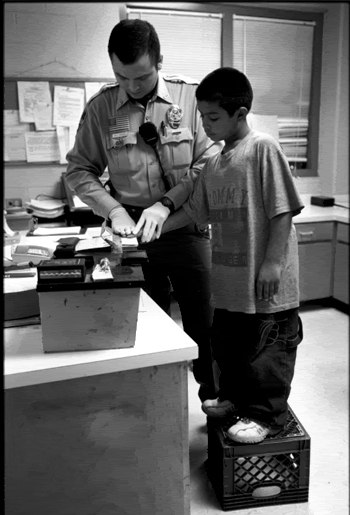


We'll leave the discussion about the changes to the juvenile justice system for another day. Today I'd like to focus on how this has affected our schools. I'm sure you've probably heard some of the anecdotal stories...like the one about the 5 year old girl in Florida who was hauled off in handcuffs by police for having a temper tantrum at school. Then there's the story of 12 year-old Alexa Gonzales in New York, who was arrested for doodling on her desk, and the 13 year old boy in Maryland who was arrested for refusing to say the pledge of allegiance. Stories like this are cropping up in the news pretty regularly these days.


The judge who was interviewed for this story makes the point...we are criminalizing the behaviors of children that were formerly handled by teachers and principals. The effect of this on children and their education has been documented by the ACLU.

Not surprisingly, studies show that being arrested has detrimental psychological effects on children. An arrest nearly doubles the odds that a child will eventually drop out of school. Coupled with a court appearance, an arrest nearly quadruples the odds of dropping out and increases the likelihood of future interaction with police. Arrests and police interactions also disproportionately affect low-income schools with large African-American and Latino populations. In essence, being arrested in school robs children of their access to educational opportunity.


Many have labeled this pattern the school to prison pipeline.
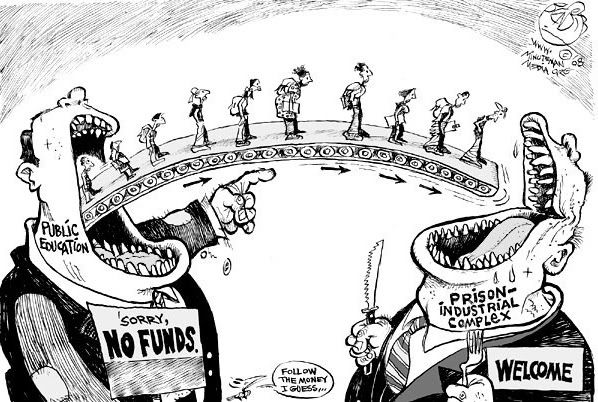


Once again, Henry Giroux describes what is happening.

The shift to a society now governed through crime, market-driven values and the politics of disposability has radically transformed the public school as a site for a civic and critical education. One major effect can be seen in the increasingly popular practice of organizing schools through disciplinary practices that closely resemble the culture of prisons. For instance, many public schools, traditionally viewed as nurturing, youth-friendly spaces dedicated to protecting and educating children, have become one of the most punitive institutions young people now face - on a daily basis.<...>

Students being miseducated, criminalized and arrested through a form of penal pedagogy in lockdown schools that resemble prisons is a cruel reminder of the degree to which mainstream politicians and the American public have turned their backs on young people in general and poor minority youth in particular. As schools are reconfigured around the model of the prison, crime becomes the central metaphor used to define the nature of schooling while criminalizing the behavior of young people becomes the most valued strategy in mediating the relationship between educators and students. The consequences of these policies for young people suggest not only an egregious abdication of responsibility - as well as reason, judgment and restraint - on the part of administrators, teachers and parents, but also a new role for schools as they become more prison-like, eagerly adapting to their role as an adjunct of the punishing state.


The result of this transformation of our schools has been documented by organizations like the NAACP (pdf), the ACLU, the American Bar Association, and the Advancement Project (pdf). In New York City, with the Police Department taking over responsibility for school safety in 1998, the ACLU recently filed suit against the department over the use of excessive force and wrongful arrests in the schools.

While I appreciate the Obama administration's focus on education, it seems to continue the idea that the problems can be solved without addressing this very fundamental issue. As long as we see our children as potential threats to be feared and controlled, we'll continue to lose too many of them to the criminal justice system...at a very high price both in dollars and human suffering.

ACTION

While there are many policy issues that must be addressed to improve this situation, I believe that first of all, it is a problem of imagination.

In my dream, the angel shrugged & said, If we fail this time, it will be a failure of imagination & then she placed the world gently in the palm of my hand.

- Brian Andreas


So just imagine with me for a moment if all of our schools looked like this - its possible!!!!


Or if this kind of unselfconscious enthusiasm was nurtured in all of our classrooms:


(If you haven't checked out the youtube videos of this PS22 Chorus, I strongly suggest you do so for a jolt of inspiration.)

This is what our children would ask of us and what they're willing to give in return.

Sometimes, it will mean recognizing the reality of the world in which too many of our children live and finding ways to engage them - honestly - about their expectations for themselves.


I'd suggest that anyone who's interested in understanding the challenges faced by our urban schools should watch this 4th season of HBO's series "The Wire." The main storyline follows 4 middle-school African American boys in Baltimore both in and out of school. If we can imagine a way to reach them...we'll have all the answers we need about how to end the school to prison pipeline and create an educational system that works for all of our children.

Here's some additional resources in the meantime:

Stop the Schoolhouse to Jailhouse Track
Cradle to Prison Pipeline Campaign: Key Immediate Action Steps
Mapping the Schoolhouse to Jailhouse Track: Action Kit (pdf)
Education on Lockdown (pdf)
Underperforming Schools and the Education of Vulnerable Children and Youth (pdf)

Tuesday, February 16, 2010

Health Care Summit: Conciliatory rhetoric as ruthless strategy

By now most of us know that the invitation (pdf) has gone out for Democrats and Republicans to join President Obama at a health care reform conference on February 25th. While many in the media and the blogs are caught up in seeing this as some type of effort towards bipartisanship, some are seeing the strategy on a bit deeper level.

To set the stage, from the invitation we know that the White House has invited the leadership of both the House and Senate, chairs of the key healthcare reform committees, and asked each party to invite 4 additional members. We also know that the agenda will be focused on four topics: insurance reforms, cost containment, expanding coverage, and the impact heath reform legislation will have on deficit reduction.

But perhaps the biggest surprise of all from the invitation was the statement that prior to February 25th, the White House will post online the text of a proposed health insurance reform package. The Republicans have been asked to do the same.

One of those who recognizes the strategy at work here is Jonathan Chait, who has a great article up about "The Obama Method." In it, he quotes from an article written by Mark Schmitt during the primaries.

One way to deal with that kind of bad-faith opposition is to draw the person in, treat them as if they were operating in good faith, and draw them into a conversation about how they actually would solve the problem. If they have nothing, it shows. And that's not a tactic of bipartisan Washington idealists -- it's a hard-nosed tactic of community organizers, who are acutely aware of power and conflict. It's how you deal with people with intractable demands -- put ‘em on a committee.


Chait picks it up from there.

Last year I wrote a column making a similar point. Obama uses a similar approach toward Republicans as foreign enemies like the Iranian regime: take them up on their claim to some shared goal (nuclear disarmament, health care reform), elide their preferred red herrings, engage them seriously, and then expose their disingenuousness:

This apparent paradox is one reason Obama's political identity has eluded easy definition. On the one hand, you have a disciple of the radical community organizer Saul Alinsky turned ruthless Chicago politician. On the other hand, there is the conciliatory post-partisan idealist. The mistake here is in thinking of these two notions as opposing poles. In reality it's all the same thing. Obama's defining political trait is the belief that conciliatory rhetoric is a ruthless strategy.


Jonathan Cohn understands just why this conciliatory rhetoric is so ruthless.

Republicans want to make this event--and, indeed, this whole debate--a referendum on the Democratic health care reform plan. Obama wants to make this a referendum on what to do about the nation’s health care problems, with each party putting forward its ideas. And it looks to me like Obama will get his way.

If the Republicans don’t post a plan, everybody will see that the GOP isn't serious about health care reform. If the Republicans do post a plan, they'll have to defend it. That might look even worse, given how unpromising their ideas are, although I realize that's a matter of opinion.


And Ezra Klein weighs in with this.

The Republican response to this is that they're demanding that the House and Senate refrain from coming up with any unified plan before the summit, which is sort of an odd argument. In essence, the Republican position is that a free and frank exchange of ideas sounds great as long as the Democrats don't bring their ideas.

The fact that Republicans are making bizarre requests to change the rules of the summit rather than just ignoring the gambit altogether suggests they've not figured out how to deal with the event. This is the first time since the Massachusetts election, in fact, that's it's been them, rather than the Democrats, who've seemed confused.


If you'd like a little humor to accompany that confusion, check out this hilarious clip from Jon Stewart about the summit. And here's a cartoon that pretty well sums it up.

Photobucket

But the White House strategy isn't just impacting the Republicans. As we first learned from an article in The Hill over the weekend, the impasse between the Democrats in the House and the Senate might be in the process of being breached as well in order to prepare for the summit. In discussing the submission of a proposal online prior to the event, this is what the article says.

Asked whether this indicated that Obama wants Democratic congressional leaders to wrap up their discussions about a House-Senate compromise package before the meeting, a White House official wrote: "We’ll have more details on this moving forward. Folks are continuing to work to bridge the differences in the House and [Senate] bills and we’ll have online a detailed and comprehensive proposal."


Ezra Klein backs up the idea that the reform package to be posted online prior to the summit will be the negotiated agreement between the House and the Senate.

That bit about posting a proposed health insurance reform package is important. I spoke to the White House over the weekend and they indicated that the president's package will not be a new White House plan, but a compromise between the House and Senate bills. That is to say, the White House expects that the House and Senate will have a compromise plan by February 25th.


Its likely that this compromised plan will be the one that was close to being finalized prior to the MA election. As we all know, there seems to have been a bit of an impasse about getting this plan moving since then. But here's how Cohn describes what he sees happening now. Referring to the publication of a plan online, he says.

That passage seems to suggest one of the following is true:

1) House and Senate leadership have nearly finished negotiating a new compromise version of their legislation. The text the administration plans to post will reflect that compromise.

2) House and Senate leadership are still struggling to come to an agreement, if not over what to pass then in what sequence to pass it. The administration hopes this promise will force them to wrap things up.<...>

If it's (1), the House and Senate have finally worked out most of their differences. If it's (2), President Obama is starting to give them the shove they need.


What we see here is the opening salvo of what this strategy has already accomplished just in the planning...the Republicans in disarray and the Democrats coming together. I'd say this is marvelous news for health care reform!!!!!

Wednesday, February 3, 2010

Having an impact on electoral politics

For most of us who consider ourselves activists, electoral politics can be a frustrating business. That's because too often we go into the voting both having to decide whether to vote for the lesser of two evils and know that, no matter how informed we are...the wingers, teabaggers, and idjit voters (video) get just as much of a voice in the process as we do.

Of course, on that last one, those of us in Minnesota got a wake-up call this past year when 312 of the over 2.8 million votes cast meant the different between another term for Norm Coleman and freshman Senator Al Franken. Boy, am I glad that I didn't sit that one out!

But today, I'm riding pretty high on the impact my one little vote had last night. Let me give you a little background about what's happening so you'll understand why.

As many of you are aware, MN has no incumbent running for re-election as Governor. As we speak, there are 12 Democrats running and 7 Republicans. This state likes to make politics a bit complicated, so we have dual tracks for weaning down those numbers. First of all, we have caucuses to determine party endorsements. Then, in a few months we'll have primaries that will determine who the candidates will be in November. It is up to each candidate to decide whether or not to abide by the party endorsement process. For example, Mark Dayton will run in the primary regardless and isn't even asking for the Democratic endorsement.

In the caucus process, getting the endorsement in a state-wide election is a 3 or 4 step process. Last night we had precinct caucuses. Over the next couple of months there will be district and/or county gatherings leading up to the state convention where the endorsement of a candidate for Governor will be completed.

BUT, last night those of us who attended this initial step participated in a non-binding straw vote. What will happen over the next few days is that many of those 11 remaining Democrats are likely to drop out of the race due to their poor showing in the straw poll.

And here's the kicker...I was one of less that 30,000 Democrats in this state that participated in this crucial first step in the process of deciding who our candidate for Governor is likely to be. I voted for RT Rybak, someone I have known since he was a journalist for alternative media before he became Mayor of Minneapolis. I see RT as one of those Minnesota politicians who is following in the footsteps of the great Paul Wellstone - progressive with the ability to appeal across-the-board to folks who feel disenfranchised from the system.

Photobucket
Rybak was Co-chair of the Minnesota for Howard Dean presidential campaign (2004)and Chair of the Minnesota for Barack Obama campaign (2008)

My vote for Rybak was one of less than 5,000 that made him the front-runner in this contest last night. Its certainly no guarantee that this will get him the endorsement, much less a win in the primaries and general election. But its sure as hell a good start. And I am so glad to have given about an hour of my time last night to be part of making that happen. I'll also be happy to give up a few more hours of my time in the next couple of months to attend upcoming conventions and see this process through.

Overall, I pretty much stayed out of the discussions about what we as Democrats should learn from the Senate race in MA a few weeks ago. Seems to me that we can project whatever message we want to hear from all of that. But the one thing I did take away from it is that Democrats who sat out of the early primary process were perhaps the biggest contributors to that failure. If Martha Coakley was such a poor candidate, then we need to get involved early to do whatever we can to ensure we have a say in the process. Waiting until we are left with choosing between the "lesser of two evils" is where we give up our power to have an impact.

Sunday, January 31, 2010

Good Crazy

Many people have written extraordinary articles and diaries about Obama's performance last Friday at the House Republican Retreat. But for me, none have captured what I saw better than Melissa Harris-Lacewell in an article she wrote titled "The Obama I Remember" for The Nation.

She begins by summarizing her experience as a neighbor and constituent of his beginning with his term in the Illinois State Senate. And then she says this.

These early encounters with Obama remind me that he is President not solely, or even primarily, because of innate gifts, but because he moves up a learning curve more swiftly and fully than anyone else in public life. My consistent support for President Obama, despite my real differences with him on a number of policy issues, is deeply rooted in my understanding of his openness to and capacity for learning.

I trust that when he does not have the answer he will seek it. I trust that when he fails with one strategy, he will adjust. I trust that when he needs a new skill, he will learn it. I trust that when he needs advice, he will seek it.


This, for me, captures what I most admire in other human beings...an openness and willingness to learn. And I think it is also the quality that most distinguishes Obama from his predecessor George Bush.

But then Harris-Lacewell goes on to talk about Obama's performance at the Republican Retreat and how it reminded her of what students said about him as a Law Professor at the University of Chicago.

That Barack Obama showed up today. The President put on a clinic in public discourse, political argument, intellectual dexterity and moral courage. It was a reminder of what democracy could be if we engaged our opponents with substance, patience and civility rather than invectives, gamesmanship and boorishness.<...>

President Obama is modeling a different kind of democratic engagement. It is a model he adhered to during the election and he continues to follow it now. President Obama refuses to believe that we can have a functioning democracy if the majority refuses to speak to the minority. He takes seriously his responsibility to govern in the interest of both his supporters and his opponents. He remains committed to the possibility that he and his Party may not always be in sole possession of good ideas.


I think there are many progressives that missed this focus in what Obama said last Friday. In our enthusiasm for his intellect and the forcefulness with which he spoke, we have perhaps overlooked things like this.

And I'm not a pundit. I'm just a President, so take it for what it's worth. But I don't believe that the American people want us to focus on our job security. They want us to focus on their job security. (Applause.) I don't think they want more gridlock. I don't think they want more partisanship. I don't think they want more obstruction. They didn't send us to Washington to fight each other in some sort of political steel-cage match to see who comes out alive. That's not what they want. They sent us to Washington to work together, to get things done, and to solve the problems that they're grappling with every single day.


So no, Obama is not done reaching out to Republicans. He still believes that - even when we don't agree - the way in which we talk to one another and engage in the battle of ideas can change.

Does that sound crazy to you? Given the pattern we see with GOP leaders, it does to me. But it reminds me of something another one of my favorite writers, Ta Nehisi-Coates, wrote back in November 2008 just days after the election. He talked about his fascination with the words of Rev. Joseph Lowery about "good crazy."


"I came over here where crazy things are happening," Lowery told his audience, and then, referring to Obama and the echoes of his own history, added: "There are people in this country who say certain things can't happen, but who can tell? Who can tell? . . . Something crazy may happen in this country."<...>

Here is where Barack Obama and the civil rights leaders of old are joined -- in a shocking, almost certifiable faith in humanity, something that subsequent generations lost. The Rev. Martin Luther King Jr. may have led African Americans out of segregation, and he may have cured incalculable numbers of white racists, but more than all that, he believed that the lion's share of the population of this country would not support the rights of thugs to pummel people who just wanted to cross a bridge. King believed in white people, and when I was a younger, more callow man, that belief made me suck my teeth. I saw it as weakness and cowardice, a lack of faith in his own. But it was the opposite. King's belief in white people was the ultimate show of strength: He was willing to give his life on a bet that they were no different from the people who lived next door.


I agree with Nehisi-Coates. Obama is engaging in a "shocking, almost certifiable faith in humanity" and I regularly question whether that faith is justified. He really believes that its possible, as Harris-Lacewell said, to "engage our opponents with substance, patience and civility." Last Friday, he showed us how to do that - all while remaining forceful in his convictions and not compromising his own beliefs.

This is the "trust deficit" Obama talked about both in his State of the Union speech and with the Republicans. What is shocking about Obama's position on this is that he is willing to step out - in trust - and lead the way. It drives many of us crazy because we know that the other side's reaction will be to abuse that trust...just as the early civil rights leaders were abused by white racists.

But what Obama is counting on is that the American people are watching. And much like MLK believed that white people "wouldn't support the right of thugs to pummel people who just wanted to cross a bridge," Obama is relying on his belief that the American people eventually won't support the abuse of our national trust and dialogue.

I agree that its a big gamble. But I begin to wonder...if Martin Luther King could believe in white people back in the 1950's, who am I to question what other "good crazy" might be possible.

Friday, January 1, 2010

On the potential danger of progressive ideologues

As we debate strategies and tactics for many of the common goals we share, I've been thinking about passion, rage, and other emotions that inevitably become part of the process when we all care this deeply about something. I am one that believes that emotions are a necessary part of the mix. Those that seek to avoid them make me suspicious. That's because they are part of our make-up as human beings and tend to fester in ugly ways if we don't acknowledge them.

But emotions can also cloud our thinking if we let them lead us or if we try to deny them completely. I believe that this is part of the blindness referred to when Merriam Webster defines ideologue this way.

an often blindly partisan advocate or adherent of a particular ideology


We progressives are pretty good at spotting the ideologues on the conservative end of the spectrum. I'll grant that, with our embrace of science and reality, we tend to be less susceptible. But that doesn't mean it never happens, as a community in Minnesota learned the hard way about 25 years ago.

In 1984, the town of Jordon, MN - about 35 miles outside of Minneapolis and home to 2,900 people - experienced something that comes close to the Salem witch hunts of the past. It all started when a woman reported to the police that a neighbor had sexually molested her 9 year old daughter. The man had a criminal history of sexual assault and was given a reduced sentence for pleading guilty and agreeing to testify about other incidents. By the time it was all over, 24 others had been arrested, including a local policeman, a deputy sheriff, and bizarrely enough, the woman who had made the first complaint. In the end, charges of ritual sexual abuse and the alleged murder of several children were part of the story.

Just imagine how something like this affected a small midwestern rural town. Here's how it was written about at the time.

Jordan, Minnesota is a town with three streets, four churches, a championship high school football team—and an atmosphere heavy with fear. It is a town where people shun old friends, where mothers forbid their children to enter the homes of neighbors, where parents have stopped taking their kids to baby-sitters, because they don't know whom to trust. Jordan is a town that buzzes with a cacophony of charges and countercharges, talk of sex rings and witch-hunts, and rumors of acts so dark, so vile, that they are merely hinted at. It is a place where the fear is so pervasive and so deep that some parents admit sadly that they are afraid to show affection for their own children lest they themselves come under suspicion of unspeakable acts.


The prosecutor in the county at the time was a woman by the name of Kathleen Morris. She was charged with investigating the original complaint and it was her office that interviewed witnesses, defendants, and the children identified as victims. After the original perpetrator pled guilty, she managed to try one couple who were exonerated in a jury trial. Here is her reaction.

That verdict infuriated Morris and she responded with tears and an unprofessional outburst. "This means we live in a society that does not believe children," she said, violating the unwritten rule against criticizing juries. Raging at what she saw as the injustice of the acquittal, Morris even attacked a cardinal tenet of the judicial system, telling the local media, "I'm sick to death of things like the presumption of innocence."


Subsequently, Morris dropped all of the remaining charges and MN Attorney General Skip Humphrey took over the investigation and produced a report.

At the conclusion of their investigation, the FBI/BCA agents submitted their investigative findings to Attorney General Humphrey. Those findings are as follows:

There is no credible evidence to support allegations of murder, which arose during the sexual abuse investigation.

There is insufficient evidence to justify the filing of any new sex abuse charges.


The report goes on to detail how, in her zeal against child sexual abuse, Morris had done things like offered exoneration to defendants to testify against others, removed children from their homes and repeatedly questioned them for months until they admitted to abuse, and told children what other victims had already reported and/or interviewed groups of children together.

In the end, this is what the report found:

In the Scott County cases, however, something clearly went awry. This is not to suggest that the objectives of Scott County authorities were improper. There is no evidence that the Scott County authorities were motivated by anything other than concern for the protection of children. That concern is shared by the Attorney General and by everyone involved in the investigation. That legitimate concern, however, must be balanced against the rights of accused individuals. That balance can be best maintained when such cases are investigated and handled in a manner which results in the development of credible evidence. The best way to protect children is to conduct investigations in a responsible manner, in a way that will lead to discovery of what really happened and lead to convictions, if justified by the evidence. It is in this regard that the Scott County cases foundered.


I was living in the Twin Cities at the time this happened and was a family therapist working with many children who had been sexually and/or physically abused. As the story unfolded, it became clear to me that Kathleen Morris had noble motives but let the horror she felt about child sexual abuse cloud her judgement and her practices. The people of Jordon were left with the consequences of suspicion and distrust of their neighbors - never knowing who was guilty and who was innocent. Many people had their lives and families torn apart needlessly and many children were abused by a system that was supposed to be designed to protect them. And you better believe that it made me angry.

I recognize this is an extreme case. But in its extremity, it demonstrates the damage that even good-intentioned ideologues can do. The minute we consider ourselves the "savior" in any cause we're fighting for, let our emotions lead us without weighing the consequences, and start demonizing anyone who gets in our way...we're at risk of doing the same kind of damage to ourselves, our community and the very ideals we're fighting for.

Thursday, December 31, 2009

I HATE New Year's Resolutions

Yeah, I said it. And I'll say it again...I hate New Years resolutions!!!

Most of all, I hate what they've become in our culture...a way to mostly look at the superficial qualities of our lives and think that somehow we'll be happier if we change them. Oh, and there are usually tons of products we can buy that will "help" us achieve them, so its now time to pony up.

But there is something even more insidious about how we approach resolutions. For some people (not all), this becomes a time to unleash all of the "shoulds" that have been rolling around in our heads. Most often, these are the shoulds that others in our lives or culture have laid on us as baggage. To resolve to meet those shoulds is usually not only doomed to fail, but negates our own true desires for ourselves.

I'll admit that I come to this issue with a bit of baggage from my past. I haven't hesitated to disclose that for the first 20+ years of my life I was steeped in right wing christian fundamentalism and that it took me over 10 years to shed all of that.

What I remember more than anything growing up is hearing "the rules" about how I was supposed to live my life. And that if I just had enough discipline or willpower, I'd be the "good girl" that God and all of the other adults in my life told me I should be. I tried. As a matter of fact, I tried with every fiber of my being. But ultimately, I always failed in some way. And of course, that failure was a result of my short comings - so then there's the guilt and shame to add to the failure.

But then one day, with the help of some very wise people, I began to realize that I was looking in the wrong direction. In other words, I was looking "out" at what the rules were instead of "in" at who I already was. While absorbing that was eventually a life-changing experience, it didn't come without a price. Here's how poet David Whyte describes it.

Revelation Must Be Terrible

Revelation must be terrible
with no time left to say goodbye.

Imagine the moment staring at
the still waters with only the brief tremor of your body
to say you are leaving everything
and everyone you know behind.

Being far from home is hard,
but you know, at least, we
are exiled together.

When you open your eyes to the world
you are on you own for the first time.

No one is even interested in saving you now


Yep...I was free of the rules, but I was on my own. No daddy, or preacher, or god to tell me what to do. That was a frightening moment. But as I (figuratively) stood there for awhile and began to look inward, I saw something with the potential of authenticity and wholeness that could never be attained in my failed attempts to follow the rules. Discovering who I was and what I wanted (warts and all) eventually became my journey. The downside is not having a fall-back when I fail...no one to blame. But the upside is never having to be a victim of anyone else's pressures/expectations. And if I do it right - bending to accommodate others is a choice I make out of love, respect, or perhaps even self-interest. But its my choice.

So I'll not be making any new year's resolutions this year - except to continue to look inward and do a little bit better job of embracing the person that I already am. That's perhaps why this is one of my all-time favorite songs.


And if fits so nicely with the ending to Whyte's poem from above.

and the world steps in to test the calm fluidity
of your body from moment to moment,
as if it believed you could join
its vibrant dance of fire and calmness
and final stillness...

as if you were meant to be exactly where you are,
as if like the dark branch of a desert river
you could flow on without a speck of guilt
and everything - everywhere would still be
just as it should be,
as if your place in the world mattered
and the world could neither speak nor hear the fullness
of its own bitter and beautiful cry without the deep well
of your body resonating in the echo...

knowing that it takes only that one terrible
word to make the circle complete,
revelation must be terrible
knowing you can never hide your voice again.

Monday, December 21, 2009

The narrative of disappearance

Years ago I was introduced to a poet by the name of David Whyte. Since then, I have only half-jokingly referred to him as my "spiritual guru."

About once or twice a year, I get a newsletter from Whyte and it always includes an essay from him reflecting deeply about how he sees the world at the moment. Last week the newsletter arrived and I think in it, Whyte speaks to our current situation in a way that goes much deeper than our politics, and yet recognizes the political challenges we're facing.

I would encourage you, if you're interested in this kind of thing, to go read the whole thing at the link in the above paragraph. But here's a portion of it that I think gets to the essence of what he has to say.

Human beings stand at the center of these sometimes swift, sometimes slow, always moving patterns of presence and absence, but rarely intuit their own essence might be revealed and magnified by what is veiled and hidden, or by what has been taken away. Yet this form of subtraction may be the very hallmark of our time. At the present time we are asked to live in companionship with patterns and dynamics that are either disappearing, have not fully emerged or can never be fully named; patterns perhaps already changing into forms for which we have yet no language.

It is tempting, in this limbo time between the traumas of a world once said to be in ceaseless war with terrorism and a not yet fully formed future ideal, to feel righteously lost. Everything seems to be paused and hanging in a mist-wrought, barely moving dance. The world's economic systems, the world's ecological systems, the relations between haves and have-nots, the sovereignty of nation states upon which many millions of individuals have based their identities, all these are taking forms which we cannot quite recognize, and in that movement through form seem to be on the verge of disappearing.<...>

Little wonder then that if we prefer the appearance of stability or clear unobstructed vision we will manufacture fake narratives to replace the complexity, changeability and raw beauty of real ones, especially if the stories we always wanted to be true seem to shimmer and disappear. <...>

It may be that we live in a time of collective heartbreak, where for the first time in history we are being asked to witness the disappearance and reappearance on a global scale of what it means to be fully human; to give away our identity and see how it is returned to us through a sincere participation in the trials and necessities of the coming years. Part of that heartbreak is the sense that we might not be equal to the ecological, political and economic transitions that are necessary, that our own selfishness may be writ too deeply into our genes and that the future is therefore untenable and unreachable. We do not as yet know if this is true, but the old humanistic story around ourselves as a successful species, always on the up and up and appointed to some special destiny, is fading and silvering into the night air, and we are left, at this point in history, contemplating the unknown immensity of the night behind it.


I believe that Whyte has captured here the basis for so much of the angst we feel both in the world at large and in this tiny little space of interaction we call the blogosphere. If indeed, we are being asked as humans to give up what we have known as our identity without really being able to see the alternative, it is no wonder that, as Whyte says, so many of us feel the need to rush things and create a fake narrative to ease the strain. The problem he doesn't address is the fierceness with which we need to cling to those narratives because some part of us knows they're not real...at least not yet. And so we fight over whose narrative bears the closest resemblance to reality.

I have no grand answers to the question of what we do with that anxiety. But thinking about it once again reminds me of something Nezua wrote a while ago at The Unapologetic Mexican.

We are always new. Every moment is new. No moment need be like anything that came before, even when the resemblance is striking and our imagination lacking. And yet, of course we must learn from who we once were. But to let a lesson that once helped inform every step forward is to walk an old path, and to preclude the sight of new horizons from our view.<...>

Because life is not like a series of books in a course on ...anything. It fluctuates. We fluctuate. We are not a being, but a becoming, as Friedrich once said. And sometimes ideas are hammered out and we draw lines and walls and are told we fall on one side or the other and so do our thoughts and so does all that follows from them...and so it goes. We buy into these illusory borders, too.<...>

I am far more comfortable navigating the in-between than I am in any Place. I like no thing as much as the coming and going from one to another. It is on the purpling beaches of dusk and the roseing gauze of dawn that my true eye shines lidless and I see so much more than in broad daylight. In the falling away of my tired husk I remember my shape can only be held temporarily. And to cling too tightly to it is to rot.

Being sure is but the borderwall we place around a heart to ward off the skinstripping wind of the next living moment.


While discussing this quote in a comment thread at Daily Kos last week, jonimbluefaninWV shared a phrase that captures this position very well - he called it a "state of critical ambivalence." While Nezua finds that his "true eye shines" in that state, I think that for most of us, it is one that is extremely uncomfortable. And yet its where we find ourselves nonetheless. I expect that it is those who can navigate the "skinstripping wind of the next living moment" who will not only survive, but show us the way.

Immigrants and domestic migrants could be major factors in the Texas Senate race.

A few weeks ago I wrote about how MAGA influencers are trying to convince their base that - despite Trump's growing disapproval rates -...