Saturday, January 5, 2013

The Obama Method

These days lots of political pundits are either trying to game out how President Obama will avoid negotiating with Republicans over the debt ceiling (which he has promised to do) or they are busy giving him advice about how to avoid it. The truth is - this is going to be a tough call. The President of the United States has the obligation to maintain the full faith and credit of this country. He also has the responsibility to do everything he can to avoid another great recession.

And yet the Republicans are threatening to challenge all of that if they don't get their way on basically gutting things like Medicare, Medicaid and Social Security. The hostage in this scenario is the American (and world) economy. The ransom being demanded by the hostage-takers is basically the entire New Deal. Those are the stakes. And its critically important for the American people to understand what the Republicans are doing.

One of the most interesting things I've read about all this comes from Greg Sargent. Much like I did last time Republicans pulled this stunt, he talked to an actual police hostage negotiator to get advice.
A hostage negotiator needs to persuade a hostage taker that he is totally isolated and that the negotiator is the only one who holds the key to his way out — that “deep down, he is not in control of the situation.”
As I was reading that - I thought of the similarities of dealing with a situation like this and what the President has been faced with in dealing with Iran over their attempts to get nuclear weapons. That is a comparison that Jonathan Chait made a few years ago when he described the "Obama Method." I know Chait has gone a bit "hair on fire" lately about President Obama. But back then I think he nailed it.
Obama's method begins with attempts to find common ground, expressions of respect for the adversary's core beliefs, and profuse hope for cooperation...

This rhetoric removes the locus of debate from the realm of tribal conflict-- red state versus blue state, Islam versus America--and puts it onto specific questions--Is the American health care system fair? Is terrorism justified?-- where Obama believes he can win support from soft adherents of the opposing camp... 
This is a perfect summation of Obama's strategy. It does not presuppose that his adversaries are people of goodwill who can be reasoned with. Rather, it assumes that, by demonstrating his own goodwill and interest in accord, Obama can win over a portion of his adversaries' constituents as well as third parties.
So if that is Obama's method, we might look to how he described his approach to dealing with Iran (and Israel) in order to predict how he is likely to handle this hostage situation with the Republicans. Here are some excerpts from the President's interview with Jeffrey Goldberg about that.
We, immediately upon taking over, mapped out a strategy that said we are going to mobilize the international community around this issue and isolate Iran to send a clear message to them that there is a path they can follow that allows them to rejoin the community of nations, but if they refused to follow that path, that there would be an escalating series of consequences...

I think that the Israeli government recognizes that, as president of the United States, I don't bluff. I also don't, as a matter of sound policy, go around advertising exactly what our intentions are. But I think both the Iranian and the Israeli governments recognize that when the United States says it is unacceptable for Iran to have a nuclear weapon, we mean what we say... 
...our argument is going to be that it is important for us to see if we can solve this thing permanently, as opposed to temporarily. And the only way, historically, that a country has ultimately decided not to get nuclear weapons without constant military intervention has been when they themselves take [nuclear weapons] off the table...

I think it's entirely legitimate to say that this [Iran] is a regime that does not share our worldview or our values. I do think...that as we look at how they operate and the decisions they've made over the past three decades, that they care about the regime's survival. They're sensitive to the opinions of the people and they are troubled by the isolation that they're experiencing...They are able to make decisions based on trying to avoid bad outcomes from their perspective. So if they're presented with options that lead to either a lot of pain from their perspective, or potentially a better path, then there's no guarantee that they can't make a better decision...

My point here is not that I believe the sincerity of the statements coming out of the [Iranian] regime. The point is that for them to prove to the international community that their intentions are peaceful and that they are, in fact, not pursuing weapons, is not inconsistent with what they've said. So it doesn't require them to knuckle under to us. What it does require is for them to actually show to the world that there is consistency between their actions and their statements. And that's something they should be able to do without losing face.
If you read through all of that and substitute "Republicans" for "Iranians" and the "debt ceiling" for "nuclear weapons," I would suggest that you have a pretty good read on how President Obama will approach this. And I suspect that he'll be laying the groundwork for all of that in this inaugural address and State of the Union Speech. It should come as no surprise that the whole process matches up perfectly with what professional hostage negotiators do.

Friday, January 4, 2013

What Republicans want us to forget

Yesterday Senator McConnell published an op-ed that attempts to take direct aim at the President's consistent call for balance when dealing with the federal deficit. McConnell writes:
Predictably, the President is already claiming that his tax hike on the “rich” isn’t enough. I have news for him: the moment that he and virtually every elected Democrat in Washington signed off on the terms of the current arrangement, it was the last word on taxes. That debate is over. Now the conversation turns to cutting spending on the government programs that are the real source of the nation’s fiscal imbalance.
But there's something in this whole frame that McConnell and other Republicans want you to forget. They're acting as if the latest fiscal cliff negotiations were the first time they've fought this issue out with the President. That's obviously not the case. It really wasn't that long ago that Republicans took us to the brink of disaster with the last debt ceiling fiasco. The deal reached at that time included some things McConnell and Republicans want you to forget about.
  • More than $900 Billion in Savings over 10 Years By Capping Discretionary Spending...
  • Includes Savings of $350 Billion from the Base Defense Budget – the First Defense Cut Since the 1990s
The reason President Obama said he got these tax increases on the wealthy for free is because he'd already agreed to a huge down-payment on spending cuts as part of the last deal.

That's the kind of balance President Obama is insisting on going forward. The Republicans would like us to forget this very recent history. Let's not let them get away with that.

Thursday, January 3, 2013

What if Obama had taken some liberal's advice?

Those on the left who are complaining the loudest about the deal reached on the so-called "fiscal cliff" had some advice for the President...go off the cliff. With complete disregard for those who would have lost their lifeline - unemployment benefits - these folks thought that somehow the lunatics in the Republican Party (who they constantly suggest the President shouldn't negotiate with because they're so intransigent) would come around in the new Congress and pass a bill that would give President Obama a clear "win."

Apparently the White House didn't agree with them.
The president did not believe the dynamic would suddenly shift in his favor after Jan. 1, rejecting the conventional wisdom in Washington that all sides would have more flexibility after higher tax rates took effect. Republicans were no more likely to compromise after the deadline than before it, the White House concluded. And there was a very real fear that a resolution wouldn’t come for weeks, perhaps not before the country hit the debt limit in late February — a nightmare scenario that the president believed would destroy not only his leverage but also the still-fragile economy.

The chaos on New Year’s Day in the House validated the president’s strategy to find a solution now, White House aides said.
Nuff said.

But Michael Tomasky makes another good point.
If Obama had done what these liberals wanted and sent any signals as the New Year approached that he was ready to go over the cliff, the House Republicans would have publicized that, and then, if we had gone over the cliff, Obama would have shared the blame. It was Obama’s strict, good-faith adherence to the deadline that helped shift all the blame to the Republicans, and that is what made them play ball.
In saying that, perhaps Mr. Tomasky is beginning to grasp the idea of conciliatory rhetoric as ruthless strategy.

Wednesday, January 2, 2013

One more time on leverage

I see that some of the "hair-on-fire" liberals are coming around to say that the deal on the so-called "fiscal cliff" might not be so bad in and of itself, but it gave up all of President Obama's leverage going into the negotiations over the sequester cuts and the chaos the Republicans plan to instigate over the debt ceiling.

But I'd like us to get clear about what constitutes leverage in negotiations. To do that, I'll once again quote professional negotiator and blogger Joe Markowitz.
This is basic Negotiation 101. If you MUST make a deal, you are going to have to compromise, because the other side knows you must make a deal. And therefore you probably won't get your best deal, but you will get something accomplished. On the other hand, if you can afford to walk away from a deal, you can also afford to be uncompromising, because you win either way. Either you make the deal you want, or you blame the other side for the failure to conclude the negotiation.
What he's saying is that it is the one who can walk away from the table without a deal that has the leverage.

So lets take a look at these upcoming situations from that angle. What happens if there is no deal on an alternative to the sequestered cuts? First of all, unlike the fiscal cliff, regular voters won't be impacted immediately in any real way. So there won't be as much pressure from the public to get a deal.

Secondly, the way these cuts were set up will have a much more serious impact on Republican constituencies (half of the cuts are from defense) than Democratic constituencies (Social Security, Medicaid, programs for low income people were exempted from cuts and Medicare is limited to a 2% cut to providers).

Overall, neither side is going to want to walk away from a deal. But the Republicans will be less inclined to do so.

If the Republicans really do decide to take the debt ceiling hostage once again, that's not a negotiation. Its a game of chicken. Neither side can let the hostage die. Its simply a matter of who blinks first. President Obama has said over and over again that he's not going to play that game. So it appears as though we'll have to wait and see how long the Republicans can to hold out before they blink.

The other thing that will come into play is Joe's last line about who can afford to walk away without getting blamed. President Obama has spent 4 years building up his own capital as someone who is reasonable in being willing to compromise. The Republicans were running out of that kind of capital prior to this whole fiscal cliff fiasco. But I'd say that except for in the reddest part of Redistan, they're running in the below zero range these days. They have absolutely NO leverage when it comes to being able to withstand another stunt like we saw over the last couple of days.

So cool your jets on the "he gave away all his leverage" folks. Or, as we Obamabots like to put it...
Photobucket

On to the next round

Now that President Obama has bagged what he said he'd get for free, its on to the next round of confrontations over the federal budget. While Republicans are salivating over using the negotiations over the sequester cuts in 2 months and next debt ceiling as their opportunity to gut entitlements, the President has had a thing or two to say about that.

From his remarks before the Senate vote.
And I want to make clear that any agreement we have to deal with these automatic spending cuts that are being threatened for next month, those also have to be balanced -- because remember, my principle has always been let’s do things in a balanced, responsible way. And that means that revenues have to be part of the equation in turning off the sequester, in eliminating these automatic spending cuts.
From his statement released after the Senate vote.
There’s more work to do to reduce our deficits, and I’m willing to do it. But tonight’s agreement ensures that, going forward, we will continue to reduce the deficit through a combination of new spending cuts and new revenues from the wealthiest Americans.
From the White House fact sheet on the bill.
As we move forward to address our ongoing fiscal challenges, both spending cuts and continuing to ask the wealthy to do a little more will be part of a balanced approach.
And finally, in his remarks last night after the House passed the bill.
But we can't simply cut our way to prosperity. Cutting spending has to go hand-in-hand with further reforms to our tax code so that the wealthiest corporations and individuals can't take advantage of loopholes and deductions that aren't available to most Americans. And we can't keep cutting things like basic research and new technology and still expect to succeed in a 21st century economy. So we're going to have to continue to move forward in deficit reduction, but we have to do it in a balanced way, making sure that we are growing even as we get a handle on our spending.
Get the point?

Oh, and one more thing from his remarks last night.
Now, one last point I want to make -- while I will negotiate over many things, I will not have another debate with this Congress over whether or not they should pay the bills that they’ve already racked up through the laws that they passed. Let me repeat: We can't not pay bills that we've already incurred. 
When it comes to the debt ceiling, nope...not going there.

Are you listening Mr. Boehner and Mr. McConnell? You don't want to mess with the counter-puncher.

Tuesday, January 1, 2013

Partners

In light of the events of the last few days, I thought it would be a good time to repost this one.

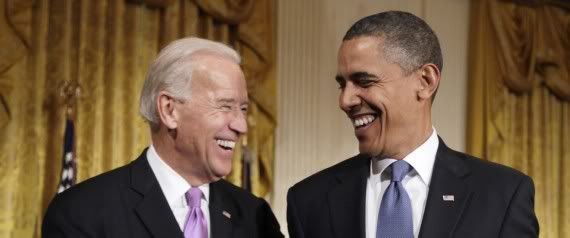
Do ya think these two sorta like each other?


Photobucket


Photobucket


The tangle and the weave

Last spring I read a wonderful book by Jonathan Odell titled The Healing - a story that takes place on a slave plantation in the South. One of my favorite moments came when midwife Polly Shine is teaching her young apprentice Granada about the art of healing and says that her own mother's people in Africa were the finest weavers in the world.
"She told me the secret...what made them so fine, mother after daughter after grandaughter, all the way down the line."

"What was it Polly?"

"She say, the difference in weavers is, some see the tangle and others see the weave. The ones that can't take their eyes off the tangle, they never rise above it."
On this first day of the new year, I am once again reminded of the wisdom in that analogy. Polly was conveying a message that went far beyond weaving and even the art of physical healing. She was talking about soul-healing - which is a necessary ingredient to liberation. If we ever want to rise above our current situation, we have to be able take our eyes off of the current struggle of the tangle and be able to see the weave.

Perhaps it shouldn't come as a surprise that a woman who had lived her life in slavery is the one who could pass on that kind of wisdom. In one of the more ironic twists of the human condition, it does seem that the deeper the struggle, the more people tend to focus on the weave. Here's how Clay Claiborne addresses that.
For someone sitting on the very edge of survival, hope is extremely important. Often it is only hope, sometimes even false hope, that allows him to make it to the next day... Cynicism is deadly for someone on the edge of survival. Even in the darkest night, he cannot afford to be cynical. That cynicism just might push him over the edge.

Cynicism is a privilege. When practiced by those in a position to do it well, cynicism allows them to criticize the oppressor and sympathize with the oppressed without ever having to move out of their comfort zone. 
What got me thinking about all that are the much more mundane events we are witnessing today as Congress works on a deal to forestall the so-called "fiscal cliff." What we're seeing once again is that some progressives are addicted to their focus on the tangle of where the ceiling was set for an increase in taxes - while they miss the weave of recognizing that this is the first time in 20 years that Republicans in the Senate have voted overwhelmingly for a tax increase. To those living on the edge of survival, that kind of privileged cynicism is unthinkable. If this deal passes the House, they just avoided a potential tax increase, have seen their unemployment insurance extended, and will still have access to things like child tax credits and/or college tuition tax credits.

After four years of witnessing this kind of poutrage coming from a contingent on the left, Polly Shine's words throw some light on the problem...due to their focus on the tangle, they'll never rise above it.

I myself have trouble quelling the hope that some day these folks will finally be able to see the weave. Every time President Obama and the Democrats move the ball a few inches farther down the field (to switch metaphors...sorry), I hope that finally they will wake up to the fact that we are all slowly rising out of the bondage of the Reagan revolution. But they literally can't see it...because they are so focused on the tangle.

So bear with me as I struggle with that hope. One thing you can count on...I'll keep my eye on the weave.  

Immigrants and domestic migrants could be major factors in the Texas Senate race.

A few weeks ago I wrote about how MAGA influencers are trying to convince their base that - despite Trump's growing disapproval rates -...