Excuse me for a moment while I draw on my past as a therapist to share something that I think is critical if we're ever going to understand what it means to "be the change we want to see in the world."
The thing I see that keeps us from getting there was described years ago by Stephen Karpman as
the Drama Triangle. Its a way of seeing the world that leaves us emotionally immature because it takes the "I" out of the equation. In other words, it strips us of all of our power. When we engage each other from this perspective, we do so from one of three positions.
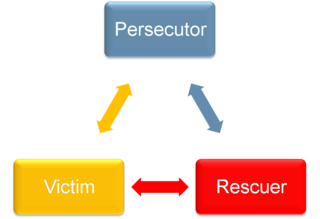
Most often liberals enter the drama triangle from the position of "rescuer." We see some injustice in the world and want to make it right. The problem is...the role of rescuer requires that we define someone as the victim and someone as the persecutor. And that's where we get locked in. We not only deny our own self-interest (that's where we take the "I" out of the equation), we strip the victim of their power and blame/demonize the persecutor.
Once we've bought into this frame, from which the "I" is excluded, we're locked in and travel around the triangle playing the other two roles as well. If you've seen situations where you or others are at the mercy of circumstances or another person, you're identifying with the victim role. And when we attack anyone who doesn't agree with us, we're playing the persecutor.
All of the positions on the drama triangle are there to deny one thing...responsibility for oneself. It's all a massive game to find a place for blame. Of course, no one on the triangle is ever willing to accept the blame and so the conversation merely escalates...hence the drama.
Too many of our political conversations are caught up in this kind of drama. As
I just noted in my last post, Markos provides a perfect example. He wants to capture the role of victim because President Obama is not fighting for him. He defines Obama as the persecutor by making him the cause of the despair among Netroots Nations attendees. Finally, he alludes to his own persecutor role by suggesting he won't fight for Obama. Nowhere in any of that does Markos talk about using his own power to fight his own battles on the issues he cares about.
We do this as well when we imply our own powerlessness against the money in politics or the media's role in defining the issues/candidates. Of course there's some truth in those claims. But the minute we see ourselves as powerless against them, we've entered the drama triangle.
Once the drama is engaged, there is no potential for solutions. That's because at every turn we've given up the one tool we have to affect change...ourselves. Our focus has turned completely to the "other" on the triangle. And so we feel powerless. Because we are.
The only way to avoid that is to completely step off the frame of the triangle and put the "I" back into the equation. We are not the victims of anyone else. And we don't need to rescue or demonize anybody. We need to act on behalf of our own self-interests by doing what we can to change things. As Gandhi once said, most of the time those actions will seem insignificant, but its important that we do them. The truth is that blaming someone else accomplishes even less.
So if we want to see change, and if we actually see ourselves as "the change we've been waiting for," our motto should be NO MORE DRAMA.