Showing posts sorted by relevance for query children poverty. Sort by date Show all posts

Tuesday, August 21, 2012

"Deep poverty" and the failure of welfare reform

It's clear now that the Romney/Ryan campaign is going to be relentless in continuing to spread their lies about the waivers the Obama administration made available to state's implementation of welfare.

Part of that lie involves pretending that the welfare reform of the 1990's was unequivocally successful. I suppose that if you are a Republican and would rather get rid of welfare all together - there might be some truth to that. But as the article about poverty by Paul Tough that I wrote about the other day explains, welfare reform has been anything BUT successful for many children living in poverty.

Tough points out the distinction that is often made between "shallow" poverty and "deep" poverty.
The Census Bureau tracks a category that the government calls “deep poverty”; families are said to be in deep poverty if they earn less than 50 percent of the poverty line — which means around $11,000 a year for a family of four, not including food stamps or other noncash support. The number of families in deep poverty grew sharply during the recent recession and its aftermath, and in 2010, the share of Americans whose families made less than half of the poverty line hit a record: 6.7 percent of the population, or 1 in 15 Americans. The numbers are even higher for children, disturbingly so. In 2010, 1 in every 10 American children lived in deep poverty.
He then goes on to explain that the reason for the increase in deep poverty has less to do with the current recession than it does with legislative changes made over the last two decades.
In 1984, federal aid to poor families was progressive, in the literal sense of the term — the poorest families got the most help. Single-parent families below 50 percent of the poverty line received, on average, $1,231 (in current dollars) per month from the federal government. Those in what could be considered shallow poverty, between 50 and 100 percent of the poverty line, received $448. But over the following 20 years, that situation was reversed. Government aid to families in deep poverty fell by 38 percent on average, while aid to families in shallow poverty increased by 86 percent. By 2004, the government was actually giving more, each month, to families in shallow poverty than to families in deep poverty.
And of course, one of the biggest contributors to this shift was welfare reform. In a sense, it shifted resources to those who are able to find work. For those who can't...you're on your own.

Tough gets to the heart of the problem with this when he addresses what that means for the children involved - and how deep poverty gets passed on from one generation to the next.
There are now seven million American children whose families earn below 50 percent of the poverty line. And in the last decade, we learned quite a lot about what it does to children to grow up surrounded by the kind of everyday chaos that often accompanies life in a family that is earning less than $11,000 a year. Neuroscientists and developmental psychologists can now explain how early stress and trauma disrupt the healthy growth of the prefrontal cortex; how the absence of strong and supportive relationships with stable adults inhibits a child’s development of a crucial set of cognitive skills called executive functions.

In fact, though, you don’t need a neuroscientist to explain the effects of a childhood spent in deep poverty. Your average kindergarten teacher in a high-poverty neighborhood can tell you: children who grow up in especially difficult circumstances are much more likely to have trouble controlling their impulses in school, getting along with classmates and following instructions. Intensive early interventions can make a big difference, but without that extra help, students from the poorest homes usually fall behind in school early on, and they rarely catch up. When you cluster lots of children with impulse-control issues together in a single classroom, it becomes harder for teachers to teach and for students to learn. And when these same children reach adolescence...they are more likely to become a danger to themselves, to each other and to their community.
That, my friends, is one of the best descriptions of what is going on in pockets of urban American that you'll read anywhere. Now throw in zero tolerance policies in our schools that lead to the school-to-prison pipeline and you have a perfect storm for ensuring that large swaths of our children fail and that deep poverty gets passed on from one generation to the next.

As Tough points out, there are no easy answers when it comes to solving this problem. But the one thing we DO know is that the lying demagogic race-baiting of the Romney/Ryan campaign is the exact opposite direction we need to go.

Saturday, February 16, 2013

What happens when a politician actually believes that "Children are our future"

I would suggest that the second most common thing for a politician in any party to say on the campaign trail is "Children are our future." Its likely that the only thing more ubiquitous would be "God bless the United States of America."

But we all know that since children can't vote, that kind of verbal commitment to children usually disappears once they get into office. Politicians like to pretend that they care about children, but its usually a lie.

That lie is exposed in a report from the Urban Institute (pdf) that was highlighted yesterday by Ezra Klein.

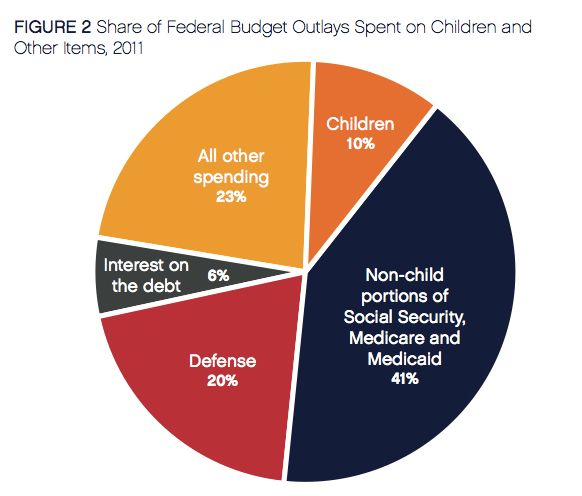
Looking solely at the federal budget, an elderly person receives close to seven federal dollars for every dollar received by a child.
Via FDR's New Deal and LBJ's Great Society, this country took great strides in lifting our elderly out of poverty.
Between 1960 and 1995, the official poverty rate of those aged 65 and above fell from 35 percent to 10 percent, and research has documented similarly steep declines dating back to at least 1939. While poverty was once far more prevalent among the elderly than among other age groups, today's elderly have a poverty rate similar to that of working-age adults and much lower than that of children.
Today, 22% (16 million) children live in poverty in the United States - and too many will stay there for the rest of their lives.
The longer a child lives in poverty, the tougher it can be for them to climb out later in life. According to an analysis by Columbia University’s National Center for Children in Poverty, 45 percent of people who spent at least half of their childhood in poverty were poor at age 35. Among those who spent less than half of their childhood in poverty, just 8 percent were poor at age 35.
Its not just the lack of financial resources that seals the fate of so many of these children. Its the effect that living in deep poverty has on their development.
There are now seven million American children whose families earn below 50 percent of the poverty line. And in the last decade, we learned quite a lot about what it does to children to grow up surrounded by the kind of everyday chaos that often accompanies life in a family that is earning less than $11,000 a year. Neuroscientists and developmental psychologists can now explain how early stress and trauma disrupt the healthy growth of the prefrontal cortex; how the absence of strong and supportive relationships with stable adults inhibits a child’s development of a crucial set of cognitive skills called executive functions.
This is probably why Nobel laureate and early childhood education expert James Heckman said “Holy smokes!” in approval when he read President Obama's pre-K plan. His reaction stems from the fact that it is based on all of the best information we have right now about how to tackle these challenges.

That's what happens when a politician actually believes that "children are our future."


Wednesday, May 6, 2015

Jeb Bush's Answer to Baltimore

At this point, I think it's fair to assume that Jeb Bush is the most moderate Republican that we're certain is going to run for president in 2016. With that in mind, I thought it would be helpful to examine his position on what to do about our urban areas like Baltimore and his ideas about fighting poverty. Given that the rest of the field is likely to be to the right of him, this is the best we're going to get from a Republican candidate.

Today Bush published an op-ed in the Chicago Tribune on just that topic. The opening is beautifully and empathically written. But then he joins the bandwagon in blaming liberal policies for the problems.
Trouble is, from the War on Poverty to the persistence of liberal big city mayors, the same government programs have been in place for over a half-century — and they have failed. We have spent trillions of dollars in the War on Poverty, and poverty not only persists, it is as intractable as ever. This represents a broken promise. And it feeds the anger of Baltimore.
What is unfortunate for the Republicans touting this line is that their argument comes just as the Center for Budget and Policy Priorities published a new study showing that in 2012 (the last year for which data is available), federal government programs reduced the poverty rate from 29.1% to 13.8% and lifted 48 million people out of poverty (including 12 million children). What this demonstrates is that, even as bad as things currently are, they could get much worse if Republicans have their way.

Bush goes on to present three of his ideas about how to tackle the problem. Here's the first one.
If our government leaders want to attack poverty, they should first acknowledge that an effective anti-poverty program is a strong family, led by two parents. The evidence on this is incontrovertible. And conservatives should not be afraid to say that as the family breaks down, so does opportunity. Our goal should be to build up families.
Where this one breaks down is when it comes to the question of what the government should do about it. A statement like, "Our goal should be to build up families" will get no argument from anyone - no matter what their political leanings might be. Policies like requiring employers to pay a minimum wage, paid sick leave, universal pre-K and affordable healthcare are all aimed at least partially on building up families. Providing access to comprehensive sex education, birth control and legal abortions have all been proven to reduce unwanted pregnancies and ensure that children are raised in supportive families. But I don't think Bush supports any of those things.

This is merely rhetoric aimed at those who think that single parents and the divorce rate are to blame for all of our country's ills, but don't have a clue about anything government can do about it.

Bush's second proposal focuses an issue he talks about a lot: education.
If we raise standards, demand accountability, reward great teachers and provide meaningful choices, we can create the tools that parents and kids need to rise up from poverty.
Once again, regardless of party, most everyone agrees that a quality education is key to ending poverty. But here's the deal with education: this country has always done a pretty good job of educating upper income white kids. When we talk about our problems, we would get a lot further towards solutions if we simply named the challenge correctly: we've never done a good job of educating poor kids of color.

Bush likes to tout his success on education as Governor of Florida. But if you use my metric on that, the record doesn't look so good. For example, 67% of low income students graduate on time in Florida. That's significantly below the national average of 73.3%. Given that it disproportionately affects students of color, it's also important to note that Florida has consistently led the nation in having the largest school-to-prison pipeline. And when students get in trouble with the law in Florida, they come in contact with a juvenile justice system that has one of the worst records in the country. Finally, the Miami Herald did a whole series last year about the failures in Florida's child protection system. The bi-line for the series says it all, "After Florida cut down on protections for children in troubled homes, deaths soared. The children died in ways cruel, outlandish, predictable and preventable."

Overall, I'd say that if you are a poor child of color, Florida would not be a good place to grow up. And getting a good education there would be fraught with problems much deeper than standards, accountability, teacher pay and/or choices. But where the state of Florida fails its poor children of color is the same place that most urban areas fail them. Actual solutions would have to involve all of the systems described above.

Here's Bush's third proposal:
To do so requires policies that encourage people in the toughest neighborhoods to start up businesses. Reducing regulations, removing expensive licensing requirements for startups and cutting occupational fees would make a substantial difference and give self-starters a chance to create high-paying jobs and hope where they live.
Oh yes, Jeb. The only thing those "self-starters" have been waiting for to start their own businesses is a reduction in regulations, licensing requirements and occupational fees. Because those folks in the "toughest neighborhoods" know absolutely nothing about how to maneuver in underground markets. I'm just sure that their biggest roadblock has nothing to do with their lack of access to capital.

You see, I went and got all snarky on that one because it is so ridiculous on it's face. That is the kind of solution that could only come from a rich white guy who knows absolutely nothing about life in urban America.

So there you have it folks: candidate-to-be Jeb Bush's "urban agenda." The one thing that binds all three proposals together is what usually happens when people try to suggest solutions to problems they've never experienced...they tend to rely on answers that have worked in their own lives rather than those that might help people they're targeting. A little more listening and empathy would go a long way.

Tuesday, February 9, 2021

Stimulus Checks Are the New Public Option

President Biden is right. The negotiations over Obamacare went on too long. But as someone who followed all of that very closely, it was frustrating to watch liberals act as if the only important item in the whole package was the public option. There were even groups that organized around defeating the entire bill once it became clear that there weren't enough Democratic votes to pass the ACA if the public option was included. Totally ignored by those folks were things like Medicaid expansion, guarantees for people with pre-existing condition, federal subsidies, and the medical loss ratio.  

As Democrats prepare to pass a COVID relief bill via budget reconciliation, I'm feeling a bit of deja vu. This time, the obsession is all about who will receive the direct cash payment of $1,400. The initial proposal was for them to go to individuals who made less than $75,000 and couples making less than $150,000. Apparently Senator Joe Manchin wants to limit them to individuals making less than $50,000 and couples making less than $100,000. Right now, that conflict is sucking all the air out of the conversation—meaning that for low information voters, that is the only provision they're hearing about. 

Last week, two Florida mayors wrote an op-ed titled, "We mayors—a Democrat in St. Petersburg and a Republican in Miami—need President Biden's American Rescue Plan to save our communities." They did a good job of going beyond the $1,400 checks in order to make it clear how important this legislation is to everyone (emphasis mine).

First and foremost, the American Rescue Plan would help us get our population vaccinated more quickly. The only way we’re ever going to really be able to pull ourselves out of this hole is by vaccinating the vast majority of the population...

Second, the plan will finish the job of getting $2,000 checks into the hands of Floridians, providing immediate economic relief to families struggling just to put food on the table and keep the lights on...

And for Floridians facing the most economic pain — those who are without a paycheck — the American Rescue Plan will extend federal unemployment benefits for millions of Americans. The plan also addresses other areas of daily life in Florida that are in crisis: It provides rental assistance to renters falling behind, creates access to affordable childcare, and gets additional emergency food and nutrition assistance to the millions of Floridians currently facing hunger.

Finally, the president’s American Rescue Plan would provide the needed funding for states and cities — like St. Petersburg and Miami — that we need just to be able to keep our police officers, firefighters, and other first responders on payroll.

There’s so much more to Biden’s plan — like getting flexible grants to Florida’s small businesses, re-opening schools, and making child care affordable during this crisis — that will help pull us out of this disaster.

 Most of that gets lost when all anyone talks about are the limits for the direct-payment checks. 

Perhaps even more important are the proposals that could have a major impact on child poverty. Even before the pandemic, nearly 11 million children in this country — about 1 in 7 — were living in poverty. That ranks as one of the highest rates of child poverty in the developed world.

David Wessel from Brookings explained what Biden has proposed as part of the America Rescue Plan and the impact it would have.
President Biden would increase the [child tax] credit from $2,000 to $3,600 for children under age 6 and to $3,000 for children under age 18, and he would make it “fully refundable,” meaning that low-income families would get the full amount even if they don’t owe any income taxes...

The Center on Budget and Policy Priorities estimates that the Biden proposal would benefit 27 million children (roughly half of all Black and Latino children) whose families don’t get the full credit now because they don’t have enough income – including nearly 10 million who are currently below the poverty line. And the Center on Poverty and Social Policy at Columbia University says this would reduce the poverty rate among children under 18 from 13.6% to 7.5%.

As the Washington Post recently reported, the White House called for an extension of the Child Tax Credit, but left it up to congressional Democrats to hammer out the details. Rep. Richard Neal (D-Mass), who chairs the House Ways and Means Committee, has released a bill outlining the plan.

Under the proposal, the Internal Revenue Service would provide $3,600 over the course of the year per child under the age of 6, as well as $3,000 per child of ages 6 to 17...

The IRS would begin sending out payments July 1 in a similar fashion to how it sent out the stimulus payments, directly depositing the payments in taxpayers’ bank accounts...The benefits will also be delivered monthly in an attempt to help poorer parents facing fluctuations of income.

All of this is still in process. But whether we're talking about an extension of unemployment benefits, money to keep state and local governments afloat, or lifting millions of children out of poverty, there is a lot more to the American Rescue Plan than where the income cap is placed for direct-payment checks of $1,400. It is important that the American public be aware of everything that's on the table.

Update: Since I mentioned Obamacare, here's something else Democrats want to include in the American Rescue Plan:

Friday, April 5, 2013

Liberals getting distracted...again

Remember what happened when Obamacare was being negotiated? Liberals got COMPLETELY distracted into thinking the only important provision was the public option. That's part of the reason so many people to this day don't know what was actually included in the legislation. As far as I see it - the public option was much less important than things like the largest Medicaid expansion in the program's history, or the medical loss ratios, or the exchanges, or the end of denials for pre-existing conditions, etc.

Today I see the exact same thing happening in that the only thing people are talking about when it comes to President Obama's budget is the fact that it contains use of chained-CPI. As I wrote about earlier today, when we actually see the details of the budget, what should become obvious is that there will be built-in measures to eliminate the impact this change has on those that are most vulnerable. With those provisions, a 0.3% annual reduction in the inflationary increase of payments is just not that big of a deal.

What I find baffling (and terribly disappointing) is that so little attention is being paid to the fact that President Obama's budget will also include implementation of his proposal for universal pre-K. To quote Vice President Biden..."this is a big fucking deal!" 

I'm struggling a bit to understand why the silence on this one. Perhaps it has to do with some liberal's addiction to howling about the negative rather than pushing for the positive. In my darker moments, I wonder whether or not they actually give a shit about children.

Let me remind you of a few facts:
  • Looking solely at the federal budget, an elderly person receives close to seven federal dollars for every dollar received by a child.
  • Today, 22% of children (16 million) live in poverty in the United States
  • The longer a child lives in poverty, the tougher it can be for them to climb out later in life. According to an analysis by Columbia University’s National Center for Children in Poverty, 45 percent of people who spent at least half of their childhood in poverty were poor at age 35. Among those who spent less than half of their childhood in poverty, just 8 percent were poor at age 35.
  • There are now seven million American children whose families earn below 50 percent of the poverty line. And in the last decade, we learned quite a lot about what it does to children to grow up surrounded by the kind of everyday chaos that often accompanies life in a family that is earning less than $11,000 a year. Neuroscientists and developmental psychologists can now explain how early stress and trauma disrupt the healthy growth of the prefrontal cortex; how the absence of strong and supportive relationships with stable adults inhibits a child’s development of a crucial set of cognitive skills called executive functions.
For years now we've been hearing about how President Obama hasn't done enough to combat poverty. And yet here we have him proposing what might be one of the most effective anti-poverty initiatives in decades, and its being met with near total silence on the left.

I'm pretty pissed about all that. So you folks that are simply lighting your hair on fire about chained-CPI can go STFU as far as I'm concerned. 

Sunday, January 8, 2012

How I learned to be a pragmatist

I've mentioned before that in my professional life I am the director of a small nonprofit. Our mission is about re-directing youth who are starting to head in the wrong direction. One of the things we do is work with youth (and their families) who have developed delinquency records prior to turning 10 years old.

What we find with those children are that 100% of them live in poverty. About 90% have parents with criminal histories and we see incidents of domestic violence, child abuse/neglect, drug abuse/mental illness in about 80% of the families. Also - about 75% of the children are African American. In other words, we're working right at the intersection of race and poverty...what the Children's Defense Fund calls the Cradle to Prison Pipeline.

This program involves heavy collaboration with our county - Child Protection, District Attorney, Public Health, etc. Most of the actual people involved are well-meaning white liberals in the land of "Minnesota Nice."

But at one point, we realized that these well-meaning people had adopted an attitude of punishing the parents in an attempt to rescue the child. Its a common approach in social services and it smacks of white privilege. Here's why...

As I said, most of the families involved are African American. For very good reasons, they don't trust "the system" to help either themselves or their children. So when the district attorney would contact them and say, "work with this program or we'll prosecute you," it was yet another threat to their family from that system. And they did everything they could to protect themselves from that - including resisting the intervention.

Its true that many of these parents were not providing the kind of home and security that their children needed. But every one of them - without a single exception - love their children and want only the best for them. But you know what...they don't trust us white folks to be much help.

So the cycle of punish and rescue continued and the children suffered.

We eventually figured out what was happening and made some adjustments. Our staff now approach these parents from the standpoint of being there to work FOR them to find ways to help their children succeed. That takes time and most of them don't believe us at first. But we stick with it and eventually form the relationship that's necessary for them to get the support and accountability they need.

So while I certainly won't join folks like Rick Santorum who think poor people should simply be left to suffer on their own, I also can't align myself with (mostly white) liberals who - in the name of helping these children - storm into situations they know nothing about and think they know what's best. Its do-gooderism run amok.

I'm not making an equivalency argument here. I'm just giving you one example (of many I could relay) about how in my experience I've come to see that any ideology that is not grounded in what works for real people facing real challenges can very quickly become part of the problem instead of the solution.

Saturday, December 13, 2014

Hidden Trauma

A lot of black academics criticized President Obama for engaging in "respectability politics" when he did things like launch the My Brother's Keeper initiative. But when the President met with the young people involved in the Becoming a Man program in Chicago and during his visit to the Standing Rock Sioux Tribal Nation, he likely heard stories like the ones in this article by Sam P.K. Collins titled: The Hidden Trauma Plaguing American Kids.
While conversations about PTSD often focus on soldiers returning from combat zones, research in recent years has shown the development of symptoms in children who live in violent environments...

The Centers for Disease Control and Prevention identifies symptoms of PTSD as flashbacks, nightmares, severe anxiety and loss of trust in people. For children of color still reeling from the effects of crime, poverty, limited health care, and poor schools in their low-income neighborhoods, the mental disorder can take a toll on the mind...

One in three young urban dwellers who experience mild to severe forms of PTSD say that people may doubt the severity of what they see, especially if they live in high-crime, high-poverty areas. But D.C.-based psychotherapist Lanada Williams argues that constant exposure to even the smallest incidences of violence — whether it’s physical, sexual, or verbal — can spur the development of mental ailments in children, especially in cases where school officials misinterpret cries for help as acts of delinquency.
Via the research Collins referred to, we are beginning to develop an understanding of the effects chronic (or complex) trauma has on child development and the behaviors that result. As he notes, failure to acknowledge it is part of the vicious cycle that feeds suspensions/expulsions from school and ultimately the school-to-prison pipeline.
“When children of color act up, we don’t try to get to the meat of what’s affecting that child. Instead, we adjudicate them and move them through the system,” Williams, also CEO of Alliance Family Solutions, a private counseling practice, told ThinkProgress.
Children of color (especially black boys) who suffer from chronic trauma are the ones who are also being robbed of their childhood innocence when they "act up."
Black boys as young as 10 may not be viewed in the same light of childhood innocence as their white peers, but are instead more likely to be mistaken as older, be perceived as guilty and face police violence if accused of a crime, according to new research.
President Obama touched on this in his interview with Jeff Johnson on BET.


At about 17:00:
Part of what I think is so heartbreaking and frustrating for a lot of folks when they watch this is a recognition that - simply by virtue of color - you've got less margin for error - that's particularly true for black boys...And so its not simply that we want to make sure that the perfect young man is treated OK. We also want a boy - who's a boy, or a young man who's maybe a little confused, maybe makes a mistake - we want them to be given the same benefit of the doubt as any other boy would be given.
This has nothing to do with respectability politics. It has to do with getting real about the challenges that too many children face as a result of the cycles created by racism. It also has a lot to do with not allowing the suffering of "hidden" trauma by these children to go unnoticed any longer.

Thursday, February 25, 2016

Let's Talk About Welfare Reform

Bernie Sanders has finally done what some of his supporters have been suggesting he should do for a while: challenge Hillary Clinton about her support of the Personal Responsibility and Work Opportunity Reconciliation Act of 1996, i.e., welfare reform.
"I spoke out against so-called welfare reform because I thought it was scapegoating people who were helpless, people who were very, very vulnerable," Sanders said Wednesday. "Secretary Clinton at that time had a very different position on welfare reform. [She] strongly supported it and worked hard to round up votes for its passage."
This could be an important discussion for Democrats to have. But that will only be possible if we are prepared to take an honest look at the issue rather than simply assume that we can cast the two candidates into a good/bad position based on what happened 20 years ago.

The first thing we need to do is dump the Republican talking points about welfare. Here are the facts: even under AFDC (pre-reform), most recipients did not depend on it long term. The following is from testimony by the Urban League in 1996 prior to the passage of welfare reform:
The majority of families who leave the welfare system do so after a relatively short period of time -- about half leave within a year; 70 percent within two years and almost 90 percent within five years.
So before welfare officially became "temporary" (it is now named Temporary Assistance to Needy Families), most women turned to it as a transition due to job loss, divorce, domestic violence, or the death of their spouse. In that sense, the time limits of welfare reform (limiting recipients to 5 years) didn't affect their lives. But as Elaine Kamarck pointed out in an article at the Washington Monthly back in September 2011, other parts of the social safety net - like the Earned Income Tax Credit, unemployment insurance, Medicaid, Social Security Disability and SCHIP - are critical.

The women who depend on welfare for longer periods of time are those we sometimes describe as living in "deep poverty" that often combines economic struggles with those of generational poverty, mental health/drug addiction issues, lack of education and trauma. This is where some data from Kevin Drum is helpful.

The green line is the one to pay attention to if you want to know the comprehensive effect of all changes to the social welfare system over the past couple of decades. And what it shows is that the percentage of households with children in extreme [ie, deep] poverty increased from about 1 percent to 1.5 percent. That represents an increase of fewer than 500,000 households.
Understanding all of that, we can then talk about what an effective anti-poverty agenda should actually look like. Rather than assume that it means going back to the old AFDC model, it would include two things:

1. Protecting and expanding the current safety net programs like the Earned Income Tax Credit, unemployment insurance, Medicaid, Social Security, etc.

2. Developing case management and other services designed to address the needs of women living in deep poverty.

On that latter point, my home state of Minnesota was one of the first to discover a program embedded in Medicaid that is invaluable in working with families living in deep poverty. It is called Child Welfare - Targeted Case Management.
Child Welfare Targeted Case Management (CW-TCM) activities coordinate social and other services designed to help the child under 21 and the child's family gain access to needed social services, mental health services, habilitative services, educational services, health services, vocational services, recreational services, and related services including, but not limited to, volunteer services, advocacy, transportation, and legal services.
Via this program, Medicaid picks up half the costs of the case managers and the local unit of government pays the other half. As an example, due to funding from CW-TCM, I witnessed an opium-addicted mother of several children get sober, re-enter the workforce, and watch her son be the first in his family to graduate from high school and go on to college...priceless.

Another alternative is exemplified by an organization run by a friend of mine, which began in Minnesota and has now expanded to other states, the Jeremiah Program. Women are provided with housing, child care and social services while they are involved in educational programs to advance their job skills.

Presidential candidates and other politicians can chose whether to use welfare reform as an attempt to discredit their opponent, or as a way to advance this kind of conversation on how we address the issue of poverty in this country. I certainly hope that they chose the latter.

Monday, April 15, 2013

How the Obama administration is taking on the achievement gap

Someone in a meeting I attended a couple of weeks ago called it "the civil rights issue of our time." What he was referring to is the fact that less than 50% of African American boys in this country graduate from high school on time (pdf).

In circles where this problem is actually talked about (too many are content to ignore it), there are a lot of theories thrown around about why. But for many, its hard to ignore the impact of another statistic...the fact that 1 in 3 black boys will spend time in jail during their lifetimes. The Children's Defense Fund calls this the Cradle to Prison Pipeline that exists at the intersection of poverty and race.

I've mentioned several times the impact that deep poverty has on children.
Neuroscientists and developmental psychologists can now explain how early stress and trauma disrupt the healthy growth of the prefrontal cortex; how the absence of strong and supportive relationships with stable adults inhibits a child’s development of a crucial set of cognitive skills called executive functions...

When you cluster lots of children with impulse-control issues together in a single classroom, it becomes harder for teachers to teach and for students to learn. And when these same children reach adolescence...they are more likely to become a danger to themselves, to each other and to their community.
What that author fails to mention is that when you cluster lots of black and brown children with impulse-control issues together in a single classroom, you tend to get a criminalization of their behavior. That starts with harsh discipline (ie suspensions and expulsions) and ends in arrests.

Last year I wrote about the fact that Obama's Department of Education had begun to collect information on civil rights and education - something that had stopped during the Bush administration. We now see that experts are studying that data and highlighting remedies. What they have found is that one in four black students have been suspended from school. And here are the consequences:
These findings are of serious concern given that research shows being suspended even once in ninth grade is associated with a 32% risk for dropping out, double that for those receiving no suspensions.
But the Obama administration isn't just collecting data. You might have heard that the Department of Justice investigated the school district and law enforcement systems in Meridian, Mississippi for their gross violations of student's civil rights in disciplinary practices.

In addition, the Department of Education is investigating the disparities in discipline of school districts in Seattle, Oakland and Wilmington.

I know these efforts are impacting schools all across the country because the two large districts here in the Twin Cities have recently undertaken major initiatives to deal with the disparities.

Finally, in his budget President Obama has included funding to provide alternatives to these practices.
President Obama’s budget proposal will include $235 million in funding for new mental health programs, focused initiatives to help schools detect early warning signs and train thousands of new mental health professionals...

Another $25 million would be put towards helping schools, where violence is pervasive, to address the trauma experienced by children and test violence prevention strategies.
To me, this is another example of the on-the-ground work the Obama administration is doing to address issues that often do not rise to the level of awareness with the general public. In this case, he's taking on "the civil rights issue of our time."

Wednesday, August 17, 2011

"We’re going to choose the next generation over the next election"

My title is a quote from President Obama's speech in Cannon Falls, MN this week. Never has the need for that kind of focus been more important.

Across the nation, the research by the Annie E. Casey Foundation found that child poverty increased in 38 states from 2000 to 2009. As a result, 14.7 million children, 20 percent, were poor in 2009. That represents a 2.5 million increase from 2000, when 17 percent of the nation's youth lived in low-income homes.

In the foundation's first examination of the impact of the recession on the nation's children, the researchers concluded that low-income children will likely suffer academically, economically and socially long after their parents have recovered...

The annual survey monitored by policy makers across the nation concludes that children from low-income families are more likely to be raised in unstable environments and change schools than their wealthier peers. As a result, they are less likely to be gainfully employed as adults.

There are other social costs. Economically disadvantaged children can result in reduced economic output, higher health expenditures and increased criminal justice costs for society, the survey concludes. The research is based on data from many sources, including the Mortgage Bankers Association, National Delinquency Survey and U.S. Census Bureau.

"Even if you don't care about kids and all you care about is your own well-being, then you ought to be concerned," said Patrick McCarthy, president of the Baltimore, Md.-based charity. "... We've got to think about what kind of state, what kind of country we can expect to have if we are not investing in the success of our children."

This brings to mind one of my favorite quotes from the last speech given by Sen. Hubert Humphrey.

...the moral test of government is how that government treats those who are in the dawn of life, the children; those who are in the twilight of life, the elderly; those who are in the shadows of life; the sick, the needy and the handicapped.

Saturday, April 9, 2016

Trade and Global Poverty

Recently I suggested that Democrats need to have a more thoughtful discussion about trade agreements. Teeing off of another excerpt from the Sanders' interview with the Daily News, Zack Beauchamp has written a must-read article about their impact on the very poorest people on earth.

He begins by pointing to the bar Sanders set for what would constitute fair trade:
I do believe in trade. But it has to be based on principles that are fair. So if you are in Vietnam, where the minimum wage is 65¢ an hour, or you're in Malaysia, where many of the workers are indentured servants because their passports are taken away when they come into this country and are working in slave-like conditions, no, I'm not going to have American workers "competing" against you under those conditions. So you have to have standards. And what fair trade means to say that it is fair. It is roughly equivalent to the wages and environmental standards in the United States.
Beauchamp goes on to discuss an outcome of Sanders' proposals to "reverse" NAFTA/CAFTA and get rid of permanent normal trade relations with China that is usually not included when we talk about trade agreements.
There's one big problem, according to development economists I spoke to: limiting trade with low-wage countries would hurt the very poorest people on Earth. A lot.
Free trade is one of the best tools we have for fighting extreme poverty. If Sanders wins, and is serious about implementing his trade agenda as outlined in the NYDN interview and elsewhere, he will impoverish millions of already-poor people.
It is worth noting that in 2015, the number of people around the globe who lived in "extreme poverty" (less than the equivalent of $1.90 a day) fell below 10% for the first time. Beauchamp notes research showing that:
The global decline in extreme poverty is inseparable from the global trading regime. When poor countries can sell cheap goods to rich countries, or bring in a lot of foreign direct investment, growth skyrockets. This means more jobs, better government services, and thus less poverty.
This poses a dilemma for Americans because, as Beauchamp points out, the same trade agreements that have reduced extreme poverty around the globe have eliminated jobs in this country. It is understandable that, for Donald Trump and his supporters, this is a simple matter that is covered by his mantra about "making American win again." But it poses a more complex challenge for liberals. A failure to acknowledge this dilemma constitutes what David Drezner calls, "economic nationalism from the left."
Beyond the economics, however, is the fact that reducing global poverty is also in our self interest. As President Obama said back in 2009, a peaceful world depends on it.
...a just peace includes not only civil and political rights -- it must encompass economic security and opportunity. For true peace is not just freedom from fear, but freedom from want.
It is undoubtedly true that development rarely takes root without security; it is also true that security does not exist where human beings do not have access to enough food, or clean water, or the medicine and shelter they need to survive. It does not exist where children can't aspire to a decent education or a job that supports a family. The absence of hope can rot a society from within.
President Obama has also suggested that - on almost every issue - our job as liberals is harder than the conservative's job.
After all, it's easy to articulate a belligerent foreign policy based solely on unilateral military action, a policy that sounds tough and acts dumb; it's harder to craft a foreign policy that's tough and smart. It's easy to dismantle government safety nets; it's harder to transform those safety nets so that they work for people and can be paid for. It's easy to embrace a theological absolutism; it's harder to find the right balance between the legitimate role of faith in our lives and the demands of our civic religion. But that's our job. And I firmly believe that whenever we exaggerate or demonize, or oversimplify or overstate our case, we lose.
We can add another item to that list: dealing with the complexities of how both our country and people around the globe can benefit from trade.

Sunday, May 31, 2009

Cruel and Unusual

Did you ever make a mistake when you were 13 years old? Hang around with the wrong people? Go to the wrong places? Take risks with your behavior?

Well, imagine that in addition, you're a black or brown 13 year old who has lived a lifetime with neglect, abuse, poverty, crime, and drug abuse. Imagine the kinds of "mistakes" you might make.

Do you deserve to spend the rest of your life in prison?

Photobucket

Well, in this United States of America, that's exactly what has happened to 73 children who were sentenced to life in prison with no possibility of parole for crimes that were committed when they were 13 or 14 years of age. All of this according to a report by the Equal Justice Initiative.

Here's just one of their stories from an article in NYU's Office of Public Affairs:

Antonio Nunez was 14 when, in April 2001, he left a party in California with two men nearly twice his age. One of the men later claimed to be a kidnapping victim. When police chased their car and shots were fired, Antonio — along with the 27-year-old driver — was arrested. No one was injured, but Antonio was convicted and sentenced to life imprisonment with no chance of parole. Just a year before, Antonio was shot multiple times while riding his bicycle near his house in South Central Los Angeles. His brother, 14, was fatally shot in the head when he ran to help Antonio.


And some data from the report:

The U.S. is the only country in the world known to have condemned 13- and 14-year-old children to imprisonment until death.

Most of these young children were accomplices to adults or older teens who were more culpable for the crime.

Most of the 73 suffered years of severe abuse and neglect. Some tried to commit suicide as young as age eight.

Children of color are disproportionately sentenced to die in prison. Of the 73 children identified, roughly two-thirds are people of color; nearly half are African American.

Most of these kids are from poor families and received grossly inadequate legal representation. Court-appointed attorneys failed to file post-conviction appeals and never challenged the death-in-prison sentence in most of these cases.

All of the 73 have been sent to adult prisons, where many are the target of horrendous physical and sexual assault by adult inmates.


In terms of international standards of decency, the U.S. finds itself alone on this one. In a United Nations resolution calling to abolish life imprisonment without the possibility of parole for children, the vote came out 185 to 1—the U.S. was the lone dissenter. 

But here's the potential for some good news about all of this: the Supreme Court has decided to review two such cases this fall, both are from Florida and neither one involved murder.

One of the cases to be considered, that of Joe Sullivan, clearly demonstrates the horrendous nature of this practice.

In 1989, someone raped a 72-year-old woman in Pensacola, Fla. Joe Sullivan was 13 at the time, and he admitted that he and two older friends had burglarized the woman’s home earlier that day. But he denied that he had returned to commit the rape.

The victim testified that her assailant was “a colored boy” who “had kinky hair and he was quite black and he was small.” She said she “did not see him full in the face” and so would not recognize him by sight. But she recalled her attacker saying something like, “If you can’t identify me, I may not have to kill you.”

At his trial, Mr. Sullivan was made to say those words several times.

“It’s been six months,” the woman said on the witness stand. “It’s hard, but it does sound similar.”

The trial lasted a day and ended in conviction. Then Judge Nicholas Geeker, of the circuit court in Escambia County, sentenced Mr. Sullivan to life without the possibility of parole.

“I’m going to send him away for as long as I can,” Judge Geeker said.


As to Joe's representation in this case:

Mr. Sullivan’s trial, for instance, lasted a day. He was represented by a lawyer who made no opening statement and whose closing argument occupies about three double-spaced pages of the trial transcript. The lawyer was later suspended, and the Florida Bar’s Web site says he is “not eligible to practice in Florida.”

There was biological evidence from the rape, but it was not presented at the trial. When Mr. Sullivan’s new lawyers recently sought to conduct DNA testing on it, they were told that the state had destroyed it in 1993.


Joe Sullivan, now 33 years old, has served 20 years of his life sentence so far. I don't know about you, but it doesn't take much empathy for me to see that this is cruel and unusual. Even if he committed this crime (which looks very suspicious to me), we don't even consider 13 year-olds mature enough to drive cars. How can we think that they should be held responsible FOR THE REST OF THEIR LIVES for something they did as children? Leonard Pitts answers that question in his Open Letter to African American Men.

I'm weary of the truth in that old Richard Pryor line about how he went to court looking for justice and that's what he found. Just us.

Contrary to what society has told us, to what so much of our music claims and to what too many of us have internalized, the reason isn't that we carry some kind of criminal gene. No, it's that we don't get second chances, don't have the same margin for error a white guy would. One strike, and you're out.


As Senator Jim Webb has said, there are many reforms to our so-called "criminal justice system" that are necessary. I strongly support his efforts and in the meantime hope that this fall the SCOTUS finally gets this one right.

Sunday, February 13, 2011

What about the children?

Rep. Paul Ryan (R-Wis.) defended proposed Republican budget cuts to popular domestic programs Sunday as necessary to maintaining fiscal health.

"No matter how popular sounding these programs are, they jeopardize our children’s future," the House Budget Committee chairman said on "Fox News Sunday."

Steve Benen's response says it all.

So, let me get this straight. In order to help protect the interests of our children, we have to cut Head Start, student loans, Title I grants (which help schools with kids who live in poverty), and nutritional aid for pregnant women and women with young children.

By making these cuts, Paul Ryan believes he's helping make children's futures brighter. Presumably, the House Budget Committee chairman also intends to teach kids about fire safety by handing them matches and lighter fluid, and encouraging them to play.

Indeed, as far as Ryan is concerned, we just can't afford Head Start, student loans, Title I grants, and nutritional aid for pregnant women and women with young children, but we can afford tax breaks for people who don't need them, costing far more money.

This is Republican thinking in a nutshell.

Tuesday, April 16, 2013

Support for universal pre-K from unexpected places (updated)

When Steve Benen, Greg Sargent, Kevin Drum, and Ed Kilgore all go out of their way to recommend that you read an article - its probably something you want to pay attention to. So I read Jonathan Cohn's article titled The Hell of American Day Care - and so should you. I can't imagine a more powerful case that could be made for President Obama's proposal funding universal pre-K. Here's the money quote:
Since the 1930s, with the introduction of Social Security, the United States has constructed—slowly, haphazardly, often painfully—a welfare state. Pensions, public housing, health care—piece by piece, the government created protections for citizens that the market doesn’t always provide. Child care is the major unfinished part of that project. The lack of quality, affordable day care is arguably the most significant barrier to full equality for women in the workplace. It makes it more likely that children born in poverty will remain there. That’s why other developed countries made child care a collective responsibility long ago.
He also notes something I've been saying for a while now.
This situation is especially disturbing because, over the past two decades, researchers have developed an entirely new understanding of the first few years of life. This period affects the architecture of a child’s brain in ways that indelibly shape intellectual abilities and behavior. Kids who grow up in nurturing, interactive environments tend to develop the skills they need to thrive as adults—like learning how to calm down after a setback or how to focus on a problem long enough to solve it. Kids who grow up without that kind of attention tend to lack impulse control and have more emotional outbursts. Later on, they are more likely to struggle in school or with the law. They also have more physical health problems. Numerous studies show that all children, especially those from low-income homes, benefit greatly from sound child care. The key ingredients are quite simple—starting with plenty of caregivers, who ideally have some expertise in child development.
But there was something he included that particularly caught my eye. When you hear people dismiss the possibility of universal pre-K ever being funded, they are likely not aware of some pretty influential people who support it.
A growing number of economists have become convinced that a comprehensive child care system is not only a worthwhile investment, but also an essential one. James Heckman, the Nobel-winning economist, has calculated that, in the best early childhood programs, every dollar that society invests yields between $7 and $12 in benefits. When children grow up to become productive members of the workforce, they feed more money into the economy and pay more taxes. They also cost the state less—for trips to the E.R., special education, incarceration, unemployment benefits, and other expenses that have been linked to inadequate nurturing in the earliest years of life. Two Fed economists concluded in a report that “the most efficient means to boost the productivity of the workforce 15 to 20 years down the road is to invest in today’s youngest children” and that such spending would yield “a much higher return than most government-funded economic development initiatives.”

In a July 2012 speech, Fed Chairman Ben Bernanke made the case that significant investment in early childhood would deliver even broader gains to the U.S. economy. “Notably, a portion of these economic returns accrues to the children themselves and their families,” he said, “but studies show that the rest of society enjoys the majority of the benefits.”
The two Fed economists he's referring to are Art Rolnick and and Rob Grunewald who work for the Federal Reserve Bank in Minneapolis. Back in 2003 they published the paper Cohn refers to suggesting that quality early childhood education is the most cost-effective investment we could make in economic development.  That report changed the conversation here locally. Since then both state government and private funders have prioritized early childhood education. What we found is that it wasn't just us "bleeding heart liberals" advocating for children and mothers anymore. All of the sudden economists and business leaders joined the conversation - so it was a total package of support. And things changed.

That is the conversation that President Obama has sparked nationally with his proposal for the federal government to partner with states to fund universal pre-K. So don't count that one out just yet.

UPDATE: If you're interested in reading more, Dylan Matthews at Wonkblog published an interview with Jonathan Cohn.

Thursday, September 30, 2021

Does Joe Manchin Believe That Income Inequality Is a Problem?

On Wednesday, Sen. Joe Manchin (D-WV) released a statement about his position on the infrastructure and reconciliation negotiations. There was one sentence that stood out to me.

Proposing a historic expansion of social programs while ignoring the fact we are not in a recession and that millions of jobs remain open will only feed a dysfunction that could weaken our economic recovery.

I'd love to hear him explain how the "social programs" in the reconciliation bill would "weaken our economic recovery." For example, one of those programs is an extension of the child tax credit that was included in the Democrats' covid relief legislation. What we learned after just one payment is that it lifted households with 3 million children out of poverty. That would be a BFD to families in West Virginia.

• Child poverty rate: 20.1% (7th highest)

• Overall poverty rate: 16% (6th highest)

• Families with annual incomes below $10,000: 4.9% (4th highest)

West Virginia also ranks last in states for median household income.

What Manchin seems to be saying is that the economy is in the process of recovering from the recession caused by covid and the status quo (where 20% of the children in his state live in poverty) is just fine. 

By way of contrast, here's what President Biden tweeted recently: 

The point of Biden's Build Back Better agenda isn't to simply help the economy recover from a pandemic, it is to address the long-term problem of income inequality and ensure that "growth benefits everyone." Getting back to the status quo isn't good enough. 

It is obvious that Manchin disagrees with the majority of Democrats on a lot of the details in the BBB reconciliation package. But it seems to me that this is the heart of the issue. He doesn't think that income inequality is a problem that needs to be addressed. 

Tuesday, April 9, 2013

What we do/don't know about President Obama's budget

Tomorrow President Obama will release his proposed budget. What? You thought he already had? No,  everyone from Speaker Boehner to lefty poutragers have rejected it before they've even seen it.

As I mentioned the other day, too many on the left are setting themselves up to do the same thing with this budget that they did with health care reform - get zeroed in on only one item (in health care reform it was the public option and this time its chained CPI) and not notice anything else.

So what should we be looking for tomorrow?

First of all, on the issue of chained CPI, we need to know the details of how President Obama plans to protect the most vulnerable. I personally don't take issue with those that are saying that using chained CPI isn't a great idea (President Obama agrees). But if we want to stay away from slippery slope arguments about it - we need to know the details of how it will affect people - especially those that are the most vulnerable.

What we know so far is that CBO has estimated that a fully implemented chained CPI would save approximately $220 billion in payments over 10 years and that President Obama's budget will likely come in at somewhere between $100-130 billion. That means that at least $90 billion in potential savings (almost half) will go to protecting the most vulnerable. That seems very significant to me - we'll know the details tomorrow.

What we also know is that the President's budget will contain funding for things like universal pre-K and the brain mapping project the White House talked about last week. This morning, we got another taste of what else might be included in an exclusive report by Sarah Kliff.
President Obama’s budget proposal will include $235 million in funding for new mental health programs, focused initiatives to help schools detect early warning signs and train thousands of new mental health professionals.
Pardon me for a moment while I highlight something about that funding that means alot to me because of the kind of work I do.
Another $25 million would be put towards helping schools, where violence is pervasive, to address the trauma experienced by children and test violence prevention strategies.
This is the kind of initiative that could begin to address the issues associated with children living in "deep poverty" that I've written about before.
Neuroscientists and developmental psychologists can now explain how early stress and trauma disrupt the healthy growth of the prefrontal cortex; how the absence of strong and supportive relationships with stable adults inhibits a child’s development of a crucial set of cognitive skills called executive functions...

When you cluster lots of children with impulse-control issues together in a single classroom, it becomes harder for teachers to teach and for students to learn. And when these same children reach adolescence...they are more likely to become a danger to themselves, to each other and to their community.
When we talk about the failure of our urban schools and the school-to-prison pipeline, these are exactly the kinds of issues we need to address...NOW!

So I'm wondering what more we'll learn when the President's budget is actually released tomorrow. I'll be paying attention to the reporters/commentators who help us fill in the details.

For all those who are consumed with thinking that President Obama is intent on buying into the austerity meme being promoted by the GOP, I'd suggest you couldn't be more wrong. What I'm seeing is a President that wants to have a conversation about our priorities. Michael Tomasky had an interesting thought about that today.
I think that while he [Obama] has reservations about chained CPI, he is willing to trade it for some of the priorities he laid out in his State of the Union address. Universal pre-K, for instance. In policy terms, there exists some inevitable trade-off in whether government will invest in the old or the young, and it wouldn’t shock me to know that on balance, Obama favors the young. That’s a debate liberals need to have and should be able to have without exchanging gunfire.
I don't agree with Tomasky that its about President Obama favoring the young. I just think that when we spend $7 on seniors for every $1 we spend on children, it might be time to take a look at that balance. I say that recognizing that the last thing I want to do is engage in gunfire about elderly vs young (after all, I'm a baby-boomer just a few years shy of retirement). Its simply time for us to think seriously about our commitment to children in this country - and how our investments are at odds with our rhetoric about their importance. I think that's a debate we need to have.

Friday, December 2, 2011

"The most offensive political speech I have ever heard spoken by an American politician"

A couple of weeks ago, Newt Gingrich talked about getting rid of child labor laws and putting children as young as 9 years old to work. Some people who commented on the idea didn't notice the context of his remarks. He'd just been asked to share his ideas about income inequality in America. He wasn't talking about putting ALL children to work - just the poor ones. So beyond being stupid policy, what he said was clearly classist with definite tones of racism.

Yesterday, Gingrich expounded and removed any doubts about that classism and racism.

Really poor children in really poor neighborhoods have no habits of working and have nobody around them who works. So they literally have no habit of showing up on Monday. They have no habit of staying all day. They have no habit of “I do this and you give me cash,” unless it’s illegal.

I've been so deeply angry since I read what he said that I've struggled with finding words to express it. My title here is a quote from an article by Rick Ungar that said if for me.

It's important to remember the facts.

...there are more than 10 million low-income (earning less than 200 percent of the federal poverty level) working families in this country - representing 45 million Americans, 22 million of which are children?

These are the very people who live in the poor neighborhoods that Gingrich is talking about -the communities where Newt seems to believe that people don’t understand working for a dollar unless it involves doing something illegal.

I'd just add that I'm sure there's plenty of continuity in the minds of both Gingrich and his audience about the race of those "really poor people who live in really poor neighborhoods" and don't know how to make money unless is means doing something illegal.

So let's just compare what it is a child learns from a single mother who works 2 jobs cleaning up other people's shit in order to put food on the table to what a child learns from their investment banker parent who sat at his/her computer all day setting up the shady deals that collapsed the entire global economy. Or the child of a disgraced politician who earns $60,000 for making a speech about poor children who don't know how to work.

I agree with Ungar...that is definitely the most offensive speech I've heard spoken by an American politician. And I'll shut up now before I say the other words that come to mind when talking about a sociopath like Newt Gingrich.

Saturday, September 1, 2012

Going on the offense about poverty

I want to join the chorus of people in twitterland and the blogoshpere who are standing up to affirm what Melissa Harris Perry said this morning on her show. And yes, I am continuing to deepen my serious girl-crush on this woman!!

In case you haven't seen it yet, here's a video of the segment.


A little after the 8 minute mark, Melissa says this in response to Monica Mehta talking about access to health care and education being enabled by rich people taking risks:
What is riskier than living poor in America? Seriously! What in the world is riskier than being a poor person in America? I live in a neighborhood where people are shot on my street corner. I live in a neighborhood where people have to figure out how to get their kid into school because maybe it will be a good school and maybe it won’t. I am sick of the idea that being wealthy is risky. No. There is a huge safety net that whenever you fail will catch you and catch you and catch you. Being poor is what is risky. We have to create a safety net for poor people. And when we won’t, because they happen to look different from us, it is the pervasive ugliness.
If you haven't watched the video yet, you really should. It is Melissa's passion for the poor as much as her words that were so inspiring.

I think Melissa is pissed off about what many of the rest of us are. Because Republicans are lying and race-baiting when it comes to poverty, we find ourselves on the defense about the issue. What Melissa did today was go on offense and say that this shit has got to stop!

As I wrote about the other day, its not enough to defend a Democratic record on welfare reform. It is true that reform worked for some people. But it was a disaster for those who live in deep poverty. And because of that, we are sacrificing the lives of children all over this country every day. The fact that Republicans want to dismiss all that because the faces of those children happen to be of a different hue than theirs is - as Melissa said - "pervasive ugliness." And its time for us to say so!

Thursday, January 29, 2026

Why did the Trump administration target Minnesota?

The question in my title is one a lot of people are asking, but not many in the media are addressing. As I've pondered it, I've come up with four reasons.

First of all, Donald Trump is a racist. He wants to rid the country of people from places he calls "shithole countries." Given that Minnesota is home to the largest number of Somali residents, the state became a target when Nick Shirley posted his video with lies about fraud in Somali-run daycare centers.

Secondly, the state's governor, Tim Walz, became an enemy when he ran for vice-president on a ticket with Kamala Harris.

Thirdly, Trump lost Minnesota in all three of his presidential campaigns. As a matter of fact, the state hasn't voted for a Republican in a presidential race since 1972. 

I'm going to let Timothy Snider explain the fourth reason.


To give you some idea of what Snyder is talking about, Gov. Tim Walz posted this on Facebook last October:
Just this year, Minnesota has ranked:
A top 10 state for safety.
A top 5 state to live in.
A top 3 state for jobs.
A top 3 state to retire.
The 2nd best state to raise a family.
The 2nd best state for children. 
A bet against Minnesota is a bad bet.

As an example, WalletHub recently rated Minnesota as the second best state to raise a family. Their ranking included measures like affordability, safety, strong job opportunities, and access to quality education, healthcare, and entertainment. Here's what they wrote about Minnesota:

Minnesota is a great place to find a job to support your family, as it has the second-highest median family income, at over $109,000, adjusted for the cost of living. It also has the second-lowest poverty rate for families and the eighth-lowest wealth gap between the lowest and highest earners. In addition to good pay, residents also receive reliable long-term benefits, as Minnesota ranks 13th in the country for employer-based retirement plan access and participation.

Another great thing about raising a family in the Land of 10,000 Lakes is what it can do for your children’s health. The state has the fifth-highest life expectancy at birth and the sixth-best public hospitals in the country. It also encourages children to stay fit amid the obesity epidemic, as it has the eighth-highest percentage of children who live in neighborhoods with a park or playground.

To top things off, families tend to stay together in Minnesota, as it has the fifth-lowest separation and divorce rate in the country.

Also worth noting is that Minnesota consistently rates at the top in terms of voter turnout. 

The history that contributed to Minnesota being a state that works has been documented by many people. I've written about it a couple of times in the past myself. I would also point out that, while the rest of the country was still recovering from the COVID pandemic, state and federal officials were already investigating fraud in the Feed Our Future program. Similarly, state and federal officials began investigating fraud in daycare centers over a decade ago. Can you name a state that has done a better job of prosecuting fraud?

The occupation of Minnesota has been an attempt to destroy a state that works. But ironically, everything that contributes to that success has also contributed to the failure of Operation Metro Surge. Adam Serwer captured it best in an article titled, "Minnesota Proved MAGA Wrong."

In Minnesota, all of the ideological cornerstones of MAGA have been proved false at once. Minnesotans, not the armed thugs of ICE and the Border Patrol, are brave. Minnesotans have shown that their community is socially cohesive—because of its diversity and not in spite of it. Minnesotans have found and loved one another in a world atomized by social media, where empty men have tried to fill their lonely soul with lies about their own inherent superiority. Minnesotans have preserved everything worthwhile about “Western civilization,” while armed brutes try to tear it down by force.

As Gov. Walz said, "a bet against Minnesota is a bad bet." 

Saturday, November 19, 2011

Republicans showing their true colors

For a long time now too many Republicans lied to poor people. They'd pretend that things like tax breaks for the rich would "trickle down" and ultimately help them economically. It never worked that way. But enough poor and working class people believed them that they continued to lie.

In many ways that era is over for the current crop of Republicans. Don't believe me? Then take a look at a couple of stories from yesterday.

First of all, you have Newt Gingrich's answer to income inequality: get rid of child labor laws and put the children to work.

Newt Gingrich tonight said at an address at Harvard that child work laws "entrap" poor children into poverty - and suggested that a better way to handle failing schools is to fire the janitors, hire the local students and let them get paid for upkeep.

The comment came in response to an undergrad's question about income equality during his talk at Harvard's Kennedy School...

He added, "You go out and talk to people, as I do, you go out and talk to people who are really successful in one generation. They all started their first job between nine and 14 years of age. They all were either selling newspapers, going door to door, they were doing something, they were washing cars."

"They all learned how to make money at a very early age," he said. "What do we say to poor kids in poor neighborhoods? Don't do it. Remember all that stuff about don't get a hamburger flipping job? The worst possible advice you could give to poor children."

So he wants to fire these children's parents from their janitor and hamburger flipping jobs and send the 9 year olds in to take their place. This, dear friends, is the "brilliance" of Newt Gingrich.

But Rick Santorum is even worse. He just thinks poor people should suffer.

During a town hall meeting in Ottumwa, Iowa Friday afternoon, Rick Santorum argued that Americans receive too many government benefits and ought to “suffer” in the Christian tradition. If “you’re lower income, you can qualify for Medicaid, you can qualify for food stamps, you can qualify for housing assistance,” Santorum complained, before adding, “suffering is part of life and it’s not a bad thing, it is an essential thing in life.”

Santorum's reference to Medicaid, food stamps, and housing assistance was by way of saying that the government shouldn't provide those things. Instead, poor people should "suffer," in the "Christian tradition," by not having health care, food and a roof over their head.

This isn't the argument some Christians make that government shouldn't be providing those things but it should be up to private philanthropy (a ridiculous idea too, but at least a step up from Santorum). He's saying we shouldn't help them at all - that they should suffer. I have NO idea what Bible this guy's reading that tells him that!

So there you have it folks...the Republican Party in all its true colors.

Immigrants and domestic migrants could be major factors in the Texas Senate race.

A few weeks ago I wrote about how MAGA influencers are trying to convince their base that - despite Trump's growing disapproval rates -...