Saturday, October 13, 2012

Truthiness

Years ago I remember watching Jim Wallis as a guest on The Daily Show. He said something that stuck in my mind...that comedians like Jon Stewart and Stephen Colbert are modern prophets. That struck me as very true.

Who can forget Colbert's performance at the White House Correspondent's Dinner? I defy anyone to name a critique of President Bush that was so thorough and devastatingly accurate.

I also think regularly about Colbert's coining of the word "truthiness." I'm not sure anyone has better captured our culture's failure to deal with this information age any better than he did.

The Colbert ReportMon - Thurs 11:30pm / 10:30c
The Word - Truthiness
www.colbertnation.com
Colbert Report Full EpisodesPolitical Humor & Satire BlogVideo Archive

I suggest that truthiness is a reaction to the information age because as human beings - we have to find a way to sort through the implosion of information we are bombarded with every day. One of the ways we've done that is to blur the lines between our feelings and thinking.

This is - of course - why Romney/Ryan can lie and flip-flop to their heart's content and some people will continue to support them. Their "gut" is telling them that President Obama is a threat (see polls that demonstrate most of Romney voters are actually more interested in defeating Obama than they are in electing Romney) and they don't want to examine that. To do so might take them on a journey into confronting their own biases. That is a dangerous proposition. And so, in this age of information, they simply cherry-pick what they let in to confirm what their "gut" is telling them.

Too often those of us on the left assume this is a matter of people trusting feelings over believing facts. And so we emphasize our facts. But that seriously misses what's happening here.

Truthiness is actually an attempt to ignore our feelings and pretend like they are thoughts. That's what makes Colbert's treatment so prophetic. If we could face our feelings (usually anger driven by fear and hurt), we could acknowledge our biases and think about them...thus diluting how they drive us. But as long as we deny them, they have control over what we let in and what we keep out.

Years ago I taught a parenting class that was focused on the stages of child development. Part of the curriculum included the idea that one of the lessons we are meant to learn as toddlers is that we can think about our feelings. I'm afraid that in this culture of "I got so angry I couldn't help myself," we've lost that art. In doing so, we are likely to fall prey to truthiness.

Friday, October 12, 2012

The entire Republican argument is slipping away

From the first words ever uttered about the 2012 presidential election, the one and only argument the Republicans have had against the re-election of President Barack Obama has been the economy.

And now even that one is slipping away. Not only did the unemployment rate drop to 7.8% - the lowest its been in almost 4 years. But that news was quickly followed by:

Unemployment claims  fell to their lowest level since February 2008.

The latest Federal Reserve Report showed broad improvement in the housing market.

Consumer confidence rose to its highest level in five years.

Federal tax receipts are up and spending is down.
The Treasury Department said Friday that the deficit for the 2012 budget year totaled $1.1 trillion. Tax revenue rose 6.4 percent from last year to more than $2.4 trillion, helping contain the deficit.

The government's revenue rose as more people got jobs and received income. Corporations also contributed more tax revenue than in 2011.

Government spending fell 1.7 percent to $3.5 trillion. The decline reflected, in part, less defense spending as U.S. military involvement in Iraq was winding down.
I have no doubt that as this reality sinks in, the Republicans will respond with more hyped-up spin and blatant lies.

But them's the facts, Mam. They got nuttin.

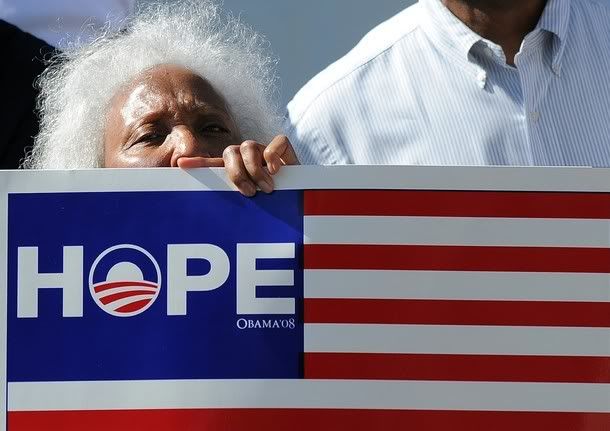
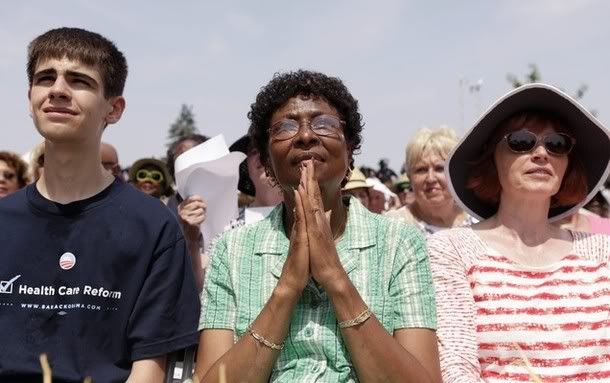
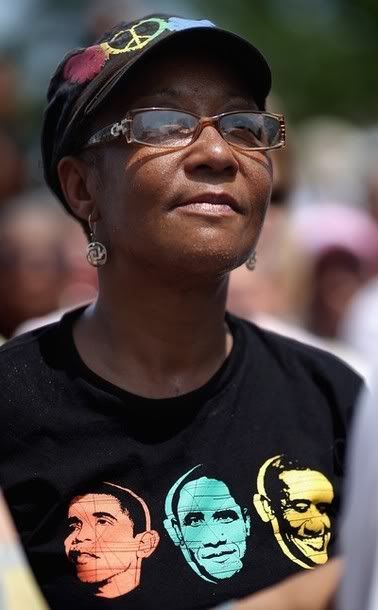
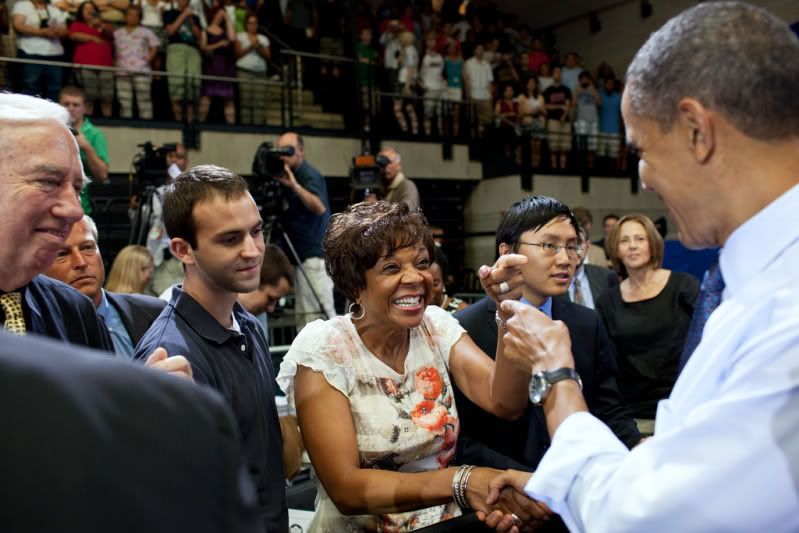
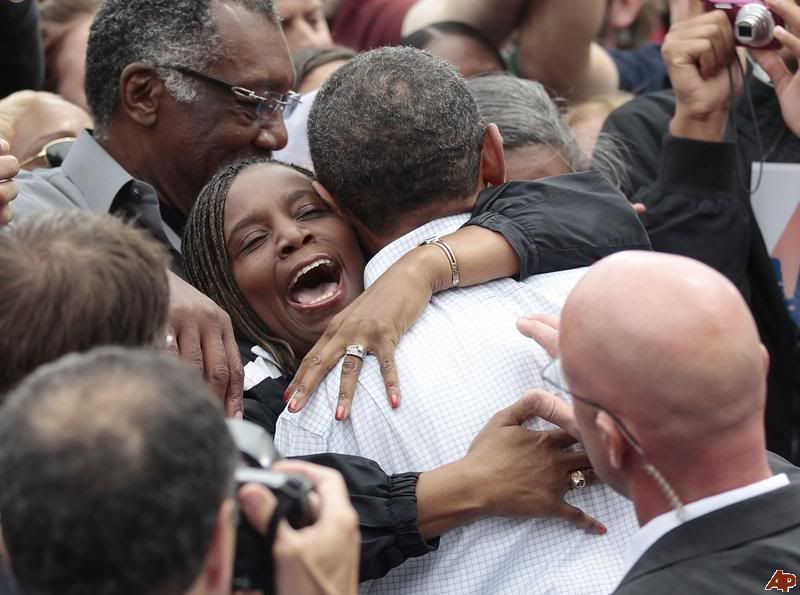
Don't mess with Grandma!!!!!!

We know that there are all kinds of people who are enthusiastic in their support for President Obama in this election. But recently Michelle Obama singled out one group that she knows a thing or two about.
It is no secret that a large segment of the African-American community put President Obama in office, with 95 percent of African Americans voting for him in 2008. And according to the NY Times, “Virtually every Black woman who voted did so for Mr. Obama,” making African-American women the largest voting bloc among all groups...

"So there is a seriousness about the direction of the country but let me tell you, older Black women love Barack Obama! Don’t mess with Barack Obama! There’s a lot of prayers going out and when you see the secret service, they’ve got to bolster up because they [Black women] are not going to let that go!”
I'd suggest that over the decades Black women have put an awful lot of their lives and energies into protecting their sons. Now they are not only proud of their adopted son - Barack Obama - they are fierce in their determination to both support and protect him.

Michelle is simply saying something that has been evident from the get-go. And we all know that you don't mess with Grandma ;-)


Photobucket


I need somebody to talk me down on this

Last night Paul Ryan picked a very interesting story to tell in attempting to humanize Mitt Romney. It was about a family's devastation after a car accident involving their children. My gawd, a car accident - when debating Joe Biden?????

The truth is that Joe handled it beautifully. He took a moment to collect himself and then said this.
Look, I don't doubt his [Romney's] personal generosity, and I understand what it's like. When I was a little younger than the congressman, my wife was in an accident, killed my daughter and my wife, and my two sons survived. I have sat in the homes of many people who've gone through what I went through because the one thing you can give people solace is to know they know you've been through it, that they can make it. 
But don't we HAVE to ask ourselves whether this was simply Ryan being unbelievably insensitive or was he being devastatingly devious in an attempt to throw Biden off his game?

P.S. This story from Ryan came after Biden's first reference to Romney's remarks about the 47%. Ryan knew that was coming and this is the story he picked to use as a response. So it didn't just surface in the heat of the moment. It was planned.

Winners in a debate? Depends on the audience

I feel the need to inject a note of caution in the analysis of last night's debate. But first, let me join my Democratic colleagues in saying how much I enjoyed watching Vice President Joe Biden. Because - if you're a Democrat - how can you not love this guy?
Photobucket
But overall, I have to say that I agree with something Greg Sargent said.
It was, compared with last week’s tame affair, much better television. Did it “work”? That entirely depends on the goal. If it was to change minds, no, that seems unlikely. If it was to re-invigorate Democrats who were despondent over Romney’s recent polling surge, or those who were angry with the president for a flat performance last week, then it probably did what it was meant to do.
There is something to be said for soothing the panic that had broken out in the Democratic ranks over the last week. To be real honest, that panic pissed me off. Kevin Drum has a point - there is a "hack gap" - and if you didn't believe him before, last night was pretty good proof. No one on the right is gnashing their teeth this morning that Paul Ryan got played.

But given the Democrat's tendency to form a circular firing squad at the first sign of trouble, VP Biden did what he needed to do to calm them down. Thank you Joe!!!!!

Going forward though, we need to think more broadly than that. Too many Democrats are using their own reactions to the debate last night to suggest that attacking the opposition is the way to win. I have my doubts about that. Most Democrats are already convinced that they should vote for Obama/Biden. Seeing our candidates go on the attack makes us feel better. But does it change anyone else's mind? That's the question we need to ask ourselves.

To try to answer that one, this morning I watched CNN's video of the debate with the dials from undecided voters. What I saw was the approval go up when either candidate spoke to the people about their situation and what their proposals were to do something about it. And I saw the approval plummet when either one attacked the other side's position. That's just a fact.

As an example, I read/heard many Democratic pundits express dismay that President Obama didn't bring up Romney's remarks about the 47%. Joe Biden did. Partisan Democrats loved it and undecided voters hated it.

When it comes to thinking about what President Obama should do in the next debate, we need to keep two things in mind. First of all, this one will be a town hall format. The candidates will not be talking to a moderator or each other. They'll be talking to voters. That changes the whole dynamic.

Secondly, President Obama is sure to be focused on who his main audience is for this debate. I doubt he'll be thinking about how to rev up the Democratic base with attacks. I suspect he'll be focusing on connecting with average voters who want to hear from someone who understands their situation (something he didn't do well last time) and is clear on what he's going to do about it.

In other words, he'll be going for the win on November 6th - not simply to convince the partisans and pundits that he can land a blow on the opposition.

Thursday, October 11, 2012

A Muslim American Makes the Case for Obama

We've seen purists like Glenn Greenwald and Conor Friedersdorf attempt to make the case about why they will not support President Barack Obama in his re-election this November. Their arguments rest mainly on foreign policy and national security issues - especially as they relate to the Muslim world.

That's why I found an article by Zaheer Ali in the Islamic Monthly to be so compelling. He agrees with the purists on their critique of President Obama when it comes to national security issues. And yet he makes a case for why Muslim Americans should still support the President.
But foreign and national security policies do not tell the whole story of Obama’s presidency, nor do they account for the totality of the Muslim-American electorate’s priorities. Muslim-Americans are one of the most ethnically and socioeconomically diverse religious communities in America, and their complex and competing political interests cannot, and should not, be simply boxed up and outsourced to concerns about foreign policy or national security. Like all Americans, Muslim-Americans must also concern themselves with the full range of domestic policies that affect the material conditions of their everyday lives. A closer look at Obama’s first term reveals major legislative accomplishments and policy implementations from which all Americans, including Muslim-Americans, benefit. When compared with his Republican opponent, Mitt Romney, Obama’s performance and proposals for the country – while not perfect – offer Muslim-Americans their greatest chances for economic security and growth, social mobility, health and well-being and political advancement.

Is Obama the perfect candidate? No. Most elections present imperfect choices, and this one is no different. The higher the office, the larger the majority needed to win, the less likely any single candidate will offer everything that the voters want. People seeking to vote on the basis of single issues, ideological puritanism or even principle, will most likely find neither of the two major party candidates appealing...

...the case for Obama is predicated on politics, pragmatism and realism, and rests on the following premises: First, though the Democratic and Republican parties are beholden to special interests, there are notable and critical differences in policy between the two parties and their standard bearers; and in these areas of difference, Muslim-Americans’ interests are better served by an Obama presidency. Second, where significant policy differences do not exist (especially in the area of foreign relations and the national security state), significant discursive differences do; and a Romney defeat is necessary to repudiate the discourse of Islamophobia (along with rampant xenophobia) running through the veins of the Republican Party. Third, the White House is not a site for radical change: Obama’s presidency has exposed the limited transformative power of the office, while offering instead incremental, liberal reforms. Because of the limitations on presidential powers, voting is only one, although necessary, aspect of electoral politics (beyond Election Day, lobbying and constituent services are just important); and electoral politics is only one of several important kinds of political activity.
Zaheer Ali then goes on to expound on those three points he outlined in the last paragraph. In the end, he demonstrates a more keen awareness of something that the history of our forbearers should have taught us, but we so often forget...the idea that the struggle continues and voting is simply one method by which we engage.
A vote for Obama is a vote for president, not messiah or mahdi. It is not overly concerned with personality and (un)likability. It is a strategy that recognizes the need for continued struggle by those with principles, ideologies and idealism seeking to create a better America for all its people. It is based on acknowledging that within the whole that is political activity, an Obama presidency is a crucial piece that still necessitates other kinds of electoral activity beyond Election Day, including voter education, mobilization, constituency development and lobbying.

So on Nov. 6, 2012, vote Obama. And agitate, organize, educate and mobilize, because the struggle will continue.
I don't share this to suggest that I agree with Zaheer Ali on his analysis of all of President Obama's positions. I do so because this is one Muslim American who has a lot to teach the rest of us about citizenship and democracy.

Wednesday, October 10, 2012

The good, the bad, and the ugly of punditry

In the aftermath of last weeks debate, many in the political pundit class revealed just how shallow they can be. And as we all know by now, the hair-on-fire about style over substance wasn't limited to those who lean conservative.

The freak-out by folks like Chris Matthews and Ed Schultz on cable was followed by the likes of Andrew Sullivan (meltdown central). But others joined the fray as well. As representative of that group, I would point to Michael Tomasky's ridiculous column asking Does Obama Even Want to Win the Election?

All of that goes to show why E.J. Dionne passed on this little bit of wisdom from an unnamed pollster.
“When you give conservatives bad news in your polls, they want to kill you,” he said. “When you give liberals bad news in your polls, they want to kill themselves.”
That rings pretty true based on much of what we've seen over the last few days.

I decided that this incident gave us an opportunity to evaluate some of our liberal pundits and see who is able to keep a cool head rather than react emotionally in the moment. I personally am not interested in listening to those who panic at the first sign of trouble, lose their perspective, and try to infect the body politic with their own doom-and-gloom.

As many of you know by now, I'm a big fan of Steve Benen who writes for Rachel Maddow's blog. During these last few days, he hasn't let me down. He's been rational in his critiques and fair-minded in his analysis.

But there is someone new on my blog roll over to the left that has impressed me a lot lately. He's not a new name to most of us - but he definitely stood out since the debate with his calm rational perspective. Its Kevin Drum who writes for Mother Jones. Here are some links to his excellent analysis over the last few days.

Groupthink and the Great Debate

The Hack Gap Rears its Ugly Head Yet Again

The Hack Gap Revisited

Less Theater Criticism, More Content Criticism, Please

Should Obama Call Romney a Liar?

Let me be clear, I'm not suggesting that I agree with everything Drum says. But if you'd like to read someone who is stepping back and providing some rational critique of what is happening right now in this presidential race, folks like Benen and Drum are definitely the place to go.

Immigrants and domestic migrants could be major factors in the Texas Senate race.

A few weeks ago I wrote about how MAGA influencers are trying to convince their base that - despite Trump's growing disapproval rates -...