Monday, March 7, 2016

The Consequences of Republican Obstruction

One of my favorite writers - Leonard Pitts - has weighed in on the topic du jour for pundits: what led to the rise of Donald Trump in the Republican presidential primary. He starts off with a quote from former Republican Senator George Voinovich: "If he was for it, we had to be against it." That was the beginning of the Republican strategy against the newly elected President back in 2009.
The popular storyline goes that voters are seeking political outsiders this year in their frustration over a government where the legislative gears are frozen and nothing gets done. What that storyline forgets is that this gridlock was by design, that GOP leaders held a meeting on the very evening of the president’s first inauguration and explicitly decided upon a policy of non-cooperation to deny him anything approaching a bipartisan triumph...

Republicans and their media accomplices buttressed that strategy with a campaign of insult and disrespect designed to delegitimize Obama. With their endless birther stupidity, their death panels idiocy, their constant budget brinksmanship and their cries of, “I want my country back!” they stoked in the public nothing less than hatred for the interloper in the White House who’d had the nerve to be elected president.

And the strategy worked, hobbling and frustrating Obama. But as a bullet doesn’t care who it hits and a fire doesn’t care who it burns, the forces of ignorance and unreason, grievance and fear the Republicans calculatedly unleashed have not only wounded the president. No, it becomes more apparent every day that those forces have gravely wounded politics itself, meaning the idea that we can — or even should — reason together, compromise, form consensus.
Of course I agree with Pitts because I wrote basically the same thing recently. Just as it is critical for a doctor to accurately diagnose a disease in order to effectively treat it, we need to be clear about why our politics is broken right now in order to craft effective solutions.

One way to test the diagnosis Pitts has articulated is to think about what happened prior to the 2010 midterm elections - when Democrats had control of both houses of Congress - and afterwards. In the first 2 years of the Obama presidency, he and the Democrats managed to pass:

1. The American Recovery and Reinvestment Act
2. The Affordable Care Act
3. The Dodd-Frank Act
4. Repeal of Don't Ask, Don't Tell
5. The Credit Card Accountability, Responsibility and Disclosure Act
6. The Lilly Ledbetter Fair Pay Act
7. The Fair Sentencing Act
8. The Family Smoking Prevention and Tobacco Control Act
9. The Healthy Hunger-Free Kids Act
10. The Hate Crimes Prevention Act

That's a pretty impressive list for just two years, isn't it? When you compare it to how little has been accomplished in the last 5 1/2 years, the contrast is astounding. The comparison is even more stark when you look at what the two Parties have been doing over those years. While the Republicans have spent most of their time trying to repeal Obamacare and threatening to blow up the economy if they don't get their way, President Obama and the Democrats have put forward a list of policy proposals that have been either ignored or actively obstructed by the Republicans.

1. Comprehensive immigration reform
2. The American Jobs Act
3. Universal pre-K
4. Raise the minimum wage
5. Paid family/sick leave
6. Free community college
7. Gun background checks
8. Criminal justice reform
9. Restoration of the Voting Rights Act

As a thought experiment, it's interesting to contemplate what might have happened over these last few years if either the Democrats had maintained their majorities in Congress and/or if the Republicans had taken the advice of people like David Frum and actually attempted to negotiate solutions.

There are voices out there who diagnose our political situation differently than the analysis above from Leonard Pitts. Some in the media are particularly fond of the "both sides do it" mythology. As we've seen, Bernie Sanders comes close to embracing that idea with his analysis that the entire political process is rigged by big money - both Republicans and Democrats. While money in politics plays a role, it is clear that Democrats have an agenda to address the challenges we face and Republicans have cast their lot with fanning the flames of fear/anger in order to obstruct progress. The consequences of that decision by the GOP are that: progress has been halted, the stage was set for a Donald Trump candidacy and our political system has been gravely wounded.

Friday, March 4, 2016

It's Time for a Dose of Hope

As regular readers here know, I've spent the last eight years following the amazing candidacy and presidency of Barack Obama. That hasn't simply been a political exercise for me (although I'll readily admit to being a political junkie). I've learned a lot from him. That has come from both analyzing his political strategy as our first POTUS with a background in community organizing as well as listening to how he often uses major speeches to inspire hope, heal our wounds and tell us a "story of America" that highlights our struggles to become "a more perfect union."

Based on those observations, I have occasionally contemplated the idea of writing a book about Obama's speeches. Lately I haven't been able to find the time to work on that. But perhaps my post this morning at the Washington Monthly is the start of chapter 1. It is titled: How to Inspire Hope in the Face of Anger, and is based on his 2004 speech at the Democratic Convention.

In these days when candidates from both sides of the aisle are engendering anger, I think its time for a dose of hope. Go take a look at what I've written about that and tell me what you think.

Thursday, March 3, 2016

Mitt Romney: Flawed Vehicle for the Anti-Trump Message

It really doesn't matter what Democrats think of Mitt Romney's speech today. He wasn't talking to them. Romney's point was to try to persuade Republicans to vote for someone (as it turns out, any Republican) other than Donald Trump.

The truth is that not many Republicans will actually hear the speech. Instead, they'll hear what Brett Baier, Bill O'Reilly, Sean Hannity and their guests have to say about it tonight. So that will be interesting to watch.

The challenge for establishment Republicans is that they really don't have a leader/spokesperson who can speak with credibility to the Trump phenomenon. Romney is probably the best they can come up with right now. But he is terribly flawed in this endeavor. The biggest reason for that is that he is the epitome of everything base voters are mad about when it comes to the Republican establishment: wealthy, moderate, loser.

Given that the one skill Trump has in spades is the ability to find and exploit his opponents weak points, that is already showing up in his twitter response to the speech.
Of course, then there's this:
This image of that endorsement four years ago will be ubiquitous on social media by the end of the day.


Nevertheless, Romney said a couple of things that are worth noting. This is one of the things I've heard some of my Republican friends say:
Think of Donald Trump's personal qualities, the bullying, the greed, the showing off, the misogyny, the absurd third grade theatrics. We have long referred to him as "The Donald." He is the only person in America to whom we have added an article before his name. It wasn't because he had attributes we admired.
Now imagine your children and your grandchildren acting the way he does. Will you welcome that?
As angry as some Republicans might be at government and their own Party's leadership, they care about their kids and who they look up to. Donald Trump is not the kind of person they want their children to emulate.

Romney summed up his speech with this:
Here's what I know. Donald Trump is a phony, a fraud. His promises are as worthless as a degree from Trump University. He's playing the American public for suckers: He gets a free ride to the White House and all we get is a lousy hat.
His domestic policies would lead to recession. His foreign policies would make America and the world less safe. He has neither the temperament nor the judgment to be president.
This is also something I've heard from my Republican friends. While they might appreciate that Trump is giving voice to their anger, there is a part of them that remembers what it is we actually elect a president to do. That is when they recognize that Trump's temperament and judgment could pose a big problem.

I can imagine Mitt Romney telling himself that before this primary was over, he needed to speak up. He's done that now. But given that he is such a flawed vehicle, I doubt his words will have much impact.

However...to the extent that those two parts of his message that I highlighted seep into the conversation that right wing media is having about this primary, it has the potential to give some Trump supporters a moment's pause.

Why the Democratic Coalition Matters: In Charts

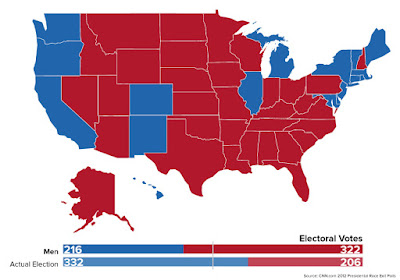
The current presidential primary is inspiring a discussion about the Democratic coalition. This is an important conversation to have. To demonstrate, I'm going to share three charts with you. The first two were created by BuzzFeed right after the 2012 presidential election. This one shows what the electoral map would have looked like if only men had voted.


It gets even worse if only white people had voted.


Finally, the third one comes from the 2008 presidential election and flips the script to ask what would have happened if only 18-29 year olds had voted.


That one should terrify Republicans.

But the message overall is that we need this coalition to succeed. That is why listening to each other about our differences and finding our common ground is so critical.

Getting Out of the Zero Sum Game

Back in 2011, Michael Norton and Samuel Sommers published some research that can help us understand the angry white racism that is fueling the Trump candidacy. Here is the abstract:
Although some have heralded recent political and cultural developments as signaling the arrival of a postracial era in America, several legal and social controversies regarding ‘‘reverse racism’’ highlight Whites’ increasing concern about anti-White bias. We show that this emerging belief reflects Whites’ view of racism as a zero-sum game, such that decreases in perceived bias against Blacks over the past six decades are associated with increases in perceived bias against Whites—a relationship not observed in Blacks’ perceptions. Moreover, these changes in Whites’ conceptions of racism are extreme enough that Whites have now come to view anti-White bias as a bigger societal problem than anti-Black bias.
They call this a zero sum view of racism - something I've written about before. In an interview with Michel Martin at NPR about this research, Norton was joined by Tim Wise, who has talked about the "perfect storm for white anxiety." He identified the four factors that comprise that storm.
I think what really has made it sort of skyrocket though, let's say from a 10-year period ago is you have a bunch of stuff happening at once. I mean one is the economic meltdown, which always, you know, creates additional anxiety. But then you have a president of color who challenges I think by virtue of his very existence, a lot of white folk's assumptions about what the leader should look like; the demographic shift, which I believe a lot of white Americans who, you know, been able to just sort of ignore that aren't anymore.
Even small towns are beginning in many ways to shift demographically; and you've got a popular culture that's thoroughly multicultural so that just about, you know, the ability of white America to take for granted that we are the norm.
Following publication of their research, Norton and Sommers wrote a column in the NYT about how this sets up a scenario of Jockeying for Stigma.
One outcome of granting rights to traditionally marginalized groups has been to leave many whites feeling marginalized themselves. What are the consequences of this sense of marginalization? For one, the very same developments that some would point to as evidence of progress toward equality (an African-American president, a Latina Supreme Court justice) are seen by others as further evidence of the threats aligned against them...
As a result, there’s a “jockeying for stigma” among groups in America today. This competition is surprising because being marginalized often equates to being powerless, yet many whites now use their sense of marginalization as a rallying cry toward action.
That "rallying cry" is exactly what is fueling the candidacy of Donald Trump.

To the extent that liberals want to tap into this white anxiety as a rallying cry - not for a racist backlash, but as a movement to address income inequality, it is necessary to abandon the frame of using it to jockey for stigma and offer an alternative. Marshall Ganz, who teaches community organizing at Harvard, tells us how to do that.
The initial challenge for an organizer—or anybody who’s going to provide leadership for change—is to figure out how to break through the inertia of habit to get people to pay attention. Often that breakthrough happens by urgency of need. Sometimes it happens because of anger—and by anger I don’t mean rage, I mean outrage. It’s the contradiction between the world as it is and the world as it ought to be. Our experience of that tension can break through the inertia and apathy of things as they always are.
How do organizers master urgency to break through inertia? The difference in how individuals respond to urgency or anxiety (detected by the brain’s surveillance system) depends on the brain’s dispositional system, the second system in the brain, which runs from enthusiasm to depression, from hope to despair. When anxiety hits and you’re down in despair, then fear hits. You withdraw or strike out, neither of which helps to deal with the problem. But if you’re up in hope or enthusiasm, you’re more likely to ask questions and learn what you need to learn to deal with the unexpected.
Hope is not only audacious, it is substantial. Hope is what allows us to deal with problems creatively. In order to deal with fear, we have to mobilize hope.
That offers us some insight that is vital to understanding our current situation. On the right, we see anger meeting with despair and leading folks to lash out in fear. The combination is not only destructive, it is dangerous.

But if that anger is offered hope, it inspires creativity and a quest for solutions.

Wednesday, March 2, 2016

The Subtext to Concerns About Clinton Not Taking Trump Seriously

There is an interesting subtext to a discussion going on about the Democratic presidential contest right now. I think it would be helpful to dig into it a bit deeper to shine a light on the questions it raises.

Before we get to that, it's important to lay out the context. As we have all seen by now, Hillary Clinton is beating Bernie Sanders primarily because she built a firewall with people of color.
Hillary Clinton took full command of the Democratic presidential race on Tuesday as she rolled to major victories over Bernie Sanders in Texas, Virginia and across the South and proved for the first time that she could build a national coalition of racially diverse voters that would be crucial in the November election.
Now that it is clear that the firewall is holding and the hopes of a Sanders victory are being challenged, many of the people who have been sympathetic to his campaign are popping up to warn Democrats that it is important to take Donald Trump's candidacy seriously.

As I noted yesterday, when I initially heard this kind of warning, I dismissed it as odd given that the opposite has typically been the case. Too many times we've witnessed Democrats backing off of their message and agenda due to pearl-clutching in response to Republican attacks. The very recent history of how this played out in the 2014 midterms is a perfect example. Case in point: A Democratic candidate for the Senate in Kentucky who refused to answer a question about whether or not she voted for a Democratic president. Did Alison Lundergan Grimes go too far in taking the threat of Mitch McConnell's antipathy for President Obama seriously? I think so.

But I dismissed these concerns too quickly, apparently. They're not only popping up on twitter. Daniel Lippman dedicated an entire article to cataloguing them from a broad array of Democrats. Let's take a look at what some of these people said so that we can understand the subtext of what is going on. First of all, here is the guy who was an advisor to Jim Webb prior to supporting Sanders - interesting combo, isn't it?
“I think Trump could beat her like a tied-up billy goat,” said Mudcat Saunders, a rural Democratic strategist who’s supporting Bernie Sanders. “There are many areas in key swing states like Virginia, North Carolina, Ohio, and Pennsylvania that look like Sherman went through and didn’t burn anything. Empty factories, empty buildings, few opportunities for young people. It’s sad. It should be no surprise to anybody that voters in those areas are gravitating to Trump.”
There's also this from another Democratic operative:
“Any place that has had manufacturing job declines, they’re very sensitive to immigration, they’re very sensitive to policies that they believe favor corporations and not them,” said Chicago Democratic operative Tom Bowen, a Rahm Emanuel political alum. “I do wonder if there’s some level of white voter that hasn’t come out in the past, a guy like Romney they thought was outsourcing their job, whereas a guy like Trump, they might actually believe that he’ll slap tariffs on Chinese imports and Mexican imports.”
Bob Shrum pretty well sums it up.
“He’s speaking to a group of people for whom conservatism is not a set of principles and programs, but a collection of grievances, alienations and angers,” he said. “And he expresses that and they’re not going to leave him unless he does something really atrocious.”
But Shrum cautioned that he doesn’t think Trump can get the share of the white vote high enough to overcome what will be a solid minority vote against him.
Perhaps now the subtext of this concern becomes clear. What worries the people who have been sympathetic to the Sanders campaign is that, by building a firewall with voters of color, Clinton has abandoned the concerns of white working class voters.

I would suggest that this is only true to the extent that white working class voters are motivated by racism. That is because people of color make up a huge portion of working class voters. They share the concerns about their children's economic future. But as I've pointed out before, they also understand the threat of the confederate insurgency we are witnessing from the right. The last thing they do is fail to take the fascism espoused by Donald Trump seriously. And neither does Hillary Clinton. That is why her message after the primary in South Carolina was one of inclusion rather than divisiveness.
...together, we can break down all the barriers holding our families and our country back; we can build ladders of opportunity and empowerment so every single American can have that chance to live up to his or her God-given potential. And then, and only then, can America live up to its full potential, too.
Despite what you hear, we don’t need to make America great again: America has never stopped being great. But we do need to make America whole again. Instead of building walls, we need to be tearing down barriers. We need to show by everything we do that we really are in this together.
So I'd say...calm down everybody. There is no chance that the Clinton campaign will fail to take the candidacy of Donald Trump seriously. And there is no need to pit white working class people's interests against those of people of color (except when white people define their interests as racist).

As Jon Favreau wrote recently, "Every election is a competition between two stories about America." He described Trump's story like this:
He is a celebrity strongman who will single-handedly save the country from an establishment that is too weak, stupid, corrupt, and politically correct to let us blame the real source of our problems—Muslims and Mexicans and Black Lives Matter protesters; the media, business, and political elites from both parties.
The last thing Democrats need to do is buy in to that story in any way, shape or form. Instead, we have to tell a totally different story.
...the story about a country that found the courage to turn away from our darkest impulses; that chose to embrace our growing diversity as a strength, not a weakness; that pushed the boundaries of opportunity outward and upward, until there are no more barriers, and no more ceilings.
Oh, and one final thought. The late great Molly Ivins would warn us that in the midst of it all, a sense of humor always helps. So there's nothing wrong with occasionally pointing and laughing at the opposition when they make fools of themselves. That doesn't make us un-serious. It keeps us sane.

Early Thoughts on a Clinton/Trump Race

For the last few days, my head has wanted to play with the idea of what a general election match-up between Hillary Clinton and Donald Trump would look like. To be honest, I've tried to fend off those thoughts because - if we've learned anything from this primary season so far - it is that forecasting the future of this race is a fools errand. For example, take a look at how David Plouffe handicapped Trump's chances in the general:
But today I'm reading about Democrats starting to prepare to face Trump in November. Stan Greenberg's Democracy Corps released some interesting data about Republican voters. In addition, Amy Chozick and Patrick Healy talked to people in the Clinton camp about how they are preparing to face The Donald.

After all that, I can't stop myself. With full caveats about how things might change, I have a few thoughts to share about a Clinton/Trump contest.

First of all, unlike Greg Sargent, I never doubted that Democrats would take Trump seriously. Given the Party's propensity to "Oh, my!!" at the slightest challenge, I'd be much more concerned about the possibility of cowering at his supposed strength.

What has been tripping my synapses lately is the reality that the whole conversation changes (mostly for Republicans) once it turns away from appealing to base voters and heads towards the general populace. Republicans have avoided going after Trump too hard for fear of offending his supporters. The Clinton campaign won't share that concern.
While Mrs. Clinton radiates positive energy on the trail, Democratic groups are beginning to coalesce around a strategy to deliver sustained and brutal attacks on Mr. Trump.
The plan has three major thrusts: Portray Mr. Trump as a heartless businessman who has worked against the interests of the working-class voters he now appeals to; broadcast the degrading comments he has made against women in order to sway suburban women, who have been reluctant to support Mrs. Clinton; and highlight his brash, explosive temper to show he is unsuited to be commander in chief.
On the debate stage, Trump won't be surrounded by weak candidates trying to show that they can out-bully him with moderators like Hugh Hewitt and the cast at Fox News. He might actually be pressed to answer questions about things like how he would deal with Vladimir Putin or how he would round up 11 million undocumented people or what he would do about climate change. Imagine that!

Chozick and Healy focus on the fact that Clinton and Trump are polar opposites when it comes to approach.
Mr. Trump and Mrs. Clinton are polar opposite politicians, and Mr. Trump’s direct and visceral style could prove difficult for Mrs. Clinton, whose inclination is detailed policy talk and 12-point plans.
That kind of thing might have been worrying before we all saw how Clinton handled the Republican members at the Benghazi Hearing a few months ago. For eleven hours she maintained her composure while they threw their rants and raves at her. In the end, they were the ones who looked foolish. I can imagine something similar in a general election debate.

Finally, I am looking forward to the day that President Obama is able to weigh in on the campaign trail for the Democratic nominee. Over the years he has shown several characteristics that Clinton could employ. For example, the President has been a master at giving the opposition enough rope to hang themselves. One needs only recall the moment when he simply said, "Please proceed, Governor" to Mitt Romney during a debate. He is also the person who - to this day - has done the best job of using humor against Donald Trump. Remember this?


There are a lot of ways to take a potential Donald Trump nomination seriously. That does not preclude demonstrating to voters that he is a fool.

Immigrants and domestic migrants could be major factors in the Texas Senate race.

A few weeks ago I wrote about how MAGA influencers are trying to convince their base that - despite Trump's growing disapproval rates -...