Showing posts with label Mandela. Show all posts

Sunday, January 11, 2015

The Heart of the Matter

When most people talk about globalization and income inequality, the talk about policies to alleviate the problem. That is an important part of the equation. But Pope Francis recently addressed the heart of the matter.
I recognize that globalization has helped many people to rise from poverty, but it has condemned many others to hunger. It's true that in absolute terms it grows world wealth, but it also increased the disparity and the new kinds of poverty.

What I notice is that this system is maintained with the culture of waste, of which I have already spoken several times. There is a politics, sociology, and also an attitude of rejection.

When at the center of the system there is not anymore man but money, when money becomes an idol, men and women are reduced and simply instruments of a social system and an economy characterized, indeed dominated by deep imbalances.
That reminded me of something David Simon said a few years ago when he talked about why he created the HBO series The Wire.
We are in the postindustrial age. We do not need as many of us as we once did. We don’t need us to generate capital, to secure wealth. We are in a transitive period where human beings have lost some of their value. Now, whether or not we can figure out a way to validate the humanity of the individual, I have great doubts...

The Wire is certainly an angry show. It’s about the idea that we are worth less. And that is an unreasonable thing to contemplate for all of us. It is unacceptable. And none of us wants to be part of a world that is going to do that to human beings. If we don’t exert on behalf of human dignity at the expense of profit and capitalism and greed, which are inevitabilities, and if we can’t modulate them in some way that is a framework for an intelligent society, we are doomed. It is going to happen sooner than we think. I don’t know what form it will take. But I know that every year America is going to be a more brutish and cynical and divided place.
And finally, I was reminded of what Derrick Jensen wrote in The Culture of Make Believe when he talked about the similarities between hate groups and corporations.
He said, "They're cousins."

I just listened.

"Nobody talks about this," he said, "but they're branches from the same tree, different forms of the same cultural imperative..."

"Which is?"

"To rob the world of its subjectivity."

"Wait - " I said.

"Or to put this another way," he continued, "to turn everyone and everything into objects."
Robbing the world of its subjectivity means removing empathy and our feelings of mutuality. It means creating distance between "us" and "them." It is also what Dr. Martin Luther King, Jr. was addressing when he said this:
We are caught in an inescapable network of mutuality, tied in a single garment of destiny. Whatever affects one directly, affects all indirectly.
When people accuse President Obama of being too accommodating with his opponents (liberals accuse him of being too accommodating with Republicans and conservatives accuse him of the same thing with global opponents), they fail to see that this is exactly the challenge he is attempting to address.

Here's how candidate Obama talked about it back in 2008 on Martin Luther King Day.
Unity is the great need of the hour - the great need of this hour. Not because it sounds pleasant or because it makes us feel good, but because it’s the only way we can overcome the essential deficit that exists in this country.

I’m not talking about a budget deficit. I’m not talking about a trade deficit. I’m not talking about a deficit of good ideas or new plans.

I’m talking about a moral deficit. I’m talking about an empathy deficit. I’m taking about an inability to recognize ourselves in one another; to understand that we are our brother’s keeper; we are our sister’s keeper; that, in the words of Dr. King, we are all tied together in a single garment of destiny...

We are told that those who differ from us on a few things are different from us on all things; that our problems are the fault of those who don’t think like us or look like us or come from where we do...

Every day, our politics fuels and exploits this kind of division across all races and regions; across gender and party. It is played out on television. It is sensationalized by the media...

So let us say that on this day of all days, each of us carries with us the task of changing our hearts and minds. The division, the stereotypes, the scapegoating, the ease with which we blame our plight on others - all of this distracts us from the common challenges we face - war and poverty; injustice and inequality. We can no longer afford to build ourselves up by tearing someone else down. We can no longer afford to traffic in lies or fear or hate. It is the poison that we must purge from our politics; the wall that we must tear down before the hour grows too late.

Because if Dr. King could love his jailor; if he could call on the faithful who once sat where you do to forgive those who set dogs and fire hoses upon them, then surely we can look past what divides us in our time, and bind up our wounds, and erase the empathy deficit that exists in our hearts.
Here's how he talked about it on a global scale during his acceptance speech for the Nobel Peace Prize.
Agreements among nations. Strong institutions. Support for human rights. Investments in development. All these are vital ingredients in bringing about the evolution that President Kennedy spoke about. And yet, I do not believe that we will have the will, the determination, the staying power, to complete this work without something more -- and that's the continued expansion of our moral imagination; an insistence that there's something irreducible that we all share.
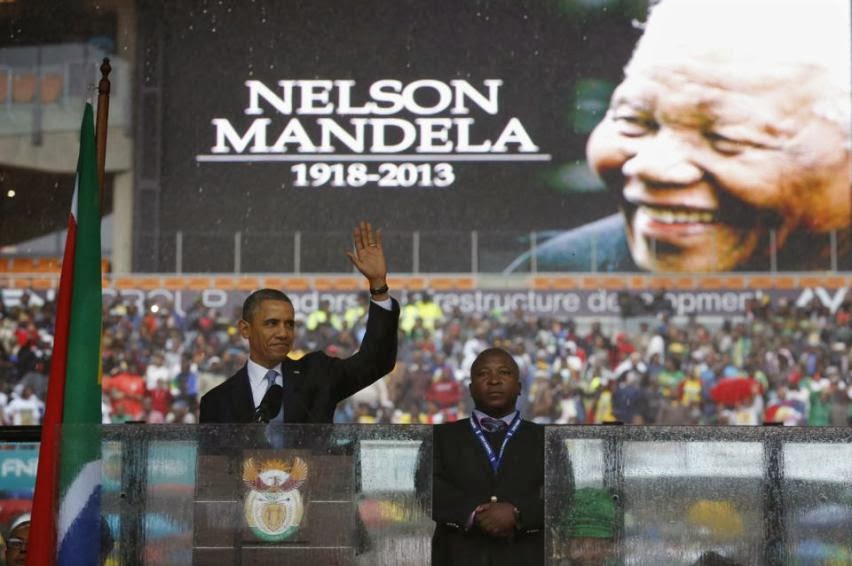
The President reminded us of this when he memorialized Nelson Mandela.
Mandela understood the ties that bind the human spirit. There is a word in South Africa- Ubuntu – that describes his greatest gift: his recognition that we are all bound together in ways that can be invisible to the eye; that there is a oneness to humanity; that we achieve ourselves by sharing ourselves with others, and caring for those around us...He not only embodied Ubuntu; he taught millions to find that truth within themselves. It took a man like Madiba to free not just the prisoner, but the jailor as well; to show that you must trust others so that they may trust you; to teach that reconciliation is not a matter of ignoring a cruel past, but a means of confronting it with inclusion, generosity and truth. He changed laws, but also hearts.
There are those that say Ubuntu is impossibly naive and unrealistic. To them, I simply respond:
You may say I'm a dreamer
But I'm not the only one
I hope someday you'll join us (John Lennon, Pope Francis, David Simon, Derrick Jensen, Martin Luther King, Nelson Mandela, President Obama)
And the world will live as one.

Tuesday, July 22, 2014

Four Simple Questions

In many shamanic societies, if you came to a shaman or medicine person complaining of being disheartened, dispirited, or depressed, they would ask one of four questions:
  1. When did you stop dancing?
  2. When did you stop singing?
  3. When did you stop being enchanted by stories?
  4. When did you stop finding comfort in the sweet territory of silence?
Let's see...it seems I've heard something similar from a great man. Where was that? Oh yeah, here:

"It is music and dancing that makes me at peace with the world...and at peace with myself."
Nelson Mandela

Friday, May 23, 2014

Wall Street and Main Street: Our inescapable network of mutuality

I believe that one of the problems with a lot of liberals is that they focus too much on the enemy. Looking at the treatment of our financial system and the 1%ers by them is often instructive. The rhetoric is all tied up in calls for retribution and defeat of the enemy.

In saying that, I am in no way attempting to excuse the injustices. They are very real. But if we are going to address them, we must maintain our North Star - a focus on who we are fighting FOR.

I am often struck by the approach of leaders from the past that we revere...people like Nelson Mandela and Martin Luther King, Jr. Both of those men led movements against oppression far beyond what we experience today. I believe that much of what guided them can be summed up in these words Martin Luther King, Jr. wrote from a Birmingham jail.
We are caught in an inescapable network of mutuality, tied in a single garment of destiny. Whatever affects one directly, affects all indirectly.
It is the same grounding that President Obama acknowledged as the basis for what made Mandela such a powerful leader.
There is a word in South Africa- Ubuntu – that describes his greatest gift: his recognition that we are all bound together in ways that can be invisible to the eye; that there is a oneness to humanity; that we achieve ourselves by sharing ourselves with others, and caring for those around us...It took a man like Madiba to free not just the prisoner, but the jailor as well; to show that you must trust others so that they may trust you; to teach that reconciliation is not a matter of ignoring a cruel past, but a means of confronting it with inclusion, generosity and truth.
Mutuality and Ubuntu are not merely statements of sentimentality. We now know that they are well-grounded in the science of everything from biology to economics. A simple focus on retribution against our enemies ultimately affects all of us. Whether or not we are willing to heed King's call to "love our enemies," we have to at least take that into account.

While I might not agree with every action taken by President Obama and his administration in the midst of the Great Recession, it is clear that they were guided by an awareness of the economic mutuality between Wall Street and Main Street. They knew that "whatever affects one directly, affects all indirectly." That is exactly what is meant by the idea of "too big to fail." Even as we are justified in decrying how we got there, no one can deny that a "failure" would have had catastrophic effects on everyone - not just Wall Street.

And so here we are six years later and the immediate crisis is over. We're back to dealing with the growing income inequality that has been building for over 30 years. Liberals whose primary focus is on defeating the enemy seem more resentful of money being made on Wall Street than they are in figuring out what to do for Main Street.  I suspect that what drives that is an assumption that if Wall Street suffers Main Street will prosper. To me, that is just another example of assuming that the master's tools will be able to dismantle the master's house. It is the master's way to pit one group against another...divide and conquer...survival of the fittest.

Ultimately what will dismantle the master's house of income inequality is a recognition of the fact that "we are caught in an inescapable network of mutuality, tied in a single garment of destiny." That means that we demonize neither the poor or the rich, nor do we call for their defeat. Instead, we begin to imagine how we can "free not just the prisoner, but the jailor as well."

Monday, April 7, 2014

What the wonks among us don't get

Yesterday Ezra Klein launched his new media venture Vox. His opening piece of writing is a doosey titled: How Politics Makes Us Stupid.
There’s a simple theory underlying much of American politics. It sits hopefully at the base of almost every speech, every op-ed, every article, and every panel discussion...It’s what we might call the More Information Hypothesis: the belief that many of our most bitter political battles are mere misunderstandings. The cause of these misunderstandings? Too little information...If only the citizenry were more informed, the thinking goes, then there wouldn’t be all this fighting.

It’s a seductive model. It suggests our fellow countrymen aren’t wrong so much as they’re misguided, or ignorant, or — most appealingly — misled by scoundrels from the other party. It holds that our debates are tractable and that the answers to our toughest problems aren’t very controversial at all...

But the More Information Hypothesis isn’t just wrong. It’s backwards. Cutting-edge research shows that the more information partisans get, the deeper their disagreements become.
This one is right up my alley because its something I think about all the time. Perhaps because I spent over 20 years questioning the religious orthodoxy under which I was raised, I am particularly fascinated with our human ability to fool ourselves into maintaining our belief systems in the face of evidence.

Not too long ago I wrote about scientific research that labelled this tendency motivated reasoning.
The theory of motivated reasoning builds on a key insight of modern neuroscience: Reasoning is actually suffused with emotion (or what researchers often call “affect”). Not only are the two inseparable, but our positive or negative feelings about people, things, and ideas arise much more rapidly than our conscious thoughts, in a matter of milliseconds...It’s a “basic human survival skill,” explains political scientist Arthur Lupia of the University of Michigan. We push threatening information away; we pull friendly information close.
What Klein adds to this discussion is the work of Yale Law Professor Dale Kahan who helps us understand what motivates this emotional response to threatening information.
Kahan calls this theory Identity-Protective Cognition: "As a way of avoiding dissonance and estrangement from valued groups, individuals subconsciously resist factual information that threatens their defining values." Elsewhere, he puts it even more pithily: "What we believe about the facts," he writes, "tells us who we are." And the most important psychological imperative most of us have in a given day is protecting our idea of who we are, and our relationships with the people we trust and love.
I am reminded of something Sarah Robinson wrote about honoring the process of those who abandon an authoritarian mindset.
We must never, ever underestimate what it costs these people to let go of the beliefs that have sustained them. Leaving the safety of the authoritarian belief system is a three-to-five year process. Externally, it always means the loss of your community; and often the loss of jobs, homes, marriages, and blood relatives as well. Internally, it requires sifting through every assumption you've ever made about how the world works, and your place within it; and demands that you finally take the very emotional and intellectual risks that the entire edifice was designed to protect you from. You have to learn, maybe for the first time, to face down fear and live with ambiguity.
That is a daunting task to ask anyone to undertake - and almost impossible to do alone.

In many ways Kahan is right - protecting who we are and our relationship with those we love and trust IS more important than facts and data. As human beings we can't survive without it. That kind of reality leaves a wonk like Ezra Klein pretty despondent as he tries to find a solution to the gulf that separates us.

Its interesting - because my mind immediately went to this:


The answer isn't - as Kahan suggests - a better "science communication strategy." It starts with broadening the definition of "we,"...an expansion of our moral imagination. When we make our circle of concern big enough to include even those we disagree with - facts are no longer a threat to our identity. It is captured by the African concept of Ubuntu.
Mandela understood the ties that bind the human spirit. There is a word in South Africa - Ubuntu – that describes his greatest gift: his recognition that we are all bound together in ways that can be invisible to the eye; that there is a oneness to humanity; that we achieve ourselves by sharing ourselves with others, and caring for those around us...He not only embodied Ubuntu; he taught millions to find that truth within themselves. It took a man like Madiba to free not just the prisoner, but the jailor as well; to show that you must trust others so that they may trust you; to teach that reconciliation is not a matter of ignoring a cruel past, but a means of confronting it with inclusion, generosity and truth. He changed laws, but also hearts.

Wednesday, March 19, 2014

The Great Experiment

In condemning Bill Kristol and the neocons for their foreign policy failures during the Bush/Cheney administration, BooMan sounds a warning to liberals.
Putin's actions in Ukraine do pose a challenge to progressives, who must begin to think carefully about America's proper posture in the world. Where we move back, other powers may move in, and often with unfortunate and destabilizing results.
Whether we like it or not, he's right. For the last 60 years, the United States has either dominated global affairs or shared that stage during the Cold War with the Soviet Union. To simply decry that kind of hegemony is not enough. We have to be realistic about the alternatives.

In order to do that we have to discard the notion that the only form of power is military dominance. Whether its the U.S. in Viet Nam/Iraq or Russia in Afghanistan - we've learned the hard way that military dominance doesn't work.

I thought of that last night when I watched the movie Mandela: The Long Walk to Freedom. As the white South African government initially responded to peaceful protests with violence, I thought to myself, "when are people finally going to realize that doesn't work?" It took another 30 years and too many lives, but black South Africans finally prevailed in their quest to rid the country of apartheid.

Throughout the movie, Mandela and members of the ANC made the point that one individual alone did not have the power to change things - but that as 2..3...4...5... came together, they had the power to prevail.

That, my friends, is the lesson we all need to learn - the power of partnership.

At this moment in history, we might only have a couple more years in which the United States is led by someone who understands this.
...human history has often been a record of nations and tribes -- and, yes, religions -- subjugating one another in pursuit of their own interests. Yet in this new age, such attitudes are self-defeating. Given our interdependence, any world order that elevates one nation or group of people over another will inevitably fail. So whatever we think of the past, we must not be prisoners to it. Our problems must be dealt with through partnership; our progress must be shared.
As we watch President Obama try to harness that power of partnership to deal with what is happening in the Ukraine, or Iran, or Syria, we are watching a Great Experiment at work (the one originally envisioned by FDR). Can the nations of the world come together to deal with these challenges via partnership rather than letting them escalate into military confrontations where the elites of the world send their people to die as they play out their power games?

We know that the neocons haven't learned this lesson. But what about American progressives? Do we see the Great Experiment at play and recognize what is at stake? Or are we too enamored with our cynicism to see what's going on?

Thursday, December 12, 2013

Understanding why some people can't "see" Ubuntu

In describing President Obama as an integral leader, Jim Stuart recently wrote this:
On balance, most of us in the US and elsewhere have a binary view of conflict: if you win, I lose, and vice versa. And we are completely immersed in the consciousness of scarcity, resource conflict, and fear of the other. Clearly, Gandhi, Mandela and King operated from a different level of consciousness, where abundance, peacemaking, and trust were the qualities seen first, and were part of each leader's basic operating system. Developmental psychologists call this level of consciousness integral, and tell us that less than 5% of the world has attained this consciousness level. Obama, I believe, is part of this small percentage of people who see things whole...

...none of this makes sense to our pundits - that operational mode doesn't compute - power is everything; the powerful are always the winners; never let your guard down; he who has the gold rules, etc, - so folks just cannot see it when something like what has just happened, occurs.
I want to credit Jim with helping me understand that some people literally cannot "see" what is happening. Yesterday I ran across a perfect example of this in commentary about the life of Nelson Mandela. It came from something written by Ted Rall, the cartoonist that was accused at Daily Kos of depicting President Obama as a gorilla/monkey. I'll warn you...its probably going to make you angry. Go ahead and let yourself react. But then take a moment to think about what he literally can't see.
Many black South Africans are disillusioned by Mandela and his ANC government. Residents of the townships are suffering horribly, yet this “black” “democratic” government hasn’t done much more for them than the old apartheid regime. This was due to two terrible decisions by Mandela in 1994. First, he decided against seeking justice against the apartheid-era criminal whites. Obviously this was the result of pressure from the USA and the West. The ANC called it “reconciliation.” Others called it a sellout. These horrible murderers got away with murder. The lesson to the murderers of the future is, don’t worry, you won’t pay for your crimes.

Second, Mandela and the ANC decided not to implement the communist programme of their socialist and communist allies. Income and wealth redistribution were left on the table. The result is a South Africa that looks the same as before: rich whites, poor blacks. Heckuva job, Nelson.
You have to wonder if Rall even saw the outpouring of love for Madiba from black South Africans over the last few days when he suggests that they are "disillusioned" by him. For an entirely different take on all that, please go read how Ta-Nehisi Coates addresses these same arguments when they come from conservatives. But I'll let that one go for now.

It is clear that Rall has absolutely ZERO ability to understand Ubuntu...the African concept that President Obama described this way:
...his [Mandela's] recognition that we are all bound together in ways that can be invisible to the eye; that there is a oneness to humanity; that we achieve ourselves by sharing ourselves with others, and caring for those around us.
It got me to thinking about Lawrence Kohlberg's stages of moral development. Here's how I'd break it down:

Ted Rall : Stage Four - "A central ideal or ideals often prescribe what is right and wrong, such as in the case of fundamentalism. If one person violates a law, perhaps everyone would—thus there is an obligation and a duty to uphold laws and rules. When someone does violate a law, it is morally wrong; culpability is thus a significant factor in this stage as it separates the bad domains from the good ones."

Nelson Mandela: Stage Six - "moral reasoning is based on abstract reasoning using universal ethical principles. Laws are valid only insofar as they are grounded in justice, and a commitment to justice carries with it an obligation to disobey unjust laws...This involves an individual imagining what they would do in another’s shoes, if they believed what that other person imagines to be true. The resulting consensus is the action taken. In this way action is never a means but always an end in itself; the individual acts because it is right, and not because it avoids punishment, is in their best interest, expected, legal, or previously agreed upon."

Al Giordano made a similar argument when discussing how liberals who are entrenched in stage four moral development made the argument that President Obama MUST prosecute Bush/Cheney for torture.
There are times when “The Law” is dressed up in liberal language in a way that masquerades the bloodlust behind witch hunts and impulses to scapegoat individuals for crimes or taboos that, in a democracy, we’re all responsible for having enabled.

The same tendencies that have always placed me squarely against McCarthyism and Red Scares put me on the opposite side of some liberal and progressive colleagues today when they demand the prosecution of Bush, or of Cheney, or of some of their underlings...

In the end, preventing torture is a political struggle and also a power struggle, so much more than a matter of "The Law." It’s about changing society and its presumptions, and changing institutions, like the military and police agencies, where the culture is so prone to that kind of abuse.
Giordano makes the case that ultimately it is in the spirit of Ubuntu that we will effectively dismantle the structures that support atrocities like torture. And that is exactly the approach Madiba took when seeking reconciliation with those who committed similar atrocities under the apartheid regime.

What I've come to see from all this is that there is a reason we come to loggerheads when trying to discuss these issues. Gawd knows that I have tried and failed more times than I'd like to remember. I'm thinking that it sounds patronizing to posit that those who don't understand are operating from a lower stage of moral development. It goes against the grain of humility that I've been talking about lately.

But the truth is, those stages of moral development - while not a perfect theory (no system that attempts to capture human behavior is perfect) - are based on tested scientific observation. In other words, they at least begin to describe the human condition. There doesn't have to be prejudice in applying them to human behavior. So as long as we come to a conversation like this with a good dose of humility in our own limitations, understanding the conflicts in this way actually releases us from the attachment to win/lose, either/or and allows us to understand. That's what I'm working on "seeing"... in the spirit of Ubuntu.

Tuesday, December 10, 2013

"It took a man like Madiba to free not just the prisoner, but the jailor as well"

Mandela understood the ties that bind the human spirit. There is a word in South Africa- Ubuntu – that describes his greatest gift: his recognition that we are all bound together in ways that can be invisible to the eye; that there is a oneness to humanity; that we achieve ourselves by sharing ourselves with others, and caring for those around us. We can never know how much of this was innate in him, or how much was shaped and burnished in a dark, solitary cell. But we remember the gestures, large and small – introducing his jailors as honored guests at his inauguration; taking the pitch in a Springbok uniform; turning his family’s heartbreak into a call to confront HIV/AIDS – that revealed the depth of his empathy and understanding. He not only embodied Ubuntu; he taught millions to find that truth within themselves. It took a man like Madiba to free not just the prisoner, but the jailor as well; to show that you must trust others so that they may trust you; to teach that reconciliation is not a matter of ignoring a cruel past, but a means of confronting it with inclusion, generosity and truth. He changed laws, but also hearts.
After listening to President Obama's remarks at the service for Nelson Mandela, those are the words that I'm reflecting on. Too often we forget that it is not only the prisoner that is chained...it is the jailor as well. Oppression affects not only the oppressed, but the oppressor. To rid the world of evils like apartheid requires that we free not only the prisoner, but the jailor as well. More than any man in recent history, Mandela knew that.

And so we must ask ourselves what is it that makes "a man [or woman] like Madiba" - one who truly reflects "Ubuntu?" As we've seen throughout history, those are the people who have bent the arc of history towards justice.

My suggestion would be that we have one of those leaders in the White House right now. And just as white South Africans initially feared Mandela while his critics were baffled by his outstretched hand to them, the dying beast of white supremacy is lashing out at President Obama, but critics misunderstand his conciliatory rhetoric.

I believe that President Obama wants to free people of color in this country from the oppression of racism. But he knows that will only happen when we can free white people from their hate. We're in the midst of that struggle right now. And as Madiba said "It always seems impossible until its done."

Friday, December 6, 2013

"Mandela has always felt most at ease around children"

Nelson Mandela has always felt most at ease around children, and in some ways his greatest deprivation was that he spent 27 years without hearing a baby cry or holding a child's hand. Last month, when I visited Mandela in Johannesburg — a frailer, foggier Mandela than the one I used to know — his first instinct was to spread his arms to my two boys. Within seconds they were hugging the friendly old man who asked them what sports they liked to play and what they'd had for breakfast. While we talked, he held my son Gabriel, whose complicated middle name is Rolihlahla, Nelson Mandela's real first name. He told Gabriel the story of that name, how in Xhosa it translates as "pulling down the branch of a tree" but that its real meaning is "troublemaker."

- Richard Stengel

Mandela the pragmatist

One of the problems with putting people up on a pedestal is that they become ethereal. From everything I've read about Nelson Mandela, he was a uniquely confident but humble man. One of his most famous quotes is "I am not a saint, unless you think of a saint as a sinner who keeps on trying."

Far from ethereal, according to his biographer Richard Stengel, Mandela was grounded in the long view while being a master tactician and pragmatist. Here are some excerpts from Stengel's identification of Mandela's 8 lessons of leadership:
Mandela is the closest thing the world has to a secular saint, but he would be the first to admit that he is something far more pedestrian: a politician. He overthrew apartheid and created a nonracial democratic South Africa by knowing precisely when and how to transition between his roles as warrior, martyr, diplomat and statesman. Uncomfortable with abstract philosophical concepts, he would often say to me that an issue "was not a question of principle; it was a question of tactics." He is a master tactician...

His unwavering principle — the overthrow of apartheid and the achievement of one man, one vote — was immutable, but almost anything that helped him get to that goal he regarded as a tactic. He is the most pragmatic of idealists.

"He's a historical man," says Ramaphosa. "He was thinking way ahead of us. He has posterity in mind: How will they view what we've done?" Prison gave him the ability to take the long view. It had to; there was no other view possible. He was thinking in terms of not days and weeks but decades. He knew history was on his side, that the result was inevitable; it was just a question of how soon and how it would be achieved. "Things will be better in the long run," he sometimes said. He always played for the long run...

Mandela loved to reminisce about his boyhood and his lazy afternoons herding cattle. "You know," he would say, "you can only lead them from behind." He would then raise his eyebrows to make sure I got the analogy.

As a boy, Mandela was greatly influenced by Jongintaba, the tribal king who raised him. When Jongintaba had meetings of his court, the men gathered in a circle, and only after all had spoken did the king begin to speak. The chief's job, Mandela said, was not to tell people what to do but to form a consensus. "Don't enter the debate too early," he used to say...

Mandela was a lawyer, and in prison he helped the warders with their legal problems. They were far less educated and worldly than he, and it was extraordinary to them that a black man was willing and able to help them. These were "the most ruthless and brutal of the apartheid regime's characters," says Allister Sparks, the great South African historian, and he "realized that even the worst and crudest could be negotiated with."...

Mandela believed that embracing his rivals was a way of controlling them: they were more dangerous on their own than within his circle of influence. He cherished loyalty, but he was never obsessed by it. After all, he used to say, "people act in their own interest." It was simply a fact of human nature, not a flaw or a defect. The flip side of being an optimist — and he is one — is trusting people too much. But Mandela recognized that the way to deal with those he didn't trust was to neutralize them with charm...

Mandela is comfortable with contradiction. As a politician, he was a pragmatist who saw the world as infinitely nuanced...Every problem has many causes. While he was indisputably and clearly against apartheid, the causes of apartheid were complex. They were historical, sociological and psychological. Mandela's calculus was always, What is the end that I seek, and what is the most practical way to get there?...

Knowing how to abandon a failed idea, task or relationship is often the most difficult kind of decision a leader has to make. In many ways, Mandela's greatest legacy as President of South Africa is the way he chose to leave it. When he was elected in 1994, Mandela probably could have pressed to be President for life — and there were many who felt that in return for his years in prison, that was the least South Africa could do..."His job was to set the course," says Ramaphosa, "not to steer the ship." He knows that leaders lead as much by what they choose not to do as what they do.
While looking for images to go with this post, I was struck by the power of Nelson Mandela's smile. It reaches out and grabs you and is there in his eyes even when not present on his lips.
I believe that Mandela was a truly joyful man. But according to Stengel, that smile had a pragmatic role to play as well.
When Mandela was running for the presidency in 1994, he knew that symbols mattered as much as substance. He was never a great public speaker, and people often tuned out what he was saying after the first few minutes. But it was the iconography that people understood. When he was on a platform, he would always do the toyi-toyi, the township dance that was an emblem of the struggle. But more important was that dazzling, beatific, all-inclusive smile. For white South Africans, the smile symbolized Mandela's lack of bitterness and suggested that he was sympathetic to them. To black voters, it said, I am the happy warrior, and we will triumph. The ubiquitous ANC election poster was simply his smiling face. "The smile," says Ramaphosa, "was the message."
So while we venerate Nelson Mandela, let us not forget that he was a man who was grounded in what it took to engage in the struggle and win. Those are lessons in life and leadership we can all emulate.

Immigrants and domestic migrants could be major factors in the Texas Senate race.

A few weeks ago I wrote about how MAGA influencers are trying to convince their base that - despite Trump's growing disapproval rates -...