Saturday, January 15, 2022

Can Someone Who Has Been Criminally Indicted - or Convicted - Run for President?

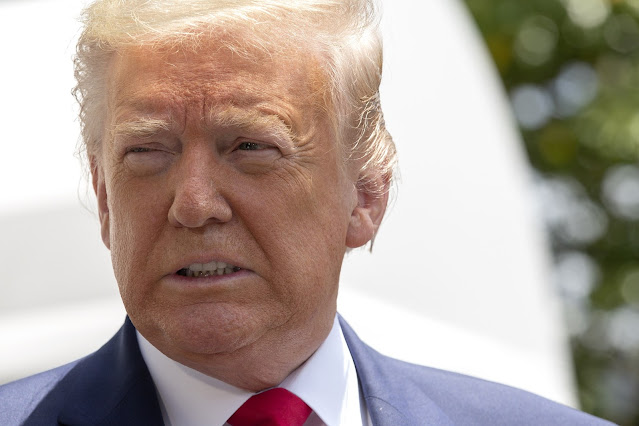
According to David Siders at Politico, it has become clear over the last week that Donald Trump will be running for president in 2024. He bases that at least in part on the former guy's thinly veiled attack on his most likely competitor for the nomination - Florida Governor Ron DeSantis. During a recent interview on the right wing OAN network, Trump called politicians who won't admit they got a Covid booster shot "gutless." That came after DeSantis refused to answer a direct question on whether he'd gotten a booster.

What Siders failed to mention is that DeSantis shot back - telling a right wing podcaster that one of his biggest regrets was not speaking out "louder" on Trump admin calls for lock downs during the pandemic. At least when it comes to Covid, DeSantis is positioning himself as even more extreme than the former guy. So the battle between these two guys is going to get very interesting. 

There are those who think that one of the things that could potentially stand in Trump's way are all of the investigations he is facing into criminal activity. Those include the ones being conducted by the Manhattan district attorney and New York attorney general over financial fraud, Fulton County's investigation over the pressure Trump applied to overturn the election results, and DOJ's investigation into the events on January 6

As we've seen, these investigations are painfully slow. But the 2024 election is still almost three years away. It is possible that at some point, Trump will at least be indicted, while conviction is much less certain within that window. 

That raises the question of whether someone who has been criminally indicted can run for president. The answer is clearly "yes." The only qualifications stated in the Constitution are that the person must be a natural born citizen of the U.S., must be at least 35 years old, and must have been a resident of the U.S. for at least 14 years. To make matters worse, convicted felons are not barred from running for president, even those who are imprisoned. In other words, Trump could run again in 2024 - even if he is indicted or possibly convicted. 

Signaling that is exactly what he would do, Trump issued this statement on the day it was announced that the Manhattan district attorney had convened a grand jury to review potential criminal charges.

This is a continuation of the greatest Witch Hunt in American history...Interesting that today a poll came out indicating I’m far in the lead for the Republican Presidential Primary and the General Election in 2024.

Our Country is broken, our elections are rigged, corrupt, and stolen, our prosecutors are politicized, and I will just have to keep on fighting like I have been for the last five years!

This is reminiscent of the one time Donald Trump actually told the truth. That was when he bragged that he could shoot someone on 5th Avenue in broad daylight and his supporters would remain loyal. Anyone who thinks that a criminal indictment, or even conviction, would sway right wing media or the MAGA crowd hasn't been paying attention. People who continue to believe the Big Lie will simply buy into the idea that the prosecution was corrupt and politicized.

But what I take from all of this is that three years is a long time. A lot can happen between now and then, which is why all of the horse race pontificating about the 2024 election is mostly a waste of time. 

Friday, January 14, 2022

AG Garland Just Decimated Right Wing Talking Points About January 6

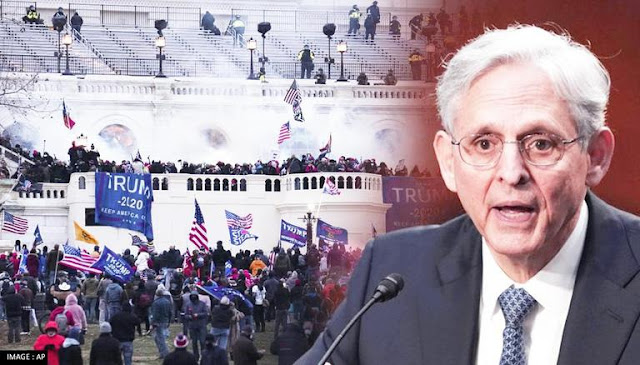
Over the last few months, right wingers have been claiming that the events on January 6 were not an insurrection or a coup attempt because none of the rioters have been charged with sedition. After the indictments were released by DOJ on Thursday, charging 11 members of the Oath Keppers with seditious conspiracy, the Daily Show suggested it is time to let that particular talking point rest in peace. 

Oops! There are a lot of people who spent Thursday needing to wipe egg off their faces. So I thought it would be interesting to see what they're saying now. 

In talking to Laura Ingraham just last week, Jonathan Turley acted like the DOJ investigations had already concluded.

The FBI arrested hundreds. They investigated thousands. And they did not find a conspiracy for insurrection or rebellion. They didn’t charge those crimes. They didn’t charge anything like them. What they found was a protest that had become a riot.

So what is Turley saying today? The goalposts have been moved

While I would not be surprised by additional charges against other co-conspirators and more details could emerge, the indictment does not support the prior allegations of a coordination or collusion with the Trump campaign...The charges of a relatively small number of extremists in this large protest belies rather than support the broader allegations of an actual insurrection.

Note that when it comes to coordination or collusion with Trump, Turley hedged his bets this time with a nod to the fact that additional charges and more details could emerge. 

Glenn Greenwald is another one that simply moved the goalposts, going from "no charges of sedition" to "DOJ charges aren't tantamount to Truth."

While not included in the Daily Show roundup, Fox News commentator Brit Hume holds the dubious distinction of tweeting this on the morning the indictments were released. 

How do you recover from that kind of humiliation? You guessed it...move the goalposts. 

With that tweet, Hume committed another "oops." There is no freestanding "sedition" charge in federal criminal law. The statute in question addresses "seditious conspiracy." 

On the one year anniversary of January 6, Ben Sharpiro tweeted "It was not a 'coup' or an 'insurrection,' nor was it charged criminally as such." He's handled that "oops" by not saying a word about the recent indictments.

Perhaps the most bold statement came from Dan O'Donnell writing at The Federalist.

If, as they have been alleging for a year now, this insurrection was really aimed at toppling the incoming Biden government and reinstating Donald Trump as president, then why have none of the more than 725 defendants been charged with “seditious conspiracy” under 18 US Code § 2384?...

Wasn’t the whole point of the Jan. 6 “insurrection” to affect the certification of the election through intimidation and coercion? Why haven’t the charges or sentences reflected this?

The answer is as simple as it is predictable: The reality of Jan. 6 is nowhere near Democrats’ rhetoric about it. Jan. 6 was a riot and a national embarrassment, but it was not an insurrection, an attempted coup, or the worst attack on America since 9/11 or Pearl Harbor.

If it were, the criminal charges would have reflected it.

Bless Dan's heart! Now that criminal charges reflect the fact that eleven Oath Keepers engaged in a seditious conspiracy, what say you? Nothing, apparently. As of this writing, not only has O'Donnell failed to respond to the indictments, there is nothing about them at the Federalist website at all.

Of course, Tucker Carlson is one of the people who regularly repeated the right wing talking point about no one being charged with sedition. So what did he do after the indictments were released? Invited one of the indicted conspirators - Thomas Caldwell - on his show and gave him a platform to lie about the charges. Carlson zeroed in on the fact that Caldwell never entered the capitol building. But that is because he had another job to do.

While certain Oath Keepers members and affiliates breached the Capitol grounds and building, others remained stationed just outside of the city in quick reaction force (QRF) teams. According to the indictment, the QRF teams were prepared to rapidly transport firearms and other weapons into Washington, D.C., in support of operations aimed at using force to stop the lawful transfer of presidential power. The indictment alleges that the teams were coordinated, in part, by Caldwell and Vallejo.

There are those on the left, who - while not being as culpable as right wingers - consistently criticized AG Merrick Garland for only charging minor offenses. Apparently they didn't grasp that, exactly one week before the grand jury issued its 48-page indictment, Garland telegraphed exactly where the investigation was headed.

In complex cases, initial charges are often less severe than later charged offenses. This is purposeful, as investigators methodically collect and sift through more evidence...

The actions we have taken thus far will not be our last.

The Justice Department remains committed to holding all January 6th perpetrators, at any level, accountable under law — whether they were present that day or were otherwise criminally responsible for the assault on our democracy. We will follow the facts wherever they lead.

That brings to mind the three rings of the attempted coup outlined by Rep. Jamie Raskin:

  1. The mass demonstration that turned into a riot,
  2. The organized violent extremist groups (Proud Boys, Oath Keepers, etc.) who initiated the violence that then spread to other rioters, and
  3. The attempt to pressure VP Pence to reject the electoral votes of several states.
It is clear that, when it comes to the DOJ investigation of January 6, they are winding down work on the outer ring and starting to bring cases against the middle ring. It is very likely that we will see subsequent indictments against other violent extremist groups, like the Proud Boys. If any of that produces clear evidence of a seditious conspiracy that was coordinated with the inner ring of Trump and his associates, Garland has committed to holding them criminally accountable. 

When it comes to Trump's culpability, we don't know yet whether DOJ will be investigating the former guy's attempt to pressure Pence into rejecting electoral votes in order to send the election to the House - or how those efforts might be tied to the seditious conspiracy. So hang on to your hats. This whole thing is FAR from over.

Thursday, January 13, 2022

Keeping Schools Open Is Much More Complicated Than Teachers Unions vs Parents

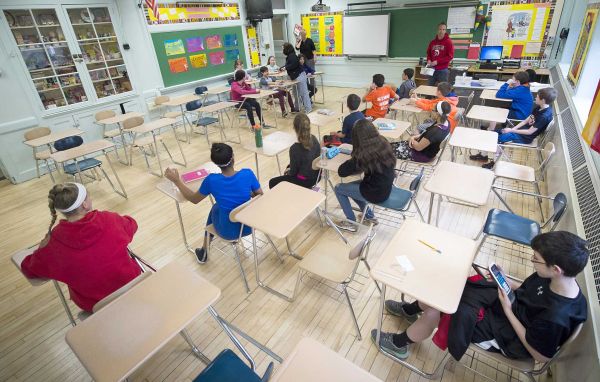
As the coronavirus continues to rage, schools have become one of the major battlegrounds on the question of how to respond. We've seen battles over mask mandates not only politicized, but escalate into some public school officials fearing for their lives. 

As the new omicron variant spurs a whole new wave of infections, the question of whether schools should return to remote learning has once again surfaced. This particular battle is being framed as one between parents and teachers unions - especially after Chicago teachers went on strike for a few days. That provides a field day for right wingers like Stephen Moore.

It is time for a national revolt against the evil empire of teachers unions that has become the worm in the apple of our education system. How outrageous it is that parents, taxpayers and politicians have to beg teachers to teach...

What is clear is that handing over political control of our schools to the unions has done irreparable damage to our children. They are the virus injuring the health and well-being of our children. But it is also true that if we, as citizens and voters, allow this hostage-taking to continue, then we are responsible for the damage. We are to blame if we keep electing politicians who genuflect to militant unions.

Moore calls for a "Reagan moment" when the former president broke the back of the air traffic controllers union. In other words, he's not even trying to be subtle about the fact that Republicans have always fought against the power of unions. So they're more than happy to frame the current situation as one in which it is the "evil empire of teachers unions" against parents who simply want their children to be able to go to school. 

The problem is that it is not just right wingers who are adopting that frame. At the New York Times, an article addressing this issue is titled, "As More Teachers’ Unions Push for Remote Schooling, Parents Worry. So Do Democrats."

Few American cities have labor politics as fraught as Chicago’s, where the nation’s third-largest school system shut down this week after teachers’ union members refused to work in person, arguing that classrooms were unsafe amid the Omicron surge.

But in a number of other places, the tenuous labor peace that has allowed most schools to operate normally this year is in danger of collapsing.

While not yet threatening to walk off the job, unions are back at negotiating tables, pushing in some cases for a return to remote learning.

At the Washington Post, Henry Olson has written an op-ed titled "Teachers unions are in the wrong on covid-19. Democrats must force them back to work."

The case both articles in these mainstream newspapers make is similar to the one made in the article by Stephen Moore. It basically amounts to: we have vaccines now, omricon appears to cause less severe illness, and there is now evidence that school closures harm students. 

That's why I found it surprising that the Wall Street Journal seems to be the only national publication that looked a little deeper. 

Public-school attendance across the U.S. has dropped to unusually low levels, complicating efforts to keep schools open, as districts also contend with major staff shortages.

Many students in kindergarten through 12th grade are out sick because of Covid-19 or are being kept home by anxious parents, as the Omicron variant surges, officials say. Remote learning often isn’t being offered anymore for students who are home. Empty desks create a quandary for teachers, who must decide whether to push ahead with lesson plans knowing a large number of their students will need to catch up.

Here is just one example they provided:

In Rochester, N.Y., public school attendance last week ranged from 61% to 66%, according to school district data. Just 44% of students at one high school were present on Jan. 3, and barely half showed up at one elementary school, Superintendent Lesli Myers-Small said at a Jan. 4 school board meeting.

She said then that student attendance would be a factor, along with staff absences and Covid-19 infection rates, in deciding whether to move to remote learning. Two days later, the district made the temporary switch to virtual instruction. 

In that case, it wasn't the teachers union that pushed for a return to remote learning, it was low student attendance, along with staff shortages. 

That tends to be the story being told by local news. For example, in my area, teachers are proposing solutions to the problem of student absences, combined with the fact that there aren't enough school bus drivers or substitute teachers.

The contributor to all of this that is getting zero attention are parents who are making the decision to keep their kids at home out of fear of contracting Covid. It sometimes isn't just concern for their child. I  recently heard a report on local public radio where a father noted that a person in their family is immunocompromised, meaning that the possibility of their child becoming infected could threaten that person's life. Almost no one in the national media is talking to parents like that. If they did, the story would become more complicated than "teachers unions vs. parents."

What we have is yet another example of right wing media creating a narrative that is then swallowed whole by mainstream media. Providing the big picture would require getting out of the bubble and acknowledging the context that is missing in a simplified "us vs them" story.

Wednesday, January 12, 2022

Democrat Cheri Beasley Could Be the Next Senator From North Carolina

Conventional wisdom has decreed that Democrats are likely to lose their congressional majorities in the 2022 midterm elections. But a lot can happen over the next ten months, so it is probably time to get busy weighing in on how we can all ensure that conventional wisdom is proven wrong this time.

In the Senate, not only is it important for Democrats to maintain their 50 seats, the only way to ensure that legislation can actually get passed is to build an actual majority. Maintenance requires that Mark Kelly (AZ), Raphael Warnock (GA), and Catherine Masto (NV) all win re-election in races that are currently considered toss-ups.

But in looking at other Senate races that are possible pick-ups, the one for an open seat in North Carolina (where Richard Burr will not seek re-election) is worth highlighting. Before looking at the candidates for 2022, it is worth noting what has been happening in the state over the last few years.

In 2008, Barack Obama won North Carolina. He went on to lose to Mitt Romney by a narrow margin in 2012. Donald Trump won the state in both 2016 and 2020, just as the same voters chose a Democrat, Roy Cooper, to be their governor. Democrat Cal Cunningham lost the 2020 Senate election to Republican incumbent Thom Tillis by less than 2% after news broke that Cunningham had an extramarital affair.

According to the 2020 census, North Carolina is the fourth fastest growing state in the country, behind only Texas, Arizona, and Florida. While more than half of the state's (mostly rural) counties lost population, 78% of the growth occurred in the two largest metro areas (Raleigh and Wilmington). Virtually all of that growth was in the adult (voting age) population. 

For the 2022 election, the Republican primary will likely come down to a contest between former governor Pat McCrory and Representative Ted Budd. Initially McCrory was favored to win, but when Lara Trump announced that she would not run, Donald Trump endorsed Budd at the state's Republican convention last summer. The party faithful are now lining up behind Trump's pick and Budd is leading the race. 

It will come as no surprise that, prior to an endorsement from the former guy, Budd demonstrated the kind of loyalty Trump expects. He voted against certification of the 2020 electoral votes and said that the January 6 insurrection "was just patriots standing up.”

At his campaign website, Budd declares himself to be a "liberal agenda crusher." The issues he promotes are standard fare for Republicans these days: cut taxes, support law enforcement, secure the border (ie, build the wall), suppress the vote, defend the 2nd Amendment, and ban abortions. Here's his introductory ad for the campaign:


As is so often the case with Republicans, that ad makes a man whose net worth is around $6.5 million look like one of the good-old-boys at the monster truck show. But the important thing to keep in mind is that he has completely tied his fate to that of Donald Trump. We'll see how that works out for him over the next 10 months.

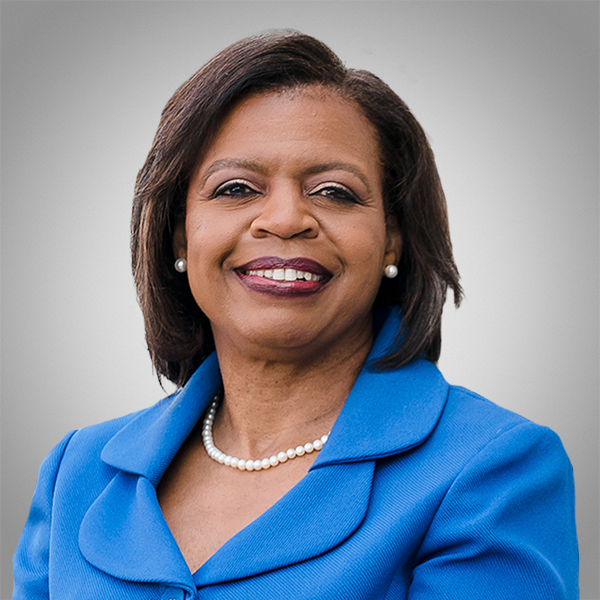
The Democrat in this race will be Cheri Beasley. Here is her introductory video:


On the issues, Beasley aligns perfectly with the majority of Democrats who are neither leftist nor centrist.  She supports expanding Obamacare, investing in efforts to mitigate climate change, ensuring voting rights, extending the child tax credit, enacting criminal justice reform, finally passing comprehensive immigration reform, protecting women's reproductive rights, and implementing common sense gun safety measures.

But, you might ask, is she electable in a state like North Carolina? In 2014, Beasley won a state-wide race for a seat on the Supreme Court. After being appointed as the Chief Justice in 2019, she ran a state-wide race for that position in 2020. Out of over 5 million votes cast, she lost by 401. But here's what was interesting about that: she won more votes than either Biden or Tillis. 

Cook Political Report and RealClearPolitics currently rate this race a toss-up, while Sabato's Crystal Ball has it leaning Republican. There are those who are suggesting that this might be the most expensive Senate race in the 2022 midterms. What we know about Rep. Budd is that he has always garnered major support from groups like the Club for Growth, which plans to invest $10 million in his campaign. However, I actually think that Beasley has a shot. But she's going to need grassroots support to get it done.

Tuesday, January 11, 2022

The January 6 Insurrection Was Not Just Political. It Was Also Deeply Religious.

Last week when we marked the one year anniversary of the January 6 insurrection, not many people were willing to talk about this:

In case you think she's exaggerating, a pastor by the name of Duke Kwon provided the evidence in response to someone on Twitter who said that the riot had nothing to do with Christianity. 

As the young woman in the video above said, "You cannot combat far right extremism without understanding that it is inextricably linked to white evangelicalism in the United States."

Katherine Stewart, author of the book "The Power Worshipers," has been trying to warn us about the danger posed by Christian nationalism for a long time. Here's what she wrote back in 2018: 

The great thing about kings like Cyrus, as far as today’s Christian nationalists are concerned, is that they don’t have to follow rules. They are the law. This makes them ideal leaders in paranoid times…

I have attended dozens of Christian nationalist conferences and events over the past two years. And while I have heard plenty of comments casting doubt on the more questionable aspects of Mr. Trump’s character, the gist of the proceedings almost always comes down to the belief that he is a miracle sent straight from heaven to bring the nation back to the Lord. I have also learned that resistance to Mr. Trump is tantamount to resistance to God.

This isn’t the religious right we thought we knew. The Christian nationalist movement today is authoritarian, paranoid and patriarchal at its core. They aren’t fighting a culture war. They’re making a direct attack on democracy itself.

Of course, not all white evangelicals are Christian nationalists. For those who find the ties between Christianity and violent extremism to be reprehensible, this is not a time to get defensive, but to call it out. As an example, David French is doing yeoman's work on that front. His latest piece is titled, "A Nation of Christians Is Not Necessarily a Christian Nation." For the nationalists who are willing to destroy democracy in the name of returning to some mythical day in the past when this was a Christian nation, he says:

The Christianity of the United States of America, both as a matter of individual expression and institutional justice, is an enormously complex topic, but one thing I can say with confidence—there was no golden age of American Christianity. And we cannot look back at any moment and say, this is when America was a Christian nation.

What conservative Evangelicals are “losing” today isn’t so much liberty as power.

The fact that so many are unwilling to name the religious roots of the January 6 insurrection is an example of the power conservative evangelicals still wield in this country. But as the young woman says in the video above, "we can't push back against something we're not willing to talk about." 


Sunday, January 9, 2022

Republicans Want to Talk About Inflation. Democrats Focus on Job Creation. Here's Why They're Both Wrong

Republicans are facing a bit of a dilemma. In the midst of the Biden Boom, they are determined to paint the president's economic policies as a massive failure. Other than blaming him for measures designed to mitigate a pandemic that they're helping to fuel, the most potent tool they've used is to fear-monger about inflation. The GOP got a major assist on that one from mainstream media. As a result, three-quarters of Republicans now point to prices as the key indicator of economic health (up from 25% a year ago).

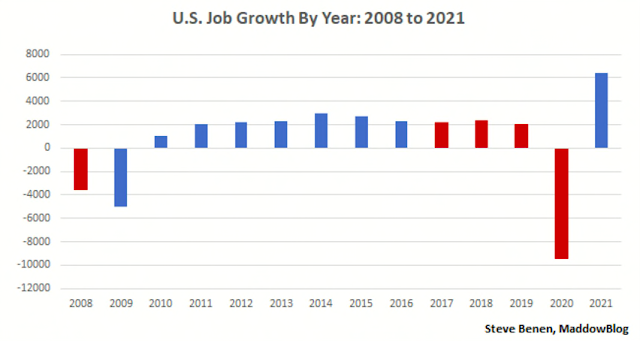
Democrats have taken the more traditional approach to measuring the health of the economy by focusing on job creation. On that front, Biden has been a tremendous success.

But with some major changes underway, both indicators will increasingly miss the point. When it comes to inflation, this has been a main driver:
The U.S. economic recovery from the covid pandemic was the strongest of any of the big Western economies...

The Biden stimulus pushed the bank accounts of even the lowest-income Americans to unexpected heights. On average, they had more than twice as much in their savings accounts as they did when the pandemic began.

The Federal Reserve, the U.S. central bank that controls interest rates, helped, too. It held rates near zero and pumped hundreds of billions of dollars into the economy.

The twin fire hoses of cash — one from Congress, one from the Fed — sent Americans’ spending roaring back.

The question that poses for Republicans is how they will pivot as inflation slows down

For Democrats, a focus on job creation ignores the fact that the economy isn't creating too few jobs, it's that we're facing a labor shortage. Economists are tying themselves in knots trying to figure out why Americans aren't going back to work. Of course, in the midst of an ongoing pandemic, some of those reasons are understandable, like fears about health, caring for someone who's sick, and lack of child care. But here's the big one:

Retirements explain a large chunk of the missing workers. For some, soaring retirement accounts and home values, combined with the lower expenses of a simplified work-from-home lifestyle, made it financially feasible to retire early. Others retired solely on Social Security, without retirement accounts to ease the way.

A Washington Post analysis found that over 1.5 million more people were retired in November 2021 than would have been expected based on pre-pandemic trends. Employment has actually declined in the last year among workers who were 55 or older at the start of the pandemic.

What almost no one is talking about is that this country was facing a labor shortage BEFORE the pandemic - much of it related to the fact that baby boomers are retiring. Today, boomers range in age from mid-50s to mid-70s, so many have been either retiring or planning to retire. It appears that the pandemic merely sped up that process. 

Here's what Ezra Klein wrote about that back in 2013:

Everyone agrees that aging economies with low birth rates are in trouble...The retirement of the baby boomers is correctly understood as an economic challenge. The ratio of working Americans to retirees will fall from 5-to-1 today to 3-to-1 in 2050. Fewer workers and more retirees is tough on any economy.

When Klein says that "everyone agrees," he's right. Back in 2017, Paul Ryan said the same thing - even if his solution to the problem was abhorrent.

 This is what the Wall Street Journal was reporting back in 2016:

In Dallas, the King of Texas Roofing Co. says it has turned down $20 million worth of projects in the past two years because it doesn’t have enough workers.

In the San Francisco Bay Area, Joe Hargrave is expanding his successful Tacolicious chain of restaurants, but says he is building smaller ones due to “a massive shortage of restaurant workers.”

And in Florida, Steve Johnson, who harvests oranges for the citrus industry, says, “Right now, if I had 80 guys, I could put every one of them to work.”

As hiring accelerates and the labor market tightens thanks to a steady U.S. recovery, employers who need low-skilled workers are increasingly struggling to fill vacancies.

The situation in rural American was even worse. Here's how Art Cullen described what was happening in Iowa:

The population numbers since 2010 look bad for most rural Iowa counties: Pocahontas, down 7.8%; Sac, down 6.1%; Audubon, down 10%; Cass, down 7.3%; Adams, down 9.5%. A small sampling of isolated rural counties. They may have peaked in population in 1940 or before. The sad news is: Nothing is on the horizon to turn it around.

Here is how a researcher in my home state of Minnesota documented the problem back in 2019:

Employment projections indicate that, by 2022, Minnesota will need nearly 3.2 million workers to keep pace with historic rates of economic growth statewide. With just 2.9 million people over the age of 16 expected to be in the labor force and working, our state is expected to fall about 239,000 workers short.

That is the economic challenge this country will continue to face - too few workers - even when the pandemic is no longer an issue.

Paul Ryan sounded an early warning about how Republicans are likely to respond to the challenge. We're already hearing right wingers talk about the need for women to have more babies. For the nativists, that is often pitted against the solution that has always been a hallmark of the U.S. economy: immigration. That is precisely what Klein was writing about in 2013.

There are few free lunches in public policy. But taking advantage of our unique position as a country where the world’s best, brightest and hardest-working desperately want to live is surely one. In the end, economies aren’t mainly about budgets and tax codes, though Congress occasionally pretends otherwise. They’re about workers and business owners. Immigration reform is a way to get more of both.

Immigration reform is often cast as an issue that is a concern for people of color - primarily Hispanics. But the fact is that it should be a priority for all of us. Our economy is going to depend on it.

Saturday, January 8, 2022

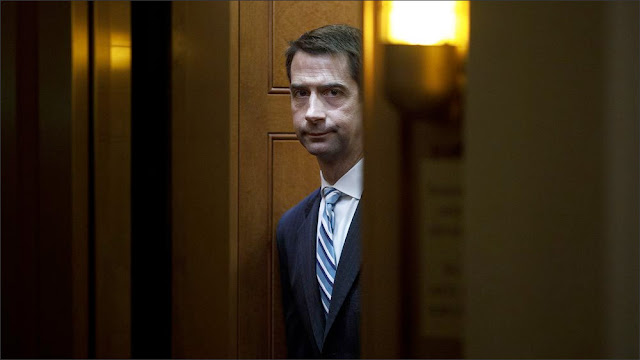
I, For One, Take Senator Tom Cotton Very Seriously

Becket Adams, who writes for the Washington Examiner, says that the media needs to take Senator Tom Cotton (R-AR) seriously, suggesting that "he is actually smarter and more reasonable than his critics say."

Given Cotton's track record, the "more reasonable" part is problematic. But I would be the last one to question the senator's intelligence, which is why I've always taken him seriously. Unlike Donald Trump, who combined his malevolence with ignorance, Cotton is smart and knows exactly what he's doing. He's the guy who graduated from Harvard in three years and then went on to get a degree from Harvard Law. That's impressive. 

As Molly Ball wrote back in 2014, Cotton's undergraduate thesis at Harvard on the Federalist Papers gives us a window into a politician who is otherwise something of a cipher.

Cotton insists that the Founders were wise not to put too much faith in democracy, because people are inherently selfish, narrow-minded, and impulsive. He defends the idea that the country must be led by a class of intellectually superior officeholders whose ambition sets them above other men. Though Cotton acknowledges that this might seem elitist, he derides the Federalists’ modern critics as mushy-headed and naive.

Since Cotton still defends that thesis, it is clear that he, too, takes himself seriously as one of those "intellectually superior officeholders." That kind of elitism might not sit well with the fake populism espoused by his party these days. And yet, as Jeffrey Toobin noted, Cotton has somehow managed to garner support from both the insurgent and establishment wings of the Republican Party.

Stephen Bannon, Trump’s former top strategist and the chairman of the right-wing Web site Breitbart News, told me, “Next to Trump, he’s the elected official who gets it the most—the economic nationalism. Cotton was the one most supportive of us, up front and behind the scenes, from the beginning. He understands that the Washington élite—this permanent political class of both parties, between the K Street consultants and politicians—needs to be shattered.” At the same time, Cotton has maintained strong ties with the establishment wing of the G.O.P. Karl Rove, President George W. Bush’s chief political adviser, told me, “Cotton is not like a Steve Bannon, who wants to blow up the existing structure, uproot the ideology of the Republican Party and replace it with something new. He’s a rising star. He’s capable of building bridges within the Party. He wants to get things done.”

I would suggest that Karl Rove values Cotton for his extremely hawkish foreign policy positions. For example, the senator from Arkansas said that waterboarding isn't torture and that Gitmo detainees "can rot in hell." 

Perhaps the position Cotton took on Iran's nuclear weapons is what distinguishes him the most. During his first year in the Senate, as the Obama administration was in the midst of multilateral negotiations to halt the country's development of nuclear weapons, Cotton penned an open letter the Leaders of the Islamic Republic of Iran basically telling them that they shouldn't take the negotiations seriously because either Congress or the next president could revoke any agreement that was ultimately reached. The freshman senator was able to get 46 of his Republican colleagues to sign the letter that undermined the foreign policy of a sitting president. 

Cotton followed that up by defending his preferred method of addressing the issue of Iran's nuclear weapons: a few days of bombing...easy peasy. It's not hard to understand why those who were willing to lie this country into a war in the Middle East would love this guy.

It is Cotton's nativism that attracts the Steve Bannon's of the world. They love the fact that the senator not only fought against criminal justice reform, he actually said that this country has an under-incarceration problem. It was also Cotton who referred to slavery as a "necessary evil" and tweeted this during the protests over George Floyd's murder.

He went on to elaborate in an opinion column that was published by the New York Times.

Since his days in the House, Cotton has opposed comprehensive immigration reform. But it's worth noting that, in early 2018, Trump told lawmakers to seek a bipartisan solution on immigration and signaled that he would sign whatever they put in front of him. 

A bipartisan group of Senators came up with a proposal that the president appeared to support. But when they arrived at the White House to discuss it, they were surprised to be met with several immigration hardliners (perhaps invited by Stephen Miller) who had already talked Trump into opposing the proposal. Of course, one of them was Tom Cotton. It was during that meeting that the president made his infamous remarks about immigrants from shithole countries.

Those are some of the policy positions taken by Senator Cotton. But the fact that he is a mean and spiteful person has occasionally been on display. For example, after Cotton was part of the group that ambushed the bipartisan immigration proposal, Republican Senator Lindsay Graham referred to him as "the Steve King of the Senate." Cotton fired back that, in his 2016 presidential run, Graham "didn’t even make it off the kiddie table in the debates.”

But the moment I began to see that Senator Cotton had sociopathic tendencies was when I read what he did to President Obama's nominee to be the U.S. Ambassador to Bahamas - Cassandra Butts. Frank Bruni told the story.

Senator Tom Cotton, an Arkansas Republican, put a hold specifically on Butts and on nominees for the ambassadorships to Sweden and Norway. He had a legitimate gripe with the Obama administration over a Secret Service leak of private information about a fellow member of Congress, and he was trying to pressure Obama to take punitive action. But that issue was unrelated to Butts and the Bahamas.

Cotton eventually released the two other holds, but not the one on Butts. She told me that she once went to see him about it, and he explained that he knew that she was a close friend of Obama’s — the two first encountered each other on a line for financial-aid forms at Harvard Law School, where they were classmates — and that blocking her was a way to inflict special pain on the president.

After waiting more than two years for Cotton to release his hold on her nomination, Butts died on May 25, 2016.

So yes Mr. Adams, I take Tom Cotton very seriously. As they say..."as serious as a heart attack." 

Immigrants and domestic migrants could be major factors in the Texas Senate race.

A few weeks ago I wrote about how MAGA influencers are trying to convince their base that - despite Trump's growing disapproval rates -...